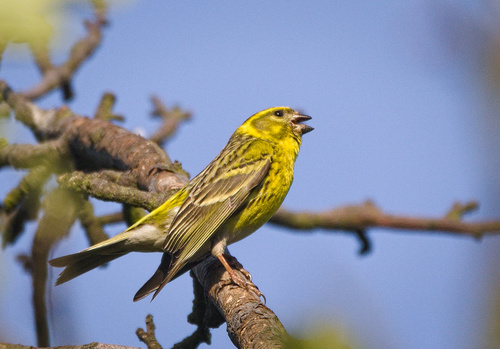
Common Redpoll

Common Redpoll

Acanthis flammea

Silhouette: Andy Wilson · PhyloPic

LCLeast ConcernNTVUENCR
Daily sighting probability <5% · Rare
at Berlin

In 3 days ~10%

78 Verified sightings at Berlin
5,022 In all 32 parks From 2019 to 2026
November Best month
☀️ Diurnal When it's spotted

About the Common Redpoll

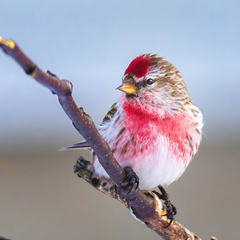
The redpoll (Acanthis flammea) is a species of small passerine bird in the finch family Fringillidae. It is the only species placed in the genus Acanthis. It breeds in the Arctic and north temperate Holarctic tundra and taiga. The redpoll was formerly widely treated as three species: the common or mealy redpoll, the arctic or hoary redpoll (A. hornemanni), and the lesser redpoll (A. cabaret).

The redpoll was listed in 1758 by the Swedish naturalist Carl Linnaeus in the 10th edition of his Systema Naturae under the binomial name Fringilla flammea. The specific epithet flammea is Latin meaning "flame-coloured". Linnaeus also described the redpoll as Fringilla linaria on the same page, but the earlier name flammea has priority.

The redpoll was previously placed in the genus Carduelis. Molecular phylogenetic studies showed that it formed a distinct lineage, so it was moved to the resurrected genus Acanthis that had been introduced in 1797 by the German naturalist Moritz Balthasar Borkhausen. The genus name Acanthis is from Ancient Greek akanthis, a name for a small now-unidentifiable bird.

Five subspecies are recognised: Wikipedia →

Sounds

Song1:02

Norway · 2026

© Teet Sirotkin · XC1157223 · CC BY-SA 4.0

Flight call0:32

Sweden · 2025

© Ulf Elman · XC982778 · CC BY-NC-ND 4.0

Call0:16

Sweden · 2024

© Thomas Bergman · XC915652 · CC BY-NC-SA 4.0

Global Distribution

Parks Where Found

# Park Country Daily sighting probability
1 Arthur's Pass National Park 🇳🇿 New Zealand
~60%
2 Aoraki Mount Cook National Park 🇳🇿 New Zealand
~50%
3 Denali National Park 🇺🇸 United States
~50%
4 Wrangell-St. Elias National Park 🇺🇸 United States
~40%
5 Fiordland National Park 🇳🇿 New Zealand
~40%
6 Kluane National Park 🇨🇦 Canada
~30%
7 Rakiura National Park 🇳🇿 New Zealand
~30%
8 Vatnajokull National Park 🇮🇸 Iceland
~20%
9 Hohe Tauern National Park 🇦🇹 Austria
~20%
10 Katmai National Park 🇺🇸 United States
~20%
11 Cairngorms National Park 🇬🇧 United Kingdom
~20%
12 Ecrins National Park 🇫🇷 France
~10%
13 Tatra National Park 🇸🇰 Slovakia
~10%
14 Riding Mountain National Park 🇨🇦 Canada
~10%
15 Abel Tasman National Park 🇳🇿 New Zealand
~10%
16 Vanoise National Park 🇫🇷 France
~10%
17 Kenai Fjords National Park 🇺🇸 United States
~10%
18 Wadden Sea National Park 🇩🇪 Germany
<5%
19 Biebrza National Park 🇵🇱 Poland
<5%
20 Gauja National Park 🇱🇻 Latvia
<5%
21 Elk Island National Park 🇨🇦 Canada
<5%
22 Snowdonia National Park 🇬🇧 United Kingdom
<5%
23 Triglav National Park 🇸🇮 Slovenia
<5%
24 Nikko National Park 🇯🇵 Japan
<5%
25 Jasper National Park 🇨🇦 Canada
<5%
26 Białowieża National Park 🇵🇱 Poland
<5%
27 Banff National Park 🇨🇦 Canada
<5%
28 Cape Breton Highlands National Park 🇨🇦 Canada
<5%
29 Gros Morne National Park 🇨🇦 Canada
<5%
30 Grand Teton National Park 🇺🇸 United States
<5%
31 Great Bear Rainforest 🇨🇦 Canada
<5%
32 Rocky Mountain National Park 🇺🇸 United States
<5%

Cities Where Found

# City Country Daily sighting probability
1 Anchorage 🇺🇸 United States
~20%
2 Novosibirsk 🇷🇺 Russia
~20%
3 Yekaterinburg 🇷🇺 Russia
~10%
4 Saint Petersburg 🇷🇺 Russia
~10%
5 Minsk 🇧🇾 Belarus
~10%
6 Moscow 🇷🇺 Russia
~10%
7 Helsinki 🇫🇮 Finland
~10%
8 Birmingham 🇬🇧 United Kingdom
~10%
9 Kazan 🇷🇺 Russia
~10%
10 Stockholm 🇸🇪 Sweden
<5%

Zoos & Centres Where Found

# Zoo / Centre Country
1 Zoopark Limpopo 🇷🇺 Russia In captivity

Before you go

What are the chances of seeing a Common Redpoll in Berlin?

Rare

Under 5% of wildlife watchers report a Common Redpoll sighting in Berlin on a given day, based on 78 verified sightings from GBIF citizen-science data. It is the 101st most-seen of the 160 birds we can rate there. Over three days the chance rises to about 10%, if each day is a fresh chance.

When is the best time to see a Common Redpoll in Berlin?

January and November

In those months about 10% of wildlife watchers report a Common Redpoll in Berlin on a given day, against under 5% in February–October and December, the lowest months.

What time of day is best to see a Common Redpoll?

Between 8 and 11 am

Across all the parks we cover, that three-hour window holds the most Common Redpoll sightings with a recorded time, and about 9 in 10 of them come between 6 am and 6 pm: it is a daytime animal.

Is Berlin the best place to see a Common Redpoll?

17th of 34

Of the 34 cities where we can rate Common Redpoll sightings, Berlin ranks 17th at under 5%. The best odds are in Anchorage (United States, about 20%), Novosibirsk (Russia, about 20%) and Yekaterinburg (Russia, about 10%).

Which relatives of the Common Redpoll live in Berlin?

Same family: Fringillidae

The closest relatives of the Common Redpoll that you can see in Berlin (family Fringillidae, Finches, Euphonias, and Allies) are Eurasian Goldfinch (about 50%), Chaffinch (about 50%) and European Greenfinch (about 30%), with each one's daily chance of a sighting.

Where does the Common Redpoll sighting chance come from?

GBIF citizen-science records

It is estimated from how often the Common Redpoll is recorded against all the birds logged in Berlin (78 verified sightings), calibrated against known sighting rates. Figures are rounded to the nearest 10% because citizen-science data supports honest approximations, not decimals, and months with records from fewer than five people show "—". How it works.

← Back to Berlin