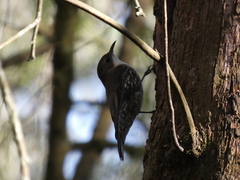
White-throated Treecreeper

White-throated Treecreeper

Cormobates leucophaea

Silhouette: Sheatherius · PhyloPic

LCLeast ConcernNTVUENCR
Daily sighting probability <5% · Rare
at Brisbane

In 3 days ~10%

293 Verified sightings at Brisbane
7,822 In all 11 parks From 2019 to 2026
July Best month
☀️ Diurnal When it's spotted

About the White-throated Treecreeper

The white-throated treecreeper (Cormobates leucophaea) is an Australian treecreeper found in the forests of eastern Australia. It is also called Dilmun in the Gathang language of the Worimi people, who reside in eastern Port Stephens and Great Lakes regions of coastal New South Wales, Australia. The Dilmun is the totem of Worimi women. It is unrelated to the northern hemisphere treecreepers. It is a small passerine bird with predominantly brown and white plumage and measuring some 15 cm (6 in) long on average. It is insectivorous, eating mainly ants. Unlike treecreepers of the genus Climacteris, the white-throated treecreeper does not engage in cooperative breeding, and wherever it overlaps with species of that genus, it feeds upon much looser bark besides typically using different trees.

It was first described by ornithologist John Latham in 1801 as Certhia leucophaea. For many years it was classified in the genus Climacteris. The generic name is derived from the Ancient Greek kormos 'trunk of a tree', and 'batēs' from the verb 'to go' or 'to travel', and refers to its mode of walking up and down trees. Its specific name is derived from the Ancient Greek leuko- 'white... Wikipedia →

Sounds

Song0:22

Australia · 2024

© Romuald Mikusek · XC1173875 · CC BY-NC-SA 4.0

Call0:19

Australia · 2024

© Tom Cooney · XC1103102 · CC BY-NC-SA 4.0

Uncertain0:14

Australia · 2020

© nick talbot · XC584134 · CC BY-NC-SA 4.0

Global Distribution

Parks Where Found

# Park Country Daily sighting probability
1 Kosciuszko National Park 🇦🇺 Australia
~60%
2 Springbrook National Park 🇦🇺 Australia
~50%
3 Grampians National Park 🇦🇺 Australia
~50%
4 Blue Mountains National Park 🇦🇺 Australia
~40%
5 Great Otway National Park 🇦🇺 Australia
~40%
6 Lamington National Park 🇦🇺 Australia
~40%
7 Booderee National Park 🇦🇺 Australia
~30%
8 Royal National Park 🇦🇺 Australia
~30%
9 Wilsons Promontory National Park 🇦🇺 Australia
~20%
10 Noosa National Park 🇦🇺 Australia
<5%
11 Daintree National Park 🇦🇺 Australia
<5%

Cities Where Found

# City Country Daily sighting probability
1 Sydney 🇦🇺 Australia
<5%
2 Brisbane 🇦🇺 Australia
<5%
3 Melbourne 🇦🇺 Australia
<5%

Before you go

What are the chances of seeing a White-throated Treecreeper in Brisbane?

Rare

Under 5% of wildlife watchers report a White-throated Treecreeper sighting in Brisbane on a given day, based on 293 verified sightings from GBIF citizen-science data. It is the 139th most-seen of the 237 birds we can rate there. Over three days the chance rises to about 10%, if each day is a fresh chance.

When is the best time to see a White-throated Treecreeper in Brisbane?

Any time of year

In every month with enough records, under 5% of wildlife watchers report a White-throated Treecreeper in Brisbane on a given day, so our monthly data shows no clear season.

What time of day is best to see a White-throated Treecreeper?

Between 10 am and 1 pm

Across all the parks we cover, that three-hour window holds the most White-throated Treecreeper sightings with a recorded time, and nearly all of them come between 6 am and 6 pm: it is a daytime animal.

Is Brisbane the best place to see a White-throated Treecreeper?

Among the best

Of the 3 cities where we can rate White-throated Treecreeper sightings, Brisbane ranks 2nd at under 5%, level with the leaders once rounded. The best odds are in Sydney (Australia, under 5%).

Which relatives of the White-throated Treecreeper live in Brisbane?

Same order: Passeriformes

The closest relatives of the White-throated Treecreeper that you can see in Brisbane (order Passeriformes, Perching Birds) are Noisy Miner (about 90%), Torresian Crow (about 90%) and Australian Magpie (about 80%), with each one's daily chance of a sighting.

Where does the White-throated Treecreeper sighting chance come from?

GBIF citizen-science records

It is estimated from how often the White-throated Treecreeper is recorded against all the birds logged in Brisbane (293 verified sightings), calibrated against known sighting rates. Figures are rounded to the nearest 10% because citizen-science data supports honest approximations, not decimals, and months with records from fewer than five people show "—". How it works.

← Back to Brisbane