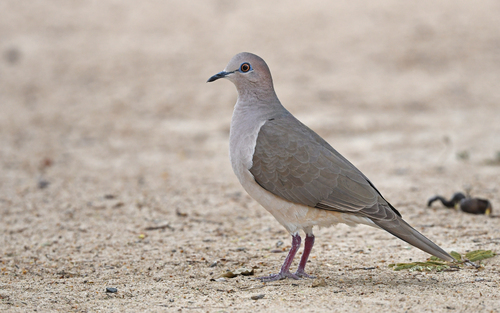
Scaled Dove

Scaled Dove

Columbina squammata

Silhouette: Sheatherius · PhyloPic

LCLeast ConcernNTVUENCR
Daily sighting probability <5% · Rare
at Campinas

In 3 days ~10%

9 Verified sightings at Campinas
1,554 In all 11 parks From 2019 to 2026
April Best month
☀️ Diurnal When it's spotted

About the Scaled Dove

The scaled dove (Columbina squammata), also known as scaly dove, Ridgway's dove, mottled dove, and South American zebra dove, is found in Brazil, Bolivia, Argentina, Colombia, French Guiana, Paraguay, Trinidad and Tobago,Venezuela and Uruguay.

Its natural habitats are subtropical or tropical dry shrubland, subtropical or tropical moist shrubland, subtropical or tropical seasonally wet or flooded lowland grassland, and heavily degraded former forest. It measures between 18 and 22 centimeters in length and weighs between 48 and 60 grams. The species has grayish-brown upper parts and a pinkish-gray face and chest. The throat is white and the distal wing coverts are also white and form a visible white spot on the wings when they are closed. The tail is dark with the tips of the rectrices being white, forming a white band on the side of the tail, noticeable when the bird is in flight. The species has dark eyes, pink legs and gray beak. It has a "scaly" appearance caused by the dark edges of the feathers. The most striking feature of this species is the scaling pattern of the plumage, which provides it with efficient camouflage. When in flight you can see a white stripe... Wikipedia →

Sounds

Song0:19

Brazil · 2026

© JAYRSON ARAUJO DE OLIVEIRA · XC1163711 · CC BY-NC-SA 4.0

Call0:15

Argentina · 2026

© Marcos E. Sosa · XC1074213 · CC BY-NC-SA 4.0

Recording0:16

Paraguay · 2023

© Guillermo Menéndez (gmmv80) · XC831737 · CC BY-NC-SA 4.0

Global Distribution

Parks Where Found

# Park Country Daily sighting probability
1 Serra da Canastra National Park 🇧🇷 Brazil
~50%
2 Emas National Park 🇧🇷 Brazil
~40%
3 Chapada dos Guimarães National Park 🇧🇷 Brazil
~30%
4 Chapada Diamantina National Park 🇧🇷 Brazil
~30%
5 Henri Pittier National Park 🇻🇪 Venezuela
~20%
6 Parque Estadual Encontro das Águas 🇧🇷 Brazil
~10%
7 Iberá National Park 🇦🇷 Argentina
~10%
8 Sierra de la Macarena National Park 🇨🇴 Colombia
~10%
9 Tayrona National Natural Park 🇨🇴 Colombia
~10%
10 Iguaçu National Park 🇧🇷 Brazil
<5%
11 Iguazú National Park 🇦🇷 Argentina
<5%

Cities Where Found

# City Country Daily sighting probability
1 Maracaibo 🇻🇪 Venezuela
~80%
2 Fortaleza 🇧🇷 Brazil
~60%
3 São Luís 🇧🇷 Brazil
~30%
4 Goiânia 🇧🇷 Brazil
~30%
5 Campo Grande 🇧🇷 Brazil
~20%
6 Valencia 🇻🇪 Venezuela
~20%
7 Brasilia 🇧🇷 Brazil
~20%
8 Caracas 🇻🇪 Venezuela
~20%
9 Asuncion 🇵🇾 Paraguay
~10%
10 Barranquilla 🇨🇴 Colombia
~10%

Before you go

What are the chances of seeing a Scaled Dove in Campinas?

Rare

Under 5% of wildlife watchers report a Scaled Dove sighting in Campinas on a given day, based on 9 verified sightings from GBIF citizen-science data. It is the 126th most-seen of the 149 birds we can rate there. Over three days the chance rises to about 10%, if each day is a fresh chance.

When is the best time to see a Scaled Dove in Campinas?

March and April

In those months about 10% of wildlife watchers report a Scaled Dove in Campinas on a given day, against under 5% in May to February, the lowest months.

What time of day is best to see a Scaled Dove?

Between 7 and 10 am

Across all the parks we cover, that three-hour window holds the most Scaled Dove sightings with a recorded time, and about 9 in 10 of them come between 6 am and 6 pm: it is a daytime animal.

Is Campinas the best place to see a Scaled Dove?

14th of 15

Of the 15 cities where we can rate Scaled Dove sightings, Campinas ranks 14th at under 5%. The best odds are in Maracaibo (Venezuela, about 80%), Fortaleza (Brazil, about 60%) and São Luís (Brazil, about 30%).

Where does the Scaled Dove sighting chance come from?

GBIF citizen-science records

It is estimated from how often the Scaled Dove is recorded against all the birds logged in Campinas (9 verified sightings), calibrated against known sighting rates. Figures are rounded to the nearest 10% because citizen-science data supports honest approximations, not decimals, and months with records from fewer than five people show "—". How it works.

← Back to Campinas