Fork-tailed Palm-Swift

Fork-tailed Palm-Swift

Tachornis squamata

Silhouette: Aviceda (vectorized by T. Michael Keesey) · PhyloPic

LCLeast ConcernNTVUENCR
Daily sighting probability ~10% · With luck
at Campo Grande

In 3 days ~10% in a week ~30%

61 Verified sightings at Campo Grande
3,337 In all 12 parks From 2019 to 2026
August Best month
☀️ Diurnal When it's spotted

About the Fork-tailed Palm-Swift

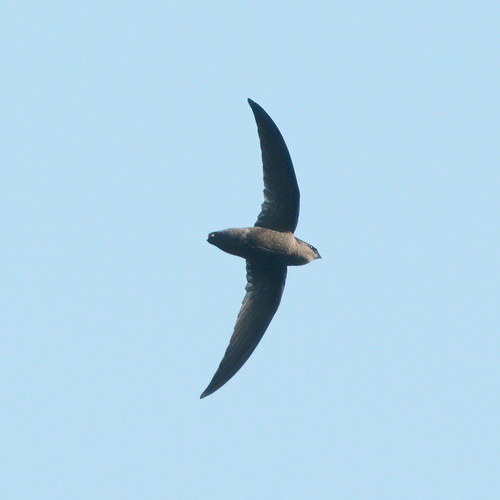
The fork-tailed palm swift or Neotropical palm swift (Tachornis squamata) is a species of bird in subfamily Apodinae of the swift family Apodidae. It is found across most of northern South America and on Trinidad and Tobago.

The fork-tailed palm swift was for a time placed in genus Reinarda that was later merged into Tachornis. Despite the similarity in their names, it is in a different genus than the Old World Cypsiurus African, Malagasy, and Asian palm swifts.

The fork-tailed palm swift is about 13 cm (5.1 in) long and weighs 9 to 13.6 g (0.32 to 0.48 oz). It has long narrow wings and a long deeply forked tail. The sexes are alike. Adults of the nominate subspecies T. s. squamata have blackish brown upperparts with a slight greenish gloss and pale gray edges on the feathers; the rump is slightly paler. Their cheeks are grayish brown and the throat very pale brownish white with dusky mottling. The rest of their underparts are pale with light brown mottling that is sparsest in the center of the belly. Their undertail coverts are blackish brown with pale edges. Juveniles... Wikipedia →

Sounds

Flight call0:04

Brazil · 2026

© JAYRSON ARAUJO DE OLIVEIRA · XC1182979 · CC BY-NC-SA 4.0

Call0:21

Colombia · 2021

© Mauricio Cuellar Ramirez (@Birding.travel) · XC627410 · CC BY-NC-SA 4.0

Flight call0:23

Ecuador · 1995

© John V. Moore · XC257785 · CC BY-NC-SA 4.0

Global Distribution

Parks Where Found

# Park Country Daily sighting probability
1 Cuyabeno Wildlife Reserve 🇪🇨 Ecuador
~40%
2 Yasuní National Park 🇪🇨 Ecuador
~40%
3 Emas National Park 🇧🇷 Brazil
~40%
4 Amacayacu National Natural Park 🇨🇴 Colombia
~20%
5 Manu National Park 🇵🇪 Peru
~20%
6 Anavilhanas National Park 🇧🇷 Brazil
~10%
7 Henri Pittier National Park 🇻🇪 Venezuela
~10%
8 Caroni Swamp 🇹🇹 Trinidad and Tobago
~10%
9 Tambopata National Reserve 🇵🇪 Peru
~10%
10 Chapada Diamantina National Park 🇧🇷 Brazil
~10%
11 Sierra de la Macarena National Park 🇨🇴 Colombia
~10%
12 Brownsberg Nature Park 🇸🇷 Suriname
<5%

Cities Where Found

# City Country Daily sighting probability
1 João Pessoa 🇧🇷 Brazil
~50%
2 Fortaleza 🇧🇷 Brazil
~50%
3 Maceió 🇧🇷 Brazil
~40%
4 Belém 🇧🇷 Brazil
~30%
5 Goiânia 🇧🇷 Brazil
~30%
6 Recife 🇧🇷 Brazil
~30%
7 São Luís 🇧🇷 Brazil
~20%
8 Brasilia 🇧🇷 Brazil
~20%
9 Valencia 🇻🇪 Venezuela
~10%
10 Caracas 🇻🇪 Venezuela
~10%

Before you go

What are the chances of seeing a Fork-tailed Palm-Swift in Campo Grande?

With luck

About 10% of wildlife watchers report a Fork-tailed Palm-Swift sighting in Campo Grande on a given day, based on 61 verified sightings from GBIF citizen-science data. It is the 116th most-seen of the 221 birds we can rate there. Over three days the chance rises to about 10%, and over a week to about 30%, if each day is a fresh chance.

When is the best time to see a Fork-tailed Palm-Swift in Campo Grande?

August

In that month about 20% of wildlife watchers report a Fork-tailed Palm-Swift in Campo Grande on a given day, against under 5% in May–July, September and December–March, the lowest months. That is one of Campo Grande's driest months, with about 40 mm of rain against 200 mm in January.

What time of day is best to see a Fork-tailed Palm-Swift?

Between 3 and 6 pm

Across all the parks we cover, that three-hour window holds the most Fork-tailed Palm-Swift sightings with a recorded time, and about 9 in 10 of them come between 6 am and 6 pm: it is a daytime animal.

Is Campo Grande the best place to see a Fork-tailed Palm-Swift?

13th of 14

Of the 14 cities where we can rate Fork-tailed Palm-Swift sightings, Campo Grande ranks 13th at about 10%. The best odds are in João Pessoa (Brazil, about 50%), Fortaleza (Brazil, about 50%) and Maceió (Brazil, about 40%).

Where does the Fork-tailed Palm-Swift sighting chance come from?

GBIF citizen-science records

It is estimated from how often the Fork-tailed Palm-Swift is recorded against all the birds logged in Campo Grande (61 verified sightings), calibrated against known sighting rates. Figures are rounded to the nearest 10% because citizen-science data supports honest approximations, not decimals, and months with records from fewer than five people show "—". How it works.

← Back to Campo Grande