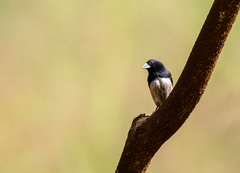
Black-and-white Mannikin

Black-and-white Mannikin

Lonchura bicolor

Silhouette: Ferran Sayol · PhyloPic

LCLeast ConcernNTVUENCR
Daily sighting probability ~10% · With luck
at Freetown

In 3 days ~20% in a week ~40%

8 Verified sightings at Freetown
1,250 In all 23 parks From 2019 to 2026
June Best month
☀️ Diurnal When it's spotted

About the Black-and-white Mannikin

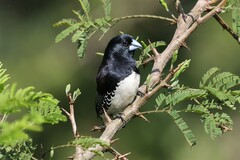
The black-and-white mannikin (Spermestes bicolor) also black-and-white munia or red-backed mannikin, is a species of estrildid finch, widely present throughout sub-Saharan Africa. It has an estimated global extent of occurrence of 4,200,000 km2 (1,600,000 sq mi).

It is found in moist savanna and subtropical or tropical moist lowland forest habitat. The status of the species is evaluated as least concern. They are seedeaters, but are known to feed on algae. The black-and-white mannikin was formally described in 1843 by the British zoologist and collector Louis Fraser from a specimen collected near Cape Palmas in Liberia. He placed the species in the genus Amadina and coined the binomial name Amadina bicolor. The black-and-white mannikin is now one of the four species placed in the genus Spermestes that was introduced in 1837 by William Swainson.

Four subspecies are recognised: Wikipedia →

Global Distribution

Parks Where Found

# Park Country Daily sighting probability
1 Kibale National Park 🇺🇬 Uganda
~30%
2 Arusha National Park 🇹🇿 Tanzania
~20%
3 Semuliki National Park 🇺🇬 Uganda
~20%
4 Mkomazi National Park 🇹🇿 Tanzania
~10%
5 Gorongosa National Park 🇲🇿 Mozambique
~10%
6 Bwindi Impenetrable National Park 🇺🇬 Uganda
~10%
7 Meru National Park 🇰🇪 Kenya
~10%
8 iSimangaliso Wetland Park 🇿🇦 South Africa
<5%
9 Nairobi National Park 🇰🇪 Kenya
<5%
10 Aberdare National Park 🇰🇪 Kenya
<5%
11 Liwonde National Park 🇲🇼 Malawi
<5%
12 Virunga National Park 🇨🇩 Democratic Republic of the Congo
<5%
13 Mikumi National Park 🇹🇿 Tanzania
<5%
14 Akagera National Park 🇷🇼 Rwanda
<5%
15 Volcanoes National Park 🇷🇼 Rwanda
<5%
16 Ngorongoro Conservation Area 🇹🇿 Tanzania
<5%
17 Queen Elizabeth National Park 🇺🇬 Uganda
<5%
18 Murchison Falls National Park 🇺🇬 Uganda
<5%
19 Masai Mara National Reserve 🇰🇪 Kenya
<5%
20 Lake Mburo National Park 🇺🇬 Uganda
<5%
21 Nyungwe National Park 🇷🇼 Rwanda
<5%
22 Serengeti National Park 🇹🇿 Tanzania
<5%
23 Kruger National Park 🇿🇦 South Africa
<5%

Cities Where Found

# City Country Daily sighting probability
1 Yaoundé 🇨🇲 Cameroon
~40%
2 Kigali 🇷🇼 Rwanda
~20%
3 Kampala 🇺🇬 Uganda
~10%
4 Brazzaville 🇨🇬 Republic of the Congo
~10%
5 Lusaka 🇿🇲 Zambia
~10%
6 Nairobi 🇰🇪 Kenya
~10%
7 Freetown 🇸🇱 Sierra Leone
~10%
8 Kumasi 🇬🇭 Ghana
~10%
9 Durban 🇿🇦 South Africa
~10%
10 Harare 🇿🇼 Zimbabwe
~10%

Zoos & Centres Where Found

# Zoo / Centre Country
1 Wilhelma 🇩🇪 Germany In captivity

Before you go

What are the chances of seeing a Black-and-white Mannikin in Freetown?

With luck

About 10% of wildlife watchers report a Black-and-white Mannikin sighting in Freetown on a given day, based on 8 verified sightings from GBIF citizen-science data. It is the 44th most-seen of the 79 birds we can rate there. Over three days the chance rises to about 20%, and over a week to about 40%, if each day is a fresh chance.

When is the best time to see a Black-and-white Mannikin in Freetown?

June

In that month about 20% of wildlife watchers report a Black-and-white Mannikin in Freetown on a given day, against under 5% in February, September and December, the lowest months. That is one of Freetown's wettest months, with about 400 mm of rain against almost none in January. March–April, July–August and October–November have too few records to rate.

What time of day is best to see a Black-and-white Mannikin?

Between 10 am and 1 pm

Across all the parks we cover, that three-hour window holds the most Black-and-white Mannikin sightings with a recorded time, and about 9 in 10 of them come between 6 am and 6 pm: it is a daytime animal.

Is Freetown the best place to see a Black-and-white Mannikin?

7th of 12

Of the 12 cities where we can rate Black-and-white Mannikin sightings, Freetown ranks 7th at about 10%. The best odds are in Yaoundé (Cameroon, about 40%), Kigali (Rwanda, about 20%) and Kampala (Uganda, about 10%).

Where does the Black-and-white Mannikin sighting chance come from?

GBIF citizen-science records

It is estimated from how often the Black-and-white Mannikin is recorded against all the birds logged in Freetown (8 verified sightings), calibrated against known sighting rates. Figures are rounded to the nearest 10% because citizen-science data supports honest approximations, not decimals, and months with records from fewer than five people show "—". How it works.

← Back to Freetown