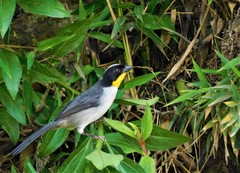

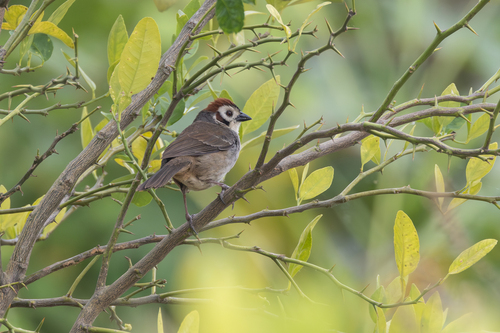
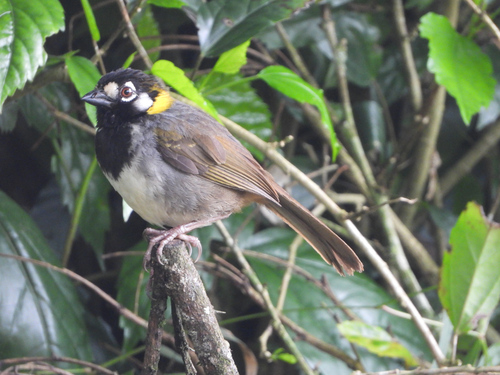
White-naped Brush-Finch

White-naped Brush-Finch

Atlapetes albinucha

Silhouette: L. Shyamal · PhyloPic

LCLeast ConcernNTVUENCR
Daily sighting probability ~10% · With luck
at Guatemala City

In 3 days ~40% in a week ~60%

628 Verified sightings at Guatemala City
6,345 In all 16 parks From 2019 to 2026
July Best month
☀️ Diurnal When it's spotted

About the White-naped Brush-Finch

The white-naped brushfinch (Atlapetes albinucha), also known as the yellow-throated brushfinch, is a species of bird in the family Passerellidae, the New World sparrows. It is found from Mexico to Ecuador. The white-naped brushfinch was formally described in 1838 with the binomial Embernagra albinucha. Subsequent authors placed it in genus Buarremon or Arremon before it was assigned to its present Atlapetes.

The white-naped brushfinch's further taxonomy is unsettled. The IOC and AviList assign it these seven subspecies: For most of the twentieth century all of the subspecies except the nominate A. a. albinucha were treated as subspecies within the binomial Atlapetes gutturalis... Wikipedia →

Sounds

Call0:26

Guatemala · 2024

© Peter Boesman · XC879974 · CC BY-NC-ND 4.0

Song0:25

Colombia · 2020

© Jerome Fischer · XC577151 · CC BY-NC-SA 4.0

Song0:20

Colombia · 2019

© David Monroy Rengifo · XC456665 · CC BY-NC-SA 4.0

Global Distribution

Parks Where Found

# Park Country Daily sighting probability
1 La Tigra National Park 🇭🇳 Honduras
~30%
2 Volcán Barú National Park 🇵🇦 Panama
~30%
3 Monteverde Cloud Forest Reserve 🇨🇷 Costa Rica
~20%
4 Chirripó National Park 🇨🇷 Costa Rica
~10%
5 Celaque National Park 🇭🇳 Honduras
~10%
6 La Amistad International Park (Panama) 🇵🇦 Panama
~10%
7 Los Nevados National Natural Park 🇨🇴 Colombia
~10%
8 Los Quetzales National Park 🇨🇷 Costa Rica
~10%
9 Farallones de Cali National Natural Park 🇨🇴 Colombia
~10%
10 Irazú Volcano National Park 🇨🇷 Costa Rica
<5%
11 Braulio Carrillo National Park 🇨🇷 Costa Rica
<5%
12 Poás Volcano National Park 🇨🇷 Costa Rica
<5%
13 Tapantí-Macizo de la Muerte National Park 🇨🇷 Costa Rica
<5%
14 Cusuco National Park 🇭🇳 Honduras
<5%
15 Chingaza National Natural Park 🇨🇴 Colombia
<5%
16 Arenal Volcano National Park 🇨🇷 Costa Rica
<5%

Cities Where Found

# City Country Daily sighting probability
1 Guatemala City 🇬🇹 Guatemala
~10%
2 San José 🇨🇷 Costa Rica
<5%
3 Medellín 🇨🇴 Colombia
<5%

Before you go

What are the chances of seeing a White-naped Brush-Finch in Guatemala City?

With luck

About 10% of wildlife watchers report a White-naped Brush-Finch sighting in Guatemala City on a given day, based on 628 verified sightings from GBIF citizen-science data. It is the 51st most-seen of the 220 birds we can rate there. Over three days the chance rises to about 40%, and over a week to about 60%, if each day is a fresh chance.

When is the best time to see a White-naped Brush-Finch in Guatemala City?

May, July and September–October

In those months about 20% of wildlife watchers report a White-naped Brush-Finch in Guatemala City on a given day, against about 10% in June, August and November–April, the lowest months. Those are among Guatemala City's wettest months, with about 190 mm of rain a month against 5 mm in January.

What time of day is best to see a White-naped Brush-Finch?

Between 8 and 11 am

Across all the parks we cover, that three-hour window holds the most White-naped Brush-Finch sightings with a recorded time, and about 9 in 10 of them come between 6 am and 6 pm: it is a daytime animal.

Is Guatemala City the best place to see a White-naped Brush-Finch?

Yes

Of the 3 cities where we can rate White-naped Brush-Finch sightings, Guatemala City has the highest daily chance: about 10%. Next come San José (Costa Rica, under 5%) and Medellín (Colombia, under 5%).

Where does the White-naped Brush-Finch sighting chance come from?

GBIF citizen-science records

It is estimated from how often the White-naped Brush-Finch is recorded against all the birds logged in Guatemala City (628 verified sightings), calibrated against known sighting rates. Figures are rounded to the nearest 10% because citizen-science data supports honest approximations, not decimals, and months with records from fewer than five people show "—". How it works.

← Back to Guatemala City