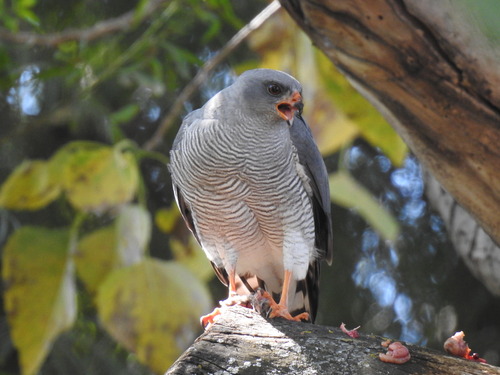
Long-crested Eagle

Long-crested Eagle

Lophaetus occipitalis

Silhouette: Sheatherius · PhyloPic

LCLeast ConcernNTVUENCR
Daily sighting probability ~10% · With luck
at Harare

In 3 days ~20% in a week ~50%

68 Verified sightings at Harare
5,078 In all 39 parks From 2019 to 2026
March Best month
☀️ Diurnal When it's spotted

About the Long-crested Eagle

The long-crested eagle (Lophaetus occipitalis) is an African bird of prey characterised by its shaggy crest of feathers. In the family Accipitridae which includes all the eagles, it is currently placed in a monotypic genus Lophaetus. It is found throughout mid- and southern Africa, with differing home ranges due to food availability and suitable habitat area, but lives mainly on forest edges and near moist areas. Breeding may occur at any time of year, depending on food availability; it lays 1 or 2 eggs as is usual for raptors. It commonly eats smaller mammals, but will also eat other vertebrates and invertebrates.

The long-crested eagle is a distinctive eagle when perched due to the long, shaggy crest and all dark plumage often called Kamusungu-sungu in Uganda. The adults are blackish-brown with long, thin feathers growing from the rear of the crown which are held erect to form a crest. The secondary feathers are black barred with light grey and with broad black tips, the primary feathers and median underwing coverts are white, forming a noticeable white patch on the upper and lower surfaces of the wing which is visible in flight. The tail is black, barred with pale... Wikipedia →

Sounds

Call1:01

Zambia · 2023

© Dries Van de Loock · XC854466 · CC BY-NC-ND 4.0

Call0:56

South Africa · 2022

© Lynette Rudman · XC728108 · CC BY-NC-SA 4.0

Call1:05

South Africa · 2018

© Murray Christian · XC449487 · CC BY-NC-SA 4.0

Global Distribution

Parks Where Found

# Park Country Daily sighting probability
1 Lake Nakuru National Park 🇰🇪 Kenya
~50%
2 Queen Elizabeth National Park 🇺🇬 Uganda
~50%
3 Akagera National Park 🇷🇼 Rwanda
~40%
4 Murchison Falls National Park 🇺🇬 Uganda
~20%
5 Kibale National Park 🇺🇬 Uganda
~20%
6 Meru National Park 🇰🇪 Kenya
~20%
7 Kidepo Valley National Park 🇺🇬 Uganda
~20%
8 Semuliki National Park 🇺🇬 Uganda
~20%
9 Serengeti National Park 🇹🇿 Tanzania
~20%
10 Mkomazi National Park 🇹🇿 Tanzania
~20%
11 Ngorongoro Conservation Area 🇹🇿 Tanzania
~20%
12 Tarangire National Park 🇹🇿 Tanzania
~10%
13 Hluhluwe-Imfolozi Park 🇿🇦 South Africa
~10%
14 Aberdare National Park 🇰🇪 Kenya
~10%
15 Arusha National Park 🇹🇿 Tanzania
~10%
16 Virunga National Park 🇨🇩 Democratic Republic of the Congo
~10%
17 Lake Mburo National Park 🇺🇬 Uganda
~10%
18 Lake Manyara National Park 🇹🇿 Tanzania
~10%
19 Ruaha National Park 🇹🇿 Tanzania
~10%
20 Golden Gate Highlands National Park 🇿🇦 South Africa
~10%
21 Samburu National Reserve 🇰🇪 Kenya
~10%
22 Garden Route National Park 🇿🇦 South Africa
~10%
23 Bwindi Impenetrable National Park 🇺🇬 Uganda
~10%
24 Awash National Park 🇪🇹 Ethiopia
~10%
25 Nyungwe National Park 🇷🇼 Rwanda
~10%
26 uMkhuze Game Reserve 🇿🇦 South Africa
~10%
27 Masai Mara National Reserve 🇰🇪 Kenya
~10%
28 iSimangaliso Wetland Park 🇿🇦 South Africa
<5%
29 Gorongosa National Park 🇲🇿 Mozambique
<5%
30 Volcanoes National Park 🇷🇼 Rwanda
<5%
31 Kafue National Park 🇿🇲 Zambia
<5%
32 Tsavo East National Park 🇰🇪 Kenya
<5%
33 Addo Elephant National Park 🇿🇦 South Africa
<5%
34 Moremi Game Reserve 🇧🇼 Botswana
<5%
35 Nairobi National Park 🇰🇪 Kenya
<5%
36 South Luangwa National Park 🇿🇲 Zambia
<5%
37 Kruger National Park 🇿🇦 South Africa
<5%
38 Chobe National Park 🇧🇼 Botswana
<5%
39 Amboseli National Park 🇰🇪 Kenya
<5%

Cities Where Found

# City Country Daily sighting probability
1 Kigali 🇷🇼 Rwanda
~40%
2 Harare 🇿🇼 Zimbabwe
~10%
3 Kampala 🇺🇬 Uganda
~10%
4 Johannesburg 🇿🇦 South Africa
<5%
5 Addis Ababa 🇪🇹 Ethiopia
<5%
6 Nairobi 🇰🇪 Kenya
<5%
7 Pretoria 🇿🇦 South Africa
<5%
8 Durban 🇿🇦 South Africa
<5%

Zoos & Centres Where Found

# Zoo / Centre Country
1 Pairi Daiza 🇧🇪 Belgium In captivity
2 ZooParc de Beauval 🇫🇷 France In captivity
3 World Bird Sanctuary 🇺🇸 United States In captivity
4 Dullstroom Bird Of Prey & Rehabilitation Centre 🇿🇦 South Africa In captivity
5 Moholoholo Wildlife Rehabilitation Centre 🇿🇦 South Africa In captivity

Before you go

What are the chances of seeing a Long-crested Eagle in Harare?

With luck

About 10% of wildlife watchers report a Long-crested Eagle sighting in Harare on a given day, based on 68 verified sightings from GBIF citizen-science data. It is the 86th most-seen of the 213 birds we can rate there. Over three days the chance rises to about 20%, and over a week to about 50%, if each day is a fresh chance.

When is the best time to see a Long-crested Eagle in Harare?

March

In that month about 20% of wildlife watchers report a Long-crested Eagle in Harare on a given day, against under 5% in April, August–September and December, the lowest months. That is one of Harare's wettest months, with about 95 mm of rain against almost none in August.

What time of day is best to see a Long-crested Eagle?

Between 9 am and noon

Across all the parks we cover, that three-hour window holds the most Long-crested Eagle sightings with a recorded time, and about 9 in 10 of them come between 6 am and 6 pm: it is a daytime animal.

Is Harare the best place to see a Long-crested Eagle?

2nd of 8

Of the 8 cities where we can rate Long-crested Eagle sightings, Harare ranks 2nd at about 10%. The best odds are in Kigali (Rwanda, about 40%).

Which relatives of the Long-crested Eagle live in Harare?

Same family: Accipitridae

The closest relatives of the Long-crested Eagle that you can see in Harare (family Accipitridae, Hawks, Eagles, and Kites) are Gabar Goshawk (about 20%), Black-winged Kite (about 10%) and Lizard Buzzard (about 10%), with each one's daily chance of a sighting.

Where does the Long-crested Eagle sighting chance come from?

GBIF citizen-science records

It is estimated from how often the Long-crested Eagle is recorded against all the birds logged in Harare (68 verified sightings), calibrated against known sighting rates. Figures are rounded to the nearest 10% because citizen-science data supports honest approximations, not decimals, and months with records from fewer than five people show "—". How it works.

← Back to Harare