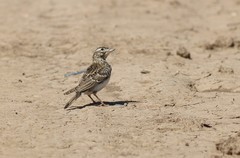
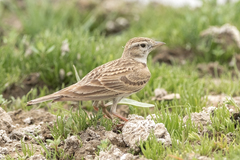
About the Greater Short-toed Lark
The greater short-toed lark (Calandrella brachydactyla) is a small passerine bird. The current scientific name is from Ancient Greek. The genus name, Calandrella, is a diminutive of kalandros, the calandra lark, and brachydactila is from brakhus, "short", and daktulos, "toe".
It breeds in southern Europe, north-west Africa, and across the Palearctic from Turkey and southern Russia to Mongolia. During migration they form large, tight flocks that move in unison; at other times they form loose flocks.
The greater short-toed lark was described by the German naturalist Johann Leisler in 1814 and given the binomial name Alauda brachydactila. This lark is now placed in the genus Calandrella that was established by another German naturalist, Johann Jakob Kaup, in 1829. The specific name brachydactyla is from the Ancient Greek βραχυδακτυλος brakhudaktulos "short-toed" from brakhus "short" and daktulos "toe". The alternate name short-toed lark may also be used for three other species in the genus Calandrella. Wikipedia →