Indian Scops-Owl

Indian Scops-Owl

Otus bakkamoena

Silhouette: Armelle Ansart (photograph), Maxime Dahirel (digitisation) · PhyloPic

LCLeast ConcernNTVUENCR
Daily sighting probability <5% · Rare
at Kozhikode

In 3 days <5%

23 Verified sightings at Kozhikode
2,313 In all 18 parks From 2019 to 2026
February Best month
🌅 Crepuscular When it's spotted

About the Indian Scops-Owl

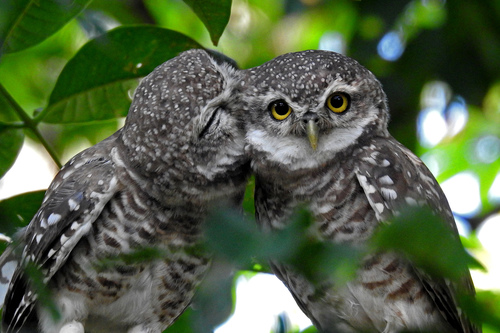
The Indian scops owl (Otus bakkamoena) is a species of owl native to South Asia. This species formerly included the collared scops owl (Otus lettia). The species epithet is derived from "bakamuna", the Sinhalese name for the eastern barn owl (Tyto javanica), and the brown fish owl (Ketupa zeylonensis).

The Indian scops owl is a small 23–25 cm (9.1–9.8 in) owl, although it is one of the largest of the scops owls. Like other scops owls, it has small head tufts, or ears. The upperparts are grey or brown, depending on the morph, with faint buff spotting. The underparts are buff with fine darker streaking. The facial disc is whitish or buff, and the eyes are orange or brown. There is a buff neckband. Sexes are similar. The flight is deeply undulating.

This species is very similar to the slightly larger partially migratory collared scops owl (Otus lettia) and the oriental scops owl (Otus sunia). They can be separated on call and eye colour. The species occurs from eastern Arabia through the Indian subcontinent, except the far north. The Indian scops owl is nocturnal. Through its natural camouflage... Wikipedia →

Sounds

Call1:04

Bangladesh · 2021

© A.S.M.Arif Ul Anam · XC682027 · CC BY-NC-SA 4.0

Recording0:33

India · 2021

© Janani · XC658243 · CC BY-NC-SA 4.0

Song0:33

India · 2017

© Peter Boesman · XC369389 · CC BY-NC-ND 4.0

Global Distribution

Parks Where Found

# Park Country Daily sighting probability
1 Gir National Park 🇮🇳 India
~30%
2 Keoladeo National Park 🇮🇳 India
~30%
3 Ranthambore National Park 🇮🇳 India
~20%
4 Bandhavgarh National Park 🇮🇳 India
~10%
5 Kanha National Park 🇮🇳 India
~10%
6 Periyar National Park 🇮🇳 India
~10%
7 Satpura National Park 🇮🇳 India
~10%
8 Chitwan National Park 🇳🇵 Nepal
<5%
9 Nagarhole National Park 🇮🇳 India
<5%
10 Mudumalai National Park 🇮🇳 India
<5%
11 Royal Bardia National Park 🇳🇵 Nepal
<5%
12 Jim Corbett National Park 🇮🇳 India
<5%
13 Udawalawe National Park 🇱🇰 Sri Lanka
<5%
14 Wilpattu National Park 🇱🇰 Sri Lanka
<5%
15 Yala National Park 🇱🇰 Sri Lanka
<5%
16 Bandipur National Park 🇮🇳 India
<5%
17 Minneriya National Park 🇱🇰 Sri Lanka
<5%
18 Sinharaja Forest Reserve 🇱🇰 Sri Lanka
<5%

Cities Where Found

# City Country Daily sighting probability
1 Jabalpur 🇮🇳 India
~10%
2 Gwalior 🇮🇳 India
<5%
3 Nagpur 🇮🇳 India
<5%
4 Jaipur 🇮🇳 India
<5%
5 Jammu 🇮🇳 India
<5%
6 Colombo [Sri Jayawardenepura Kotte] 🇱🇰 Sri Lanka
<5%
7 Thrissur 🇮🇳 India
<5%
8 Tamluk 🇮🇳 India
<5%
9 Bhubaneshwar 🇮🇳 India
<5%
10 Ludhiana 🇮🇳 India
<5%

Zoos & Centres Where Found

# Zoo / Centre Country
1 Asahiyama Zoo 🇯🇵 Japan In captivity
2 Small Breeds Farm Park 🇬🇧 United Kingdom In captivity

Before you go

What are the chances of seeing an Indian Scops-Owl in Kozhikode?

Rare

Under 5% of wildlife watchers report an Indian Scops-Owl sighting in Kozhikode on a given day, based on 23 verified sightings from GBIF citizen-science data. It is the 203rd most-seen of the 229 birds we can rate there. Over three days the chance rises to under 5%, if each day is a fresh chance.

When is the best time to see an Indian Scops-Owl in Kozhikode?

Any time of year

In every month with enough records, under 5% of wildlife watchers report an Indian Scops-Owl in Kozhikode on a given day, so our monthly data shows no clear season.

What time of day is best to see an Indian Scops-Owl?

Between 3 and 6 am

Across all the parks we cover, that three-hour window holds the most Indian Scops-Owl sightings with a recorded time, and about 6 in 10 of them come between 6 am and 6 pm: it is most active around dawn and dusk.

Is Kozhikode the best place to see an Indian Scops-Owl?

19th of 27

Of the 27 cities where we can rate Indian Scops-Owl sightings, Kozhikode ranks 19th at under 5%. The best odds are in Jabalpur (India, about 10%), Gwalior (India, under 5%) and Nagpur (India, under 5%).

Where does the Indian Scops-Owl sighting chance come from?

GBIF citizen-science records

It is estimated from how often the Indian Scops-Owl is recorded against all the birds logged in Kozhikode (23 verified sightings), calibrated against known sighting rates. Figures are rounded to the nearest 10% because citizen-science data supports honest approximations, not decimals, and months with records from fewer than five people show "—". How it works.

← Back to Kozhikode