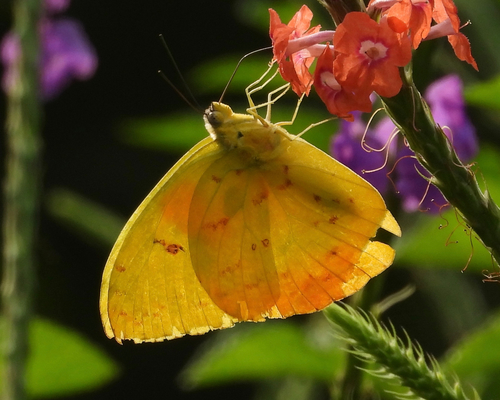
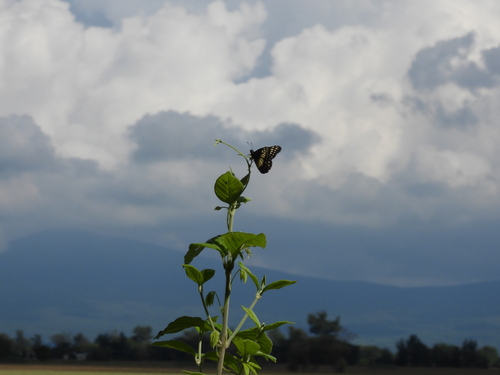
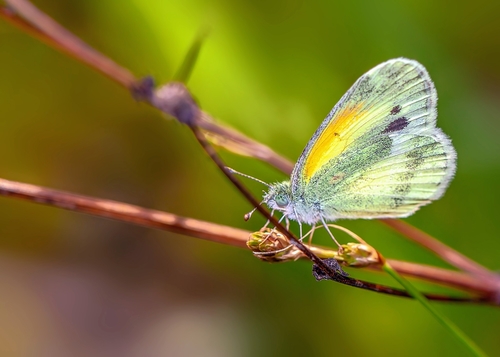
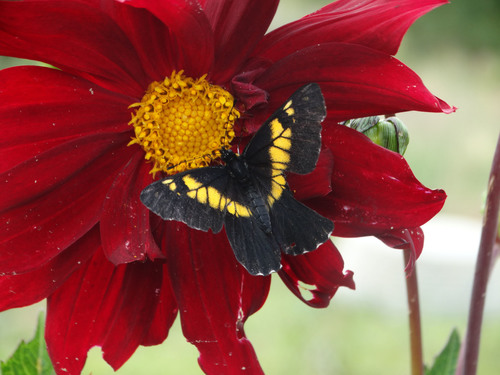
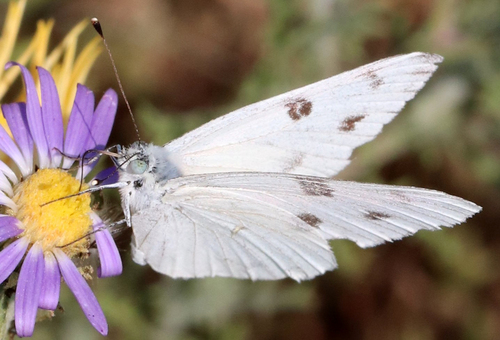
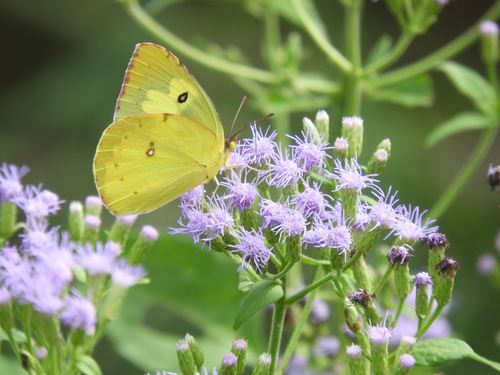

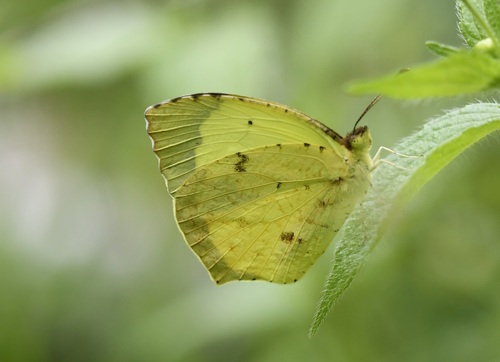
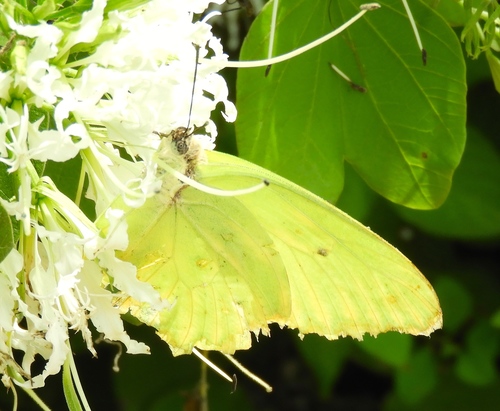
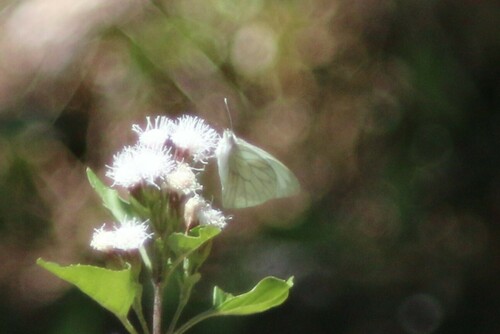
Orange Sulphur

Orange Sulphur

Colias eurytheme

Daily sighting probability <5% · Rare
at Mexico City

In 3 days ~10% in a week ~20%

10 Verified sightings at Mexico City
341 In all 16 parks From 2019 to 2026
August Best month
☀️ Diurnal When it's spotted

About the Orange Sulphur

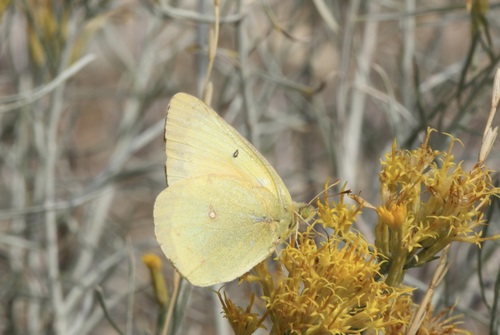
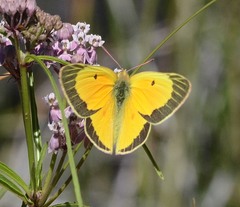
Colias eurytheme, the orange sulphur, also known as the alfalfa butterfly and in its larval stage as the alfalfa caterpillar, is a butterfly of the family Pieridae, where it belongs to the lowland group of "clouded yellows and sulphurs" subfamily Coliadinae. It is found throughout North America from southern Canada to Mexico.

Other members of this lineage including the common or clouded sulphur (C. philodice) and C. eriphyle and C. vitabunda, which are often included in C. philodice as subspecies. Hybridization runs rampant between these, making phylogenetic analyses exclusively utilizing one type of data (especially mtDNA sequences) unreliable. Therefore, little more can be said about its relationships, except that it is perhaps closer to C. (p.) eriphyle than generally assumed, strengthening the view that the latter should be considered a valid species.

The orange sulphur's caterpillars feed off various species in the pea family (Fabaceae) and are usually only found feeding at night. Occasionally this species multiplies to high numbers, and can become a serious pest to alfalfa (Medicago sativa) crops. The parasitoid wasp, Cotesia medicaginis can be used as a biocontrol agent against the caterpillars. Wikipedia →

Global Distribution

Parks Where Found

# Park Country Daily sighting probability
1 Point Pelee National Park 🇨🇦 Canada
~20%
2 Badlands National Park 🇺🇸 United States
~20%
3 Sequoia and Kings Canyon National Parks 🇺🇸 United States
~10%
4 Joshua Tree National Park 🇺🇸 United States
~10%
5 Yosemite National Park 🇺🇸 United States
~10%
6 Grand Canyon National Park 🇺🇸 United States
~10%
7 Shenandoah National Park 🇺🇸 United States
~10%
8 Big Bend National Park 🇺🇸 United States
~10%
9 Death Valley National Park 🇺🇸 United States
~10%
10 Great Smoky Mountains National Park 🇺🇸 United States
~10%
11 Channel Islands National Park 🇺🇸 United States
~10%
12 Zion National Park 🇺🇸 United States
~10%
13 Saguaro National Park 🇺🇸 United States
~10%
14 Rocky Mountain National Park 🇺🇸 United States
~10%
15 Acadia National Park 🇺🇸 United States
<5%
16 Yellowstone National Park 🇺🇸 United States
<5%

Cities Where Found

# City Country Daily sighting probability
1 Dallas 🇺🇸 United States
~20%
2 Austin 🇺🇸 United States
~20%
3 San Antonio 🇺🇸 United States
~10%
4 Sacramento 🇺🇸 United States
~10%
5 Denver 🇺🇸 United States
~10%
6 Toronto 🇨🇦 Canada
~10%
7 Chicago 🇺🇸 United States
~10%
8 San Luis Potosí 🇲🇽 México
~10%
9 Baltimore 🇺🇸 United States
~10%
10 Philadelphia 🇺🇸 United States
~10%

Before you go

What are the chances of seeing an Orange Sulphur in Mexico City?

Rare

Under 5% of wildlife watchers report an Orange Sulphur sighting in Mexico City on a given day, based on 10 verified sightings from GBIF citizen-science data. It is the 369th most-seen of the 557 insects we can rate there. Over three days the chance rises to about 10%, and over a week to about 20%, if each day is a fresh chance.

When is the best time to see an Orange Sulphur in Mexico City?

Any time of year

In every month with enough records, under 5% of wildlife watchers report an Orange Sulphur in Mexico City on a given day, so our monthly data shows no clear season.

What time of day is best to see an Orange Sulphur?

Between 11 am and 2 pm

Across all the parks we cover, that three-hour window holds the most Orange Sulphur sightings with a recorded time, and nearly all of them come between 6 am and 6 pm: it is a daytime animal.

Is Mexico City the best place to see an Orange Sulphur?

28th of 29

Of the 29 cities where we can rate Orange Sulphur sightings, Mexico City ranks 28th at under 5%. The best odds are in Dallas (United States, about 20%), Austin (United States, about 20%) and San Antonio (United States, about 10%).

Which relatives of the Orange Sulphur live in Mexico City?

Same family: Pieridae

The closest relatives of the Orange Sulphur that you can see in Mexico City (family Pieridae, Whites, Yellows, and Sulphurs) are Green-Eyed White (about 30%), Orange-Barred Sulphur (about 20%) and Mexican Dartwhite (about 10%), with each one's daily chance of a sighting.

Where does the Orange Sulphur sighting chance come from?

GBIF citizen-science records

It is estimated from how often the Orange Sulphur is recorded against all the insects logged in Mexico City (10 verified sightings), calibrated against known sighting rates. Figures are rounded to the nearest 10% because citizen-science data supports honest approximations, not decimals, and months with records from fewer than five people show "—". How it works.

← Back to Mexico City