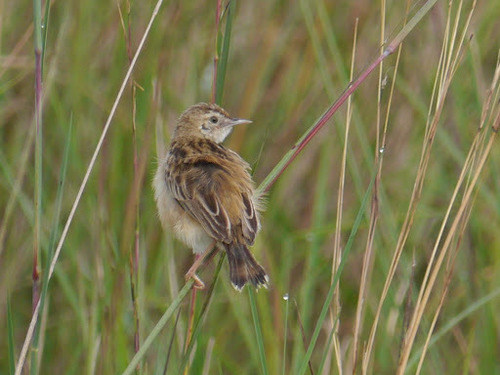
Rattling Cisticola

Rattling Cisticola

Cisticola chiniana

Silhouette: Sheatherius · PhyloPic

LCLeast ConcernNTVUENCR
Daily sighting probability <5% · Rare
at Nairobi

In 3 days ~10% in a week ~20%

39 Verified sightings at Nairobi
16,394 In all 38 parks From 2019 to 2026
August Best month
☀️ Diurnal When it's spotted

About the Rattling Cisticola

The rattling cisticola (Cisticola chiniana) is a species of bird in the family Cisticolidae which is native to Africa south of the equator, and parts of East Africa. It is a common to abundant species in open savanna and scrubland habitats, whether in arid, moist or upland regions. Especially during summer, it is highly conspicuous due to its strident and repetitive call-notes from prominent perches.

The rattling cisticola was formally described in 1843 by the Scottish zoologist Andrew Smith under the binomial name Drymoica chiniana based on a male specimen collected near the town of Zeerust in the North West Province of South Africa. The specific epithet chiniana is probably from the toponym "Chenyane" or Tshwenyane Mountains that lie to the north of Zeerust. The rattling cisticola is now one of 53 species placed in the genus Cisticola that was introduced in 1829 by the German naturalist Johann Jakob Kaup.

Seventeen subspecies are recognised: Wikipedia →

Sounds

Song1:00

Uganda · 2026

© Phil Shaw · XC1172251 · CC BY-NC-ND 4.0

Call1:26

South Africa · 2026

© Marna Buys · XC1100387 · CC BY-NC-SA 4.0

Alarm call0:31

Zambia · 2022

© Dries Van de Loock · XC758543 · CC BY-NC-ND 4.0

Global Distribution

Parks Where Found

# Park Country Daily sighting probability
1 uMkhuze Game Reserve 🇿🇦 South Africa
~70%
2 Lake Nakuru National Park 🇰🇪 Kenya
~50%
3 Kidepo Valley National Park 🇺🇬 Uganda
~50%
4 Serengeti National Park 🇹🇿 Tanzania
~50%
5 Hluhluwe-Imfolozi Park 🇿🇦 South Africa
~40%
6 Murchison Falls National Park 🇺🇬 Uganda
~40%
7 Tarangire National Park 🇹🇿 Tanzania
~40%
8 Kruger National Park 🇿🇦 South Africa
~40%
9 Mkomazi National Park 🇹🇿 Tanzania
~40%
10 Nairobi National Park 🇰🇪 Kenya
~40%
11 Mikumi National Park 🇹🇿 Tanzania
~30%
12 Tsavo West National Park 🇰🇪 Kenya
~30%
13 Masai Mara National Reserve 🇰🇪 Kenya
~30%
14 Gonarezhou National Park 🇿🇼 Zimbabwe
~30%
15 Lake Manyara National Park 🇹🇿 Tanzania
~30%
16 iSimangaliso Wetland Park 🇿🇦 South Africa
~30%
17 Arusha National Park 🇹🇿 Tanzania
~30%
18 Pilanesberg National Park 🇿🇦 South Africa
~30%
19 Waterberg Plateau Park 🇳🇦 Namibia
~20%
20 Ngorongoro Conservation Area 🇹🇿 Tanzania
~20%
21 Ruaha National Park 🇹🇿 Tanzania
~20%
22 Hwange National Park 🇿🇼 Zimbabwe
~20%
23 Moremi Game Reserve 🇧🇼 Botswana
~20%
24 South Luangwa National Park 🇿🇲 Zambia
~20%
25 Lower Zambezi National Park 🇿🇲 Zambia
~20%
26 Mana Pools National Park 🇿🇼 Zimbabwe
~20%
27 Gorongosa National Park 🇲🇿 Mozambique
~10%
28 Samburu National Reserve 🇰🇪 Kenya
~10%
29 Amboseli National Park 🇰🇪 Kenya
~10%
30 Liwonde National Park 🇲🇼 Malawi
~10%
31 Etosha National Park 🇳🇦 Namibia
~10%
32 Kafue National Park 🇿🇲 Zambia
~10%
33 Chobe National Park 🇧🇼 Botswana
~10%
34 Tsavo East National Park 🇰🇪 Kenya
~10%
35 Aberdare National Park 🇰🇪 Kenya
~10%
36 Lake Mburo National Park 🇺🇬 Uganda
<5%
37 Queen Elizabeth National Park 🇺🇬 Uganda
<5%
38 Kibale National Park 🇺🇬 Uganda
<5%

Cities Where Found

# City Country Daily sighting probability
1 Dar es-Salaam 🇹🇿 Tanzania
~30%
2 Harare 🇿🇼 Zimbabwe
~10%
3 Durban 🇿🇦 South Africa
<5%
4 Lusaka 🇿🇲 Zambia
<5%
5 Mombasa 🇰🇪 Kenya
<5%
6 Nairobi 🇰🇪 Kenya
<5%
7 Pretoria 🇿🇦 South Africa
<5%
8 Johannesburg 🇿🇦 South Africa
<5%

Before you go

What are the chances of seeing a Rattling Cisticola in Nairobi?

Rare

Under 5% of wildlife watchers report a Rattling Cisticola sighting in Nairobi on a given day, based on 39 verified sightings from GBIF citizen-science data. It is the 122nd most-seen of the 234 birds we can rate there. Over three days the chance rises to about 10%, and over a week to about 20%, if each day is a fresh chance.

When is the best time to see a Rattling Cisticola in Nairobi?

August and September

In those months about 10% of wildlife watchers report a Rattling Cisticola in Nairobi on a given day, against under 5% in October to July, the lowest months. Those are among Nairobi's driest months, with about 30 mm of rain a month against 150 mm in April.

What time of day is best to see a Rattling Cisticola?

Between 7 and 10 am

Across all the parks we cover, that three-hour window holds the most Rattling Cisticola sightings with a recorded time, and about 9 in 10 of them come between 6 am and 6 pm: it is a daytime animal.

Is Nairobi the best place to see a Rattling Cisticola?

6th of 8

Of the 8 cities where we can rate Rattling Cisticola sightings, Nairobi ranks 6th at under 5%. The best odds are in Dar es-Salaam (Tanzania, about 30%), Harare (Zimbabwe, about 10%) and Durban (South Africa, under 5%).

Which relatives of the Rattling Cisticola live in Nairobi?

Same genus: Cisticola

The closest relatives of the Rattling Cisticola that you can see in Nairobi (genus Cisticola, Cisticolas) are Singing Cisticola (about 30%), Red-faced Cisticola (about 20%) and Winding Cisticola (about 10%), with each one's daily chance of a sighting.

Where does the Rattling Cisticola sighting chance come from?

GBIF citizen-science records

It is estimated from how often the Rattling Cisticola is recorded against all the birds logged in Nairobi (39 verified sightings), calibrated against known sighting rates. Figures are rounded to the nearest 10% because citizen-science data supports honest approximations, not decimals, and months with records from fewer than five people show "—". How it works.

← Back to Nairobi