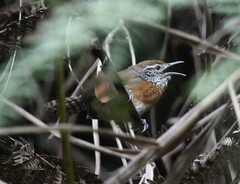

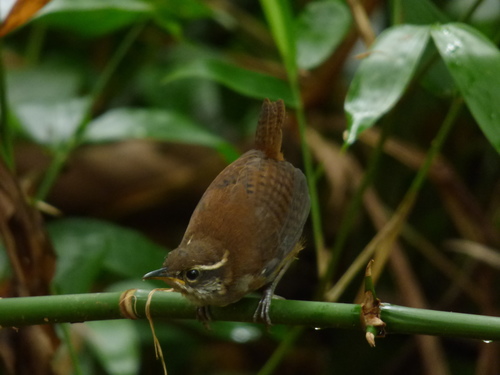
Rufous-breasted Wren

Rufous-breasted Wren

Pheugopedius rutilus

Silhouette: Matt Wilkins · PhyloPic

LCLeast ConcernNTVUENCR
Daily sighting probability <5% · Rare
at Panama City

In 3 days <5% in a week ~10%

90 Verified sightings at Panama City
6,221 In all 14 parks From 2019 to 2026
October Best month
☀️ Diurnal When it's spotted

About the Rufous-breasted Wren

The rufous-breasted wren (Pheugopedius rutilus) is a small songbird of the family Troglodytidae. It is found in Colombia, Costa Rica, Panama, Trinidad and Tobago, and Venezuela. The rufous-breasted wren was formerly placed in the genus Thryothorus which in the old, broad sense was a motley assemblage of similar-looking wrens. Since being moved into genus Pheugopedius it has at times been treated as conspecific with speckle-breasted wren (P. sclateri) and spot-breasted wren (P. maculipectus). They do form a superspecies.

The rufous-breasted wren has seven subspecies: Adult rufous-breasted wrens of the nominate subspecies are 14 cm (5.5 in) long and weigh 13.5 to 18.5 g (0.48 to 0.65 oz). Their crowns and upperparts are warm brown; their tail is gray-brown with heavy dark brown bars. They have a white supercilium with a black edge above it. Their face and throat are speckled black and white. The chest is bright chestnut... Wikipedia →

Sounds

Song0:29

Venezuela · 2026

Rosa Elena Albornoz @rosaelena_naturaleza · XC1107397 · CC0

Duet0:27

Panama · 2025

© Sue Riffe · XC1075926 · CC BY-NC-SA 4.0

Call0:33

Colombia · 2021

© Peter Boesman · XC693751 · CC BY-NC-ND 4.0

Global Distribution

Parks Where Found

# Park Country Daily sighting probability
1 Main Ridge Forest Reserve 🇹🇹 Trinidad and Tobago
~40%
2 Chirripó National Park 🇨🇷 Costa Rica
~30%
3 Parque Natural Metropolitano 🇵🇦 Panama
~30%
4 Henri Pittier National Park 🇻🇪 Venezuela
~20%
5 Carara National Park 🇨🇷 Costa Rica
~20%
6 Soberanía National Park 🇵🇦 Panama
~10%
7 Chagres National Park 🇵🇦 Panama
~10%
8 La Amistad International Park (Panama) 🇵🇦 Panama
~10%
9 Volcán Barú National Park 🇵🇦 Panama
~10%
10 Sierra de la Macarena National Park 🇨🇴 Colombia
<5%
11 Monteverde Cloud Forest Reserve 🇨🇷 Costa Rica
<5%
12 Tayrona National Natural Park 🇨🇴 Colombia
<5%
13 Marino Ballena National Park 🇨🇷 Costa Rica
<5%
14 Los Quetzales National Park 🇨🇷 Costa Rica
<5%

Cities Where Found

# City Country Daily sighting probability
1 Caracas 🇻🇪 Venezuela
~10%
2 San José 🇨🇷 Costa Rica
<5%
3 Panama City 🇵🇦 Panama
<5%
4 Valencia 🇻🇪 Venezuela
<5%

Before you go

What are the chances of seeing a Rufous-breasted Wren in Panama City?

Rare

Under 5% of wildlife watchers report a Rufous-breasted Wren sighting in Panama City on a given day, based on 90 verified sightings from GBIF citizen-science data. It is the 172nd most-seen of the 363 birds we can rate there. Over three days the chance rises to under 5%, and over a week to about 10%, if each day is a fresh chance.

When is the best time to see a Rufous-breasted Wren in Panama City?

Any time of year

In every month with enough records, under 5% of wildlife watchers report a Rufous-breasted Wren in Panama City on a given day, so our monthly data shows no clear season.

What time of day is best to see a Rufous-breasted Wren?

Between 8 and 11 am

Across all the parks we cover, that three-hour window holds the most Rufous-breasted Wren sightings with a recorded time, and about 9 in 10 of them come between 6 am and 6 pm: it is a daytime animal.

Is Panama City the best place to see a Rufous-breasted Wren?

3rd of 4

Of the 4 cities where we can rate Rufous-breasted Wren sightings, Panama City ranks 3rd at under 5%. The best odds are in Caracas (Venezuela, about 10%) and San José (Costa Rica, under 5%).

Where does the Rufous-breasted Wren sighting chance come from?

GBIF citizen-science records

It is estimated from how often the Rufous-breasted Wren is recorded against all the birds logged in Panama City (90 verified sightings), calibrated against known sighting rates. Figures are rounded to the nearest 10% because citizen-science data supports honest approximations, not decimals, and months with records from fewer than five people show "—". How it works.

← Back to Panama City