Dusky Moorhen

Dusky Moorhen

Gallinula tenebrosa

Silhouette: Andy Wilson · PhyloPic

LCLeast ConcernNTVUENCR
Daily sighting probability ~50% · Likely
at Perth

In 3 days ~90% in a week >90%

4,518 Verified sightings at Perth
1,842 In all 12 parks From 2019 to 2026
April Best month
☀️ Diurnal When it's spotted

About the Dusky Moorhen

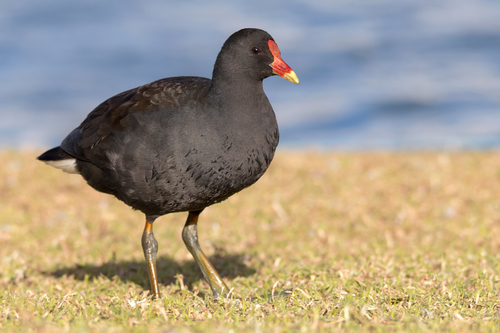
The dusky moorhen (Gallinula tenebrosa) is a bird species in the rail family and is one of the eight extant species in the moorhen genus. It occurs in Australia, New Guinea, Borneo and Indonesia. It is often confused with the purple swamphen and the Eurasian coot due to similar appearance and overlapping distributions. They often live alongside birds in the same genus, such as the Tasmanian nativehen and the common moorhen.

John Gould described the dusky moorhen in 1846 from a skin collected along the Murray River in South Australia. Its species name is derived from the Latin tenebrosa "dark". Charles Lucien Bonaparte described Gallinula haematopus in 1856, but this is now a nomen nudum. Gregory Mathews described two subspecies that have been synonymized—magnirostris from Western Australia and subfrontata from New South Wales.

Three subspecies are recognised: subspecies frontata from southeastern Borneo, the Sunda Islands, Timor and western New Guinea, subspecies neumannii from northern New Guinea, and the nominate subspecies from Australia. Common names include dusky moorhen, black gallinule, black moorhen and waterhen.

The dusky moorhen is a medium... Wikipedia →
Sounds

Call0:17

Australia · 2026

© Marc Anderson · XC1086671 · CC BY-NC-ND 4.0

Begging call1:04

Australia · 2020

© James Lambert · XC564262 · CC BY-NC-SA 4.0

Call0:12

Australia · 2019

© Ramit Singal · XC497607 · CC BY-NC-SA 4.0

Global Distribution

Parks Where Found

# Park Country Daily sighting probability
1 Royal National Park 🇦🇺 Australia
~40%
2 Great Otway National Park 🇦🇺 Australia
~10%
3 Springbrook National Park 🇦🇺 Australia
~10%
4 Blue Mountains National Park 🇦🇺 Australia
~10%
5 Grampians National Park 🇦🇺 Australia
~10%
6 Hattah-Kulkyne National Park 🇦🇺 Australia
~10%
7 Noosa National Park 🇦🇺 Australia
<5%
8 Booderee National Park 🇦🇺 Australia
<5%
9 Kosciuszko National Park 🇦🇺 Australia
<5%
10 Wilsons Promontory National Park 🇦🇺 Australia
<5%
11 Lamington National Park 🇦🇺 Australia
<5%
12 Daintree National Park 🇦🇺 Australia
<5%

Cities Where Found

# City Country Daily sighting probability
1 Brisbane 🇦🇺 Australia
~60%
2 Melbourne 🇦🇺 Australia
~60%
3 Perth 🇦🇺 Australia
~50%
4 Sydney 🇦🇺 Australia
~50%

Zoos & Centres Where Found

# Zoo / Centre Country
1 Australia Zoo 🇦🇺 Australia In captivity
2 Taronga Zoo 🇦🇺 Australia In captivity
3 Cleland Wildlife Park 🇦🇺 Australia In captivity
4 Currumbin Wildlife Sanctuary 🇦🇺 Australia In captivity
5 Melbourne Zoo 🇦🇺 Australia In captivity
6 Gorge Wildlife Park 🇦🇺 Australia In captivity
7 Ipswich Nature Centre 🇦🇺 Australia In captivity

Before you go

What are the chances of seeing a Dusky Moorhen in Perth?

Likely

About 50% of wildlife watchers report a Dusky Moorhen sighting in Perth on a given day, based on 4,518 verified sightings from GBIF citizen-science data. It is the 13th most-seen of the 162 birds we can rate there. Over three days the chance rises to about 90%, and over a week to over 90%, if each day is a fresh chance.

When is the best time to see a Dusky Moorhen in Perth?

April

In that month about 60% of wildlife watchers report a Dusky Moorhen in Perth on a given day, against about 50% in May to March, the lowest months.

What time of day is best to see a Dusky Moorhen?

Between noon and 3 pm

Across all the parks we cover, that three-hour window holds the most Dusky Moorhen sightings with a recorded time, and nearly all of them come between 6 am and 6 pm: it is a daytime animal.

Is Perth the best place to see a Dusky Moorhen?

3rd of 4

Of the 4 cities where we can rate Dusky Moorhen sightings, Perth ranks 3rd at about 50%. The best odds are in Brisbane (Australia, about 60%) and Melbourne (Australia, about 60%).

Where does the Dusky Moorhen sighting chance come from?

GBIF citizen-science records

It is estimated from how often the Dusky Moorhen is recorded against all the birds logged in Perth (4,518 verified sightings), calibrated against known sighting rates. Figures are rounded to the nearest 10% because citizen-science data supports honest approximations, not decimals, and months with records from fewer than five people show "—". How it works.

← Back to Perth