
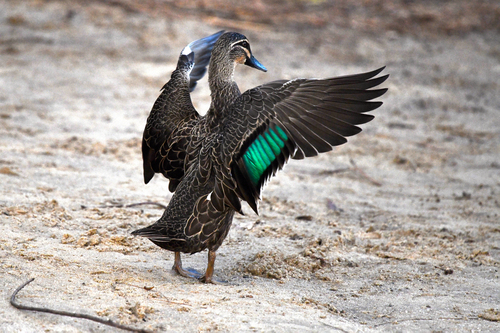
Hoary-headed Grebe

Hoary-headed Grebe

Poliocephalus poliocephalus

Silhouette: Tisha Mukherjee · PhyloPic

LCLeast ConcernNTVUENCR Endemic
Daily sighting probability ~10% · With luck
at Perth

In 3 days ~20% in a week ~50%

692 Verified sightings at Perth
491 In all 9 parks From 2019 to 2026
September Best month
☀️ Diurnal When it's spotted

About the Hoary-headed Grebe

The hoary-headed grebe (Poliocephalus poliocephalus) is a member of the grebe family. It breeds in southern parts of Australia; it winters throughout the island of Tasmania. The bird takes its name from the silvery-white streaking on its black head. It is common in Australia, with a population of about 500,000. Its habitat is similar to that of the Australasian grebe.

The hoary-headed grebe is a fairly small dark grey and white grebe. It has a brown eye and a black patch under the chin, and a narrow black streak down the back of the neck. During the breeding season the adult's plumage has white streaks over its entire head, giving them the common name of hoary-headed grebe. Juveniles have a white chin and throat and a striped face. Males have two plumage phases: after breeding they lose the buff breast and the white lines on the head, but can usually be identified then by the broad black bar down the nape.

The hoary-headed grebe is found in all states and territories of Australia. It is generally absent from the central arid regions of Australia. The hoary-headed grebe is usually found away from the shoreline in large open waters, which... Wikipedia →

Sounds

Song0:08

Australia · 2020

© Marc Anderson · XC611419 · CC BY-NC-ND 4.0

Song0:11

Australia · 2016

© Andrew Spencer · XC311776 · CC BY-NC-ND 4.0

Global Distribution

Parks Where Found

# Park Country Daily sighting probability
1 Hattah-Kulkyne National Park 🇦🇺 Australia
~10%
2 Grampians National Park 🇦🇺 Australia
~10%
3 Booderee National Park 🇦🇺 Australia
~10%
4 Great Otway National Park 🇦🇺 Australia
<5%
5 Uluru-Kata Tjuta National Park 🇦🇺 Australia
<5%
6 Wilsons Promontory National Park 🇦🇺 Australia
<5%
7 Kosciuszko National Park 🇦🇺 Australia
<5%
8 Royal National Park 🇦🇺 Australia
<5%
9 Blue Mountains National Park 🇦🇺 Australia
<5%

Cities Where Found

# City Country Daily sighting probability
1 Melbourne 🇦🇺 Australia
~20%
2 Perth 🇦🇺 Australia
~10%
3 Hobart 🇦🇺 Australia
<5%
4 Sydney 🇦🇺 Australia
<5%

Before you go

What are the chances of seeing a Hoary-headed Grebe in Perth?

With luck

About 10% of wildlife watchers report a Hoary-headed Grebe sighting in Perth on a given day, based on 692 verified sightings from GBIF citizen-science data. It is the 71st most-seen of the 162 birds we can rate there. Over three days the chance rises to about 20%, and over a week to about 50%, if each day is a fresh chance.

When is the best time to see a Hoary-headed Grebe in Perth?

July to April

In those months about 10% of wildlife watchers report a Hoary-headed Grebe in Perth on a given day, against under 5% in May and June, the lowest months.

What time of day is best to see a Hoary-headed Grebe?

Between 7 and 10 am

Across all the parks we cover, that three-hour window holds the most Hoary-headed Grebe sightings with a recorded time, and about 8 in 10 of them come between 6 am and 6 pm: it is a daytime animal.

Is Perth the best place to see a Hoary-headed Grebe?

2nd of 4

Of the 4 cities where we can rate Hoary-headed Grebe sightings, Perth ranks 2nd at about 10%. The best odds are in Melbourne (Australia, about 20%).

Which relatives of the Hoary-headed Grebe live in Perth?

Same family: Podicipedidae

The closest relatives of the Hoary-headed Grebe that you can see in Perth (family Podicipedidae, Grebes) are Australasian Grebe (about 50%) and Great Crested Grebe (about 20%), with each one's daily chance of a sighting.

Where does the Hoary-headed Grebe sighting chance come from?

GBIF citizen-science records

It is estimated from how often the Hoary-headed Grebe is recorded against all the birds logged in Perth (692 verified sightings), calibrated against known sighting rates. Figures are rounded to the nearest 10% because citizen-science data supports honest approximations, not decimals, and months with records from fewer than five people show "—". How it works.

← Back to Perth