
White-faced Ibis

White-faced Ibis

Plegadis chihi

Silhouette: Mathieu Pélissié · PhyloPic

LCLeast ConcernNTVUENCR
Daily sighting probability <5% · Rare
at Phoenix

In 3 days <5%

16 Verified sightings at Phoenix
1,229 In all 23 parks From 2019 to 2026
August Best month
☀️ Diurnal When it's spotted

About the White-faced Ibis

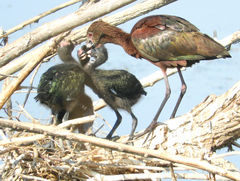
The white-faced ibis (Plegadis chihi) is a wading bird in the ibis family, Threskiornithidae. This species breeds colonially in marshes, usually nesting in bushes or low trees. Its breeding range extends from southwestern Canada and the western United States south through Mexico, as well as from southeastern Brazil and southeastern Bolivia south to central Argentina, and along the coast of central Chile. Its winter range extends from southern California and Louisiana south to include the rest of its breeding range.

In its non-breeding plumage, the white-faced ibis is very similar to the glossy ibis except that it tends to be slightly smaller and its plumage has a somewhat warmer color. Breeding adults have a pink, bare face bordered with white feathers (rather than a bluish bare face with no bordering feathers), a grey bill, and brighter-colored, redder legs. Adults have red eyes year-round, whereas glossy ibises have dark eyes. Juveniles of the two species are nearly identical.

Measurements: Length: 18.1–22.1 in (46–56 cm) Weight: 15.9–18.5 oz (450–525 g) Wingspan: 35.4–36.6 in (90–93 cm) The white-faced ibis occurs in Canada, the United States... Wikipedia →

Sounds

Call0:08

Argentina · 2022

© Franco Vushurovich · XC751188 · CC BY-NC-SA 4.0

Alarm call0:05

Mexico · 2020

© Isain Contreras Rodríguez · XC531195 · CC BY-NC-SA 4.0

Flight call0:17

Brazil · 2019

© GABRIEL LEITE · XC510883 · CC BY-NC-SA 4.0

Global Distribution

Parks Where Found

# Park Country Daily sighting probability
1 Iberá National Park 🇦🇷 Argentina
~20%
2 Death Valley National Park 🇺🇸 United States
~10%
3 El Vizcaíno Biosphere Reserve 🇲🇽 Mexico
~10%
4 Cabo Pulmo National Park 🇲🇽 Mexico
<5%
5 Channel Islands National Park 🇺🇸 United States
<5%
6 Elk Island National Park 🇨🇦 Canada
<5%
7 Padre Island National Seashore 🇺🇸 United States
<5%
8 El Palmar National Park 🇦🇷 Argentina
<5%
9 El Impenetrable National Park 🇦🇷 Argentina
<5%
10 Joshua Tree National Park 🇺🇸 United States
<5%
11 Yellowstone National Park 🇺🇸 United States
<5%
12 Bahía de Loreto National Park 🇲🇽 Mexico
<5%
13 Big Bend National Park 🇺🇸 United States
<5%
14 Zion National Park 🇺🇸 United States
<5%
15 Grand Teton National Park 🇺🇸 United States
<5%
16 Saguaro National Park 🇺🇸 United States
<5%
17 Iguaçu National Park 🇧🇷 Brazil
<5%
18 Grand Canyon National Park 🇺🇸 United States
<5%
19 Parque Estadual Encontro das Águas 🇧🇷 Brazil
<5%
20 Iguazú National Park 🇦🇷 Argentina
<5%
21 Bastimentos Island National Marine Park 🇵🇦 Panama
<5%
22 Rocky Mountain National Park 🇺🇸 United States
<5%
23 La Amistad International Park (Panama) 🇵🇦 Panama
<5%

Cities Where Found

# City Country Daily sighting probability
1 León 🇲🇽 México
~30%
2 Mexico City 🇲🇽 México
~20%
3 Toluca 🇲🇽 México
~20%
4 Rosario 🇦🇷 Argentina
~20%
5 Curitiba 🇧🇷 Brazil
~10%
6 Los Angeles 🇺🇸 United States
~10%
7 Porto Alegre 🇧🇷 Brazil
~10%
8 Monterrey 🇲🇽 México
~10%
9 Tijuana 🇲🇽 México
~10%
10 Buenos Aires 🇦🇷 Argentina
~10%

Zoos & Centres Where Found

# Zoo / Centre Country
1 Prague Zoo 🇨🇿 Czechia In captivity
2 Parc des oiseaux 🇫🇷 France In captivity
3 Living Desert Zoo and Gardens 🇺🇸 United States In captivity
4 Columbus Zoo and Aquarium 🇺🇸 United States In captivity
5 Phoenix Zoo 🇺🇸 United States In captivity
6 Oregon Zoo 🇺🇸 United States In captivity
7 Zoológico Benito Juárez 🇲🇽 Mexico In captivity
8 L'Oceanogràfic 🇪🇸 Spain In captivity
9 Chilean National Zoo 🇨🇱 Chile In captivity
10 Tracy Aviary 🇺🇸 United States In captivity
11 Aquarium of the Pacific 🇺🇸 United States In captivity
12 Rákosův pavilon 🇨🇿 Czechia In captivity
13 Velemlokárium 🇨🇿 Czechia In captivity

Before you go

What are the chances of seeing a White-faced Ibis in Phoenix?

Rare

Under 5% of wildlife watchers report a White-faced Ibis sighting in Phoenix on a given day, based on 16 verified sightings from GBIF citizen-science data. It is the 202nd most-seen of the 238 birds we can rate there. Over three days the chance rises to under 5%, if each day is a fresh chance.

When is the best time to see a White-faced Ibis in Phoenix?

Any time of year

In every month with enough records, under 5% of wildlife watchers report a White-faced Ibis in Phoenix on a given day, so our monthly data shows no clear season.

What time of day is best to see a White-faced Ibis?

Between 7 and 10 am

Across all the parks we cover, that three-hour window holds the most White-faced Ibis sightings with a recorded time, and about 9 in 10 of them come between 6 am and 6 pm: it is a daytime animal.

Is Phoenix the best place to see a White-faced Ibis?

31st of 32

Of the 32 cities where we can rate White-faced Ibis sightings, Phoenix ranks 31st at under 5%. The best odds are in León (México, about 30%), Mexico City (México, about 20%) and Toluca (México, about 20%).

Which relatives of the White-faced Ibis live in Phoenix?

Same order: Pelecaniformes

The closest relatives of the White-faced Ibis that you can see in Phoenix (order Pelecaniformes, Pelicans, Herons, Ibises, and Allies) are Great Blue Heron (about 10%), Great Egret (about 10%) and Green Heron (about 10%), with each one's daily chance of a sighting.

Where does the White-faced Ibis sighting chance come from?

GBIF citizen-science records

It is estimated from how often the White-faced Ibis is recorded against all the birds logged in Phoenix (16 verified sightings), calibrated against known sighting rates. Figures are rounded to the nearest 10% because citizen-science data supports honest approximations, not decimals, and months with records from fewer than five people show "—". How it works.

← Back to Phoenix