Long-Tailed Skipper

Long-Tailed Skipper

Urbanus proteus

Daily sighting probability ~10% · With luck
at Quito

In 3 days ~30% in a week ~60%

13 Verified sightings at Quito
284 In all 9 parks From 2019 to 2026
August Best month
☀️ Diurnal When it's spotted

About the Long-Tailed Skipper

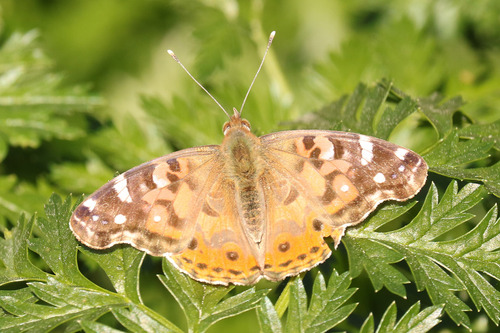
The long-tailed skipper (Urbanus proteus) is a spread-winged skipper butterfly found throughout tropical and subtropical South America, south to Argentina and north into the eastern United States and southern Ontario. It cannot live in areas with prolonged frost. It is a showy butterfly, with wings of light brown tinted with iridescent blue, and two long tails extending from the hindwings. The robust body is light blue dorsally. It has a large head, prominent eyes, and a wingspan between 4.5 and 6 centimeters.

It lays white or yellow eggs, singly or in small clusters, which hatch into a caterpillar with a yellowish body and large, dark head. After two to three weeks, the caterpillar forms a pupa. Its pupa is contained in a rolled leaf and covered in fine bluish hairs. The pupa stage may last from one to three weeks, after which the adult emerges.

The caterpillar of this skipper is a common pest of crops, especially beans, in the southern United States. For this reason, it is sometimes called the bean leafroller in that area. The caterpillars feed on leaves of plants in the legume family such as wisteria and butterfly peas and then roll the leaves around themselves... Wikipedia →

Global Distribution

Parks Where Found

# Park Country Daily sighting probability
1 Congaree National Park 🇺🇸 United States
~20%
2 Merritt Island National Wildlife Refuge 🇺🇸 United States
~20%
3 Big Cypress National Preserve 🇺🇸 United States
~10%
4 Lago de Yojoa 🇭🇳 Honduras
~10%
5 Bahía de Loreto National Park 🇲🇽 Mexico
~10%
6 Everglades National Park 🇺🇸 United States
~10%
7 Great Smoky Mountains National Park 🇺🇸 United States
~10%
8 Cumbres de Monterrey National Park 🇲🇽 Mexico
~10%
9 Monteverde Cloud Forest Reserve 🇨🇷 Costa Rica
<5%

Cities Where Found

# City Country Daily sighting probability
1 Quito 🇪🇨 Ecuador
~10%
2 Santo Domingo 🇩🇴 Dominican Republic
~10%
3 Houston 🇺🇸 United States
~10%
4 Miami 🇺🇸 United States
~10%
5 Orlando 🇺🇸 United States
~10%
6 Puebla 🇲🇽 México
~10%
7 Maceió 🇧🇷 Brazil
~10%
8 San Salvador 🇸🇻 El Salvador
~10%
9 Guatemala City 🇬🇹 Guatemala
~10%
10 Medellín 🇨🇴 Colombia
~10%

Before you go

What are the chances of seeing a Long-Tailed Skipper in Quito?

With luck

About 10% of wildlife watchers report a Long-Tailed Skipper sighting in Quito on a given day, based on 13 verified sightings from GBIF citizen-science data. It is the 42nd most-seen of the 83 insects we can rate there. Over three days the chance rises to about 30%, and over a week to about 60%, if each day is a fresh chance.

When is the best time to see a Long-Tailed Skipper in Quito?

August and October

In those months about 20% of wildlife watchers report a Long-Tailed Skipper in Quito on a given day, against under 5% in July and December–February, the lowest months. Those are among Quito's driest months, with about 50 mm of rain a month against 180 mm in April.

What time of day is best to see a Long-Tailed Skipper?

Between 11 am and 2 pm

Across all the parks we cover, that three-hour window holds the most Long-Tailed Skipper sightings with a recorded time, and nearly all of them come between 6 am and 6 pm: it is a daytime animal.

Is Quito the best place to see a Long-Tailed Skipper?

Yes

Of the 22 cities where we can rate Long-Tailed Skipper sightings, Quito has the highest daily chance: about 10%. Next come Santo Domingo (Dominican Republic, about 10%) and Houston (United States, about 10%).

Where does the Long-Tailed Skipper sighting chance come from?

GBIF citizen-science records

It is estimated from how often the Long-Tailed Skipper is recorded against all the insects logged in Quito (13 verified sightings), calibrated against known sighting rates. Figures are rounded to the nearest 10% because citizen-science data supports honest approximations, not decimals, and months with records from fewer than five people show "—". How it works.

← Back to Quito