Black Witch

Black Witch

Ascalapha odorata

Daily sighting probability ~40% · Likely
at Quito

In 3 days ~80% in a week >90%

110 Verified sightings at Quito
1,030 In all 53 parks From 2019 to 2026
January Best month
☀️🌙 Day & Night When it's spotted

About the Black Witch

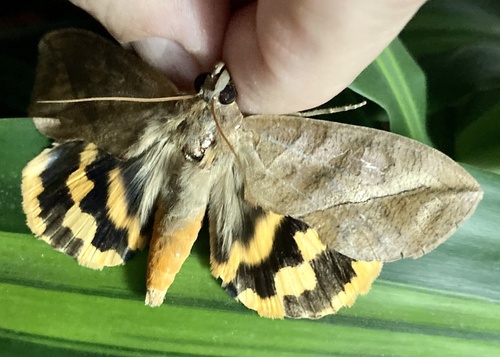
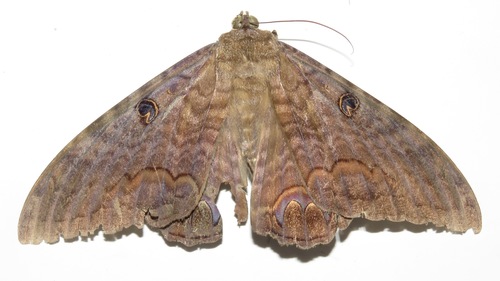
The erebid moth Ascalapha odorata, commonly known as the black witch, is a large bat-shaped, dark-colored nocturnal moth, normally ranging from the southern United States to Brazil. Ascalapha odorata is also migratory into Canada and most states of the United States. It is the largest noctuoid in the continental United States. In the folklore of many Central and South American cultures, it is associated with death or misfortune.

Female moths can attain a wingspan of 24 cm. The dorsal surfaces of their wings are mottled brown with hints of iridescent purple and pink, and, in females, crossed by a white bar. The diagnostic marking is a small spot on each forewing shaped like a number nine or a comma. This spot is often green with orange highlights. Males are somewhat smaller, reaching 12 cm in width, darker in color and lacking the white bar crossing the wings. The larva is a large caterpillar up to 7 cm in length with intricate patterns of black and greenish-brown spots and stripes.

The black witch lives from the southern United States, Mexico and Central America to Brazil, and even Argentina. Also, the moth has apparently been introduced... Wikipedia →
Global Distribution

Parks Where Found

# Park Country Daily sighting probability
1 Palo Verde National Park 🇨🇷 Costa Rica
~30%
2 Tortuguero National Park 🇨🇷 Costa Rica
~30%
3 Bahía de Loreto National Park 🇲🇽 Mexico
~30%
4 Santa Rosa National Park 🇨🇷 Costa Rica
~20%
5 Ostional Wildlife Refuge 🇨🇷 Costa Rica
~20%
6 Las Baulas Marine National Park 🇨🇷 Costa Rica
~20%
7 Cabo Pulmo National Park 🇲🇽 Mexico
~20%
8 Serra dos Órgãos National Park 🇧🇷 Brazil
~20%
9 Padre Island National Seashore 🇺🇸 United States
~20%
10 Main Ridge Forest Reserve 🇹🇹 Trinidad and Tobago
~20%
11 Henri Pittier National Park 🇻🇪 Venezuela
~20%
12 Masaya Volcano National Park 🇳🇮 Nicaragua
~20%
13 Gandoca-Manzanillo Wildlife Refuge 🇨🇷 Costa Rica
~20%
14 Calakmul Biosphere Reserve 🇲🇽 Mexico
~20%
15 Chagres National Park 🇵🇦 Panama
~20%
16 Biotopo Cerro Cahuí 🇬🇹 Guatemala
~20%
17 Iguazú National Park 🇦🇷 Argentina
~20%
18 Tambopata National Reserve 🇵🇪 Peru
~20%
19 Cumbres de Monterrey National Park 🇲🇽 Mexico
~10%
20 Manu National Park 🇵🇪 Peru
~10%
21 Tayrona National Natural Park 🇨🇴 Colombia
~10%
22 Iberá National Park 🇦🇷 Argentina
~10%
23 Cuyabeno Wildlife Reserve 🇪🇨 Ecuador
~10%
24 Cabo Blanco Absolute Nature Reserve 🇨🇷 Costa Rica
~10%
25 El Vizcaíno Biosphere Reserve 🇲🇽 Mexico
~10%
26 Cahuita National Park 🇨🇷 Costa Rica
~10%
27 Piedras Blancas National Park 🇨🇷 Costa Rica
~10%
28 Parque Natural Metropolitano 🇵🇦 Panama
~10%
29 Iguaçu National Park 🇧🇷 Brazil
~10%
30 Everglades National Park 🇺🇸 United States
~10%
31 Braulio Carrillo National Park 🇨🇷 Costa Rica
~10%
32 Tenorio Volcano National Park 🇨🇷 Costa Rica
~10%
33 Sian Ka'an Biosphere Reserve 🇲🇽 Mexico
~10%
34 Podocarpus National Park 🇪🇨 Ecuador
~10%
35 Guadalupe Mountains National Park 🇺🇸 United States
~10%
36 Monteverde Cloud Forest Reserve 🇨🇷 Costa Rica
~10%
37 Bastimentos Island National Marine Park 🇵🇦 Panama
~10%
38 Lago de Yojoa 🇭🇳 Honduras
~10%
39 Carara National Park 🇨🇷 Costa Rica
~10%
40 Big Bend National Park 🇺🇸 United States
~10%
41 Arenal Volcano National Park 🇨🇷 Costa Rica
~10%
42 La Amistad International Park (Panama) 🇵🇦 Panama
~10%
43 Tijuca National Park 🇧🇷 Brazil
~10%
44 Arrecifes de Cozumel National Park 🇲🇽 Mexico
~10%
45 Soberanía National Park 🇵🇦 Panama
~10%
46 Tapantí-Macizo de la Muerte National Park 🇨🇷 Costa Rica
~10%
47 Cañón del Sumidero National Park 🇲🇽 Mexico
~10%
48 Galápagos Islands 🇪🇨 Ecuador
~10%
49 Manuel Antonio National Park 🇨🇷 Costa Rica
~10%
50 Big Cypress National Preserve 🇺🇸 United States
~10%
51 Saguaro National Park 🇺🇸 United States
~10%
52 Corcovado National Park 🇨🇷 Costa Rica
~10%
53 Point Pelee National Park 🇨🇦 Canada
~10%

Cities Where Found

# City Country Daily sighting probability
1 Valencia 🇻🇪 Venezuela
~40%
2 Quito 🇪🇨 Ecuador
~40%
3 Havana 🇨🇺 Cuba
~30%
4 San Pedro Sula 🇭🇳 Honduras
~30%
5 Toluca 🇲🇽 México
~30%
6 Tegucigalpa 🇭🇳 Honduras
~30%
7 Cali 🇨🇴 Colombia
~30%
8 Puebla 🇲🇽 México
~30%
9 Santa Cruz de la Sierra 🇧🇴 Bolivia
~20%
10 Managua 🇳🇮 Nicaragua
~20%

Before you go

What are the chances of seeing a Black Witch in Quito?

Likely

About 40% of wildlife watchers report a Black Witch sighting in Quito on a given day, based on 110 verified sightings from GBIF citizen-science data. It is the 6th most-seen of the 83 insects we can rate there. Over three days the chance rises to about 80%, and over a week to over 90%, if each day is a fresh chance.

When is the best time to see a Black Witch in Quito?

January

In that month about 70% of wildlife watchers report a Black Witch in Quito on a given day, against under 5% in May, the lowest month. That is one of Quito's wettest months, with about 140 mm of rain against 25 mm in August.

What time of day is best to see a Black Witch?

Between 7 and 10 pm

Across all the parks we cover, that three-hour window holds the most Black Witch sightings with a recorded time, and about half of them come between 6 am and 6 pm: it is seen both by day and at night.

Is Quito the best place to see a Black Witch?

Among the best

Of the 66 cities where we can rate Black Witch sightings, Quito ranks 2nd at about 40%, level with the leaders once rounded. The best odds are in Valencia (Venezuela, about 40%).

Which relatives of the Black Witch live in Quito?

Same family: Erebidae

The closest relatives of the Black Witch that you can see in Quito (family Erebidae, Underwing, Tiger, Tussock, and Allied Moths) are Chrysocale regalis (about 10%), Owl Moth (about 10%) and Cyanopepla micans (about 10%), with each one's daily chance of a sighting.

Where does the Black Witch sighting chance come from?

GBIF citizen-science records

It is estimated from how often the Black Witch is recorded against all the insects logged in Quito (110 verified sightings), calibrated against known sighting rates. Figures are rounded to the nearest 10% because citizen-science data supports honest approximations, not decimals, and months with records from fewer than five people show "—". How it works.

← Back to Quito