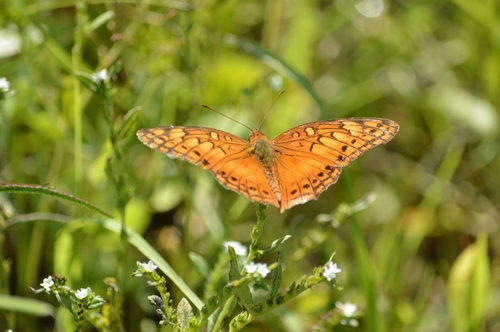
Variable Cracker

Variable Cracker

Hamadryas feronia

Daily sighting probability ~10% · With luck
at Rio de Janeiro

In 3 days ~10% in a week ~30%

10 Verified sightings at Rio de Janeiro
56 In all 6 parks From 2019 to 2026
June Best month
☀️ Diurnal When it's spotted

About the Variable Cracker

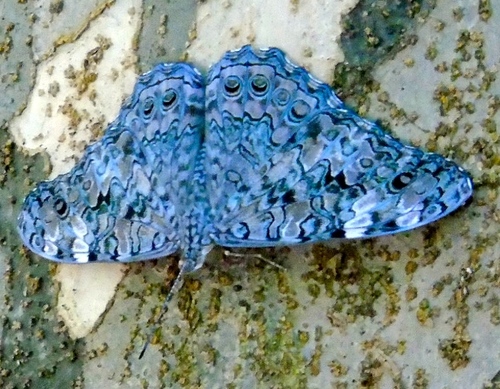
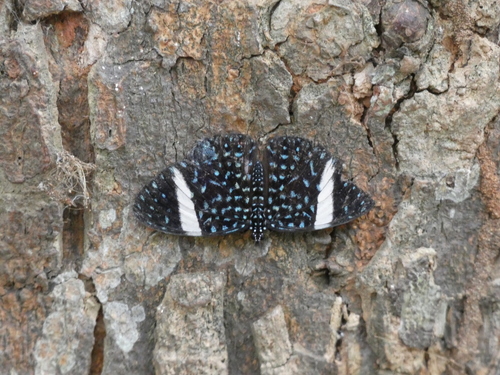
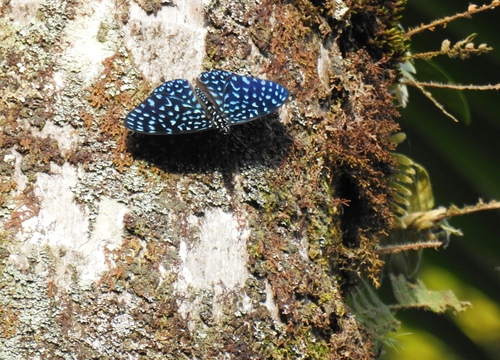
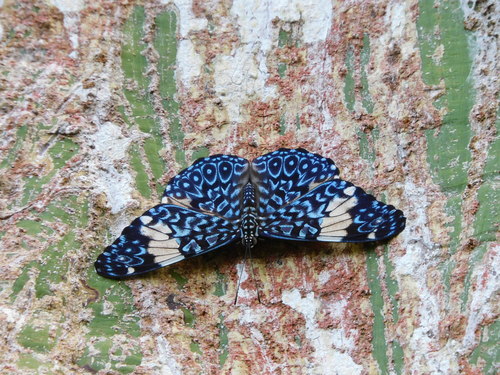
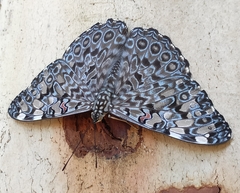
Hamadryas feronia, the blue cracker or variable cracker, is a species of cracker butterfly in the family Nymphalidae. It is found in the southern parts of North America and South America and southwards Brazil. Hamadryas feronia is similar in appearance to Hamadryas guatemalena and Hamadryas iphthime. The upperside of the fore wing is a mosaic pattern of white, brown and bluish-grey, with a row of small eyespots parallel with the outer margin; a small red bar occupies the discal cell. The upperside of the hind wing is similar but has few white patches and larger more distinct eyespots. The underside of the fore wing is white or whitish-tan with dark markings, a small red bar and a black submarginal eyespot, and the under hind wing is white or whitish-tan, with dark markings and blue rings containing larger eyespots near the rear margin.

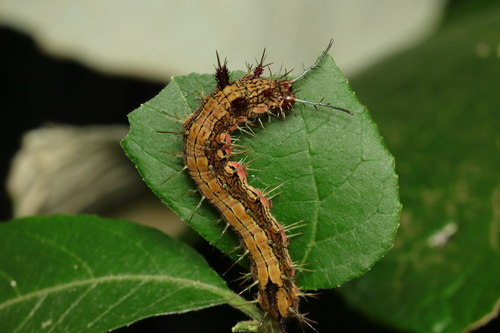
The larva has two colour morphs; it is either bluish-black above with brownish-white speckles and reddish spots on the side, or it is greyish-green with a pale-coloured longitudinal line on the side. It has dorsal spines on the second and third thoracic segments and on the seventh and eighth abdominal segments. The pupa has two long... Wikipedia →

Global Distribution

Parks Where Found

# Park Country Daily sighting probability
1 Rincón de la Vieja National Park 🇨🇷 Costa Rica
~20%
2 Lago de Yojoa 🇭🇳 Honduras
~10%
3 Soberanía National Park 🇵🇦 Panama
~10%
4 Parque Natural Metropolitano 🇵🇦 Panama
<5%
5 Tijuca National Park 🇧🇷 Brazil
<5%
6 La Amistad International Park (Panama) 🇵🇦 Panama
<5%

Cities Where Found

# City Country Daily sighting probability
1 Fortaleza 🇧🇷 Brazil
~30%
2 São Luís 🇧🇷 Brazil
~20%
3 Valencia 🇻🇪 Venezuela
~20%
4 João Pessoa 🇧🇷 Brazil
~10%
5 Salvador 🇧🇷 Brazil
~10%
6 Manaus 🇧🇷 Brazil
~10%
7 Vitória 🇧🇷 Brazil
~10%
8 Maceió 🇧🇷 Brazil
~10%
9 Guayaquil 🇪🇨 Ecuador
~10%
10 Caracas 🇻🇪 Venezuela
~10%

Before you go

What are the chances of seeing a Variable Cracker in Rio de Janeiro?

With luck

About 10% of wildlife watchers report a Variable Cracker sighting in Rio de Janeiro on a given day, based on 10 verified sightings from GBIF citizen-science data. It is the 85th most-seen of the 169 insects we can rate there. Over three days the chance rises to about 10%, and over a week to about 30%, if each day is a fresh chance.

When is the best time to see a Variable Cracker in Rio de Janeiro?

January, April, June–August and October

In those months about 10% of wildlife watchers report a Variable Cracker in Rio de Janeiro on a given day, against under 5% in February–March, May, September and November–December, the lowest months.

What time of day is best to see a Variable Cracker?

Between 9 am and noon

Across all the parks we cover, that three-hour window holds the most Variable Cracker sightings with a recorded time, and about 9 in 10 of them come between 6 am and 6 pm: it is a daytime animal.

Is Rio de Janeiro the best place to see a Variable Cracker?

13th of 15

Of the 15 cities where we can rate Variable Cracker sightings, Rio de Janeiro ranks 13th at about 10%. The best odds are in Fortaleza (Brazil, about 30%), São Luís (Brazil, about 20%) and Valencia (Venezuela, about 20%).

Which relatives of the Variable Cracker live in Rio de Janeiro?

Same genus: Hamadryas

The closest relatives of the Variable Cracker that you can see in Rio de Janeiro (genus Hamadryas, Cracker Butterflies) are Gray Cracker (about 10%), Starry Night Cracker (about 10%) and Arete Cracker (about 10%), with each one's daily chance of a sighting.

Where does the Variable Cracker sighting chance come from?

GBIF citizen-science records

It is estimated from how often the Variable Cracker is recorded against all the insects logged in Rio de Janeiro (10 verified sightings), calibrated against known sighting rates. Figures are rounded to the nearest 10% because citizen-science data supports honest approximations, not decimals, and months with records from fewer than five people show "—". How it works.
← Back to Rio de Janeiro