





Completed

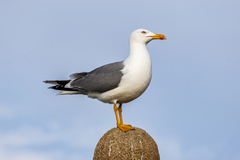


Yellow-legged Gull
Larus michahellis
Silhouette: Sharon Wegner-Larsen · PhyloPic
- KingdomAnimalia (Animals)
- PhylumChordata (Chordates)
- ClassAves (Birds)
- OrderCharadriiformes (Shorebirds and Allies)
- FamilyLaridae (Gulls, Terns, and Skimmers)
- GenusLarus (Large White-headed Gulls)
- SpeciesLarus michahellis (Yellow-legged Gull)
In 3 days ~10%
52 Verified sightings at Rotterdam [The Hague]
3,809 In all 12 parks From 2019 to 2026
September Best month
☀️ Diurnal When it's spotted
About the Yellow-legged Gull
The yellow-legged gull or western yellow-legged gull (Larus michahellis) is a large gull found in Europe, the Middle East and North Africa, which has only recently achieved wide recognition as a distinct species. It was formerly treated as a subspecies of either the Caspian gull L. cachinnans, or more broadly as a subspecies of the herring gull L. argentatus.
The genus name is from Latin Larus which appears to have referred to a gull or other large seabird, and the species name honours the German zoologist Karl Michahelles. It is now generally accepted that the yellow-legged gull is a full species, but until recently there was much disagreement. For example, British Birds magazine split the yellow-legged gull from the herring gull in 1993 but included the Caspian gull in the former, but the BOU in Great Britain retained the yellow-legged gull as a subspecies of the herring gull until 2007. DNA research, however, suggests that the yellow-legged gull is actually closest to the great black-backed gull L. marinus and the Armenian gull L. armenicus, while the Caspian gull is closer to the herring gull and the lesser black-backed gull L. fuscus, rather than being each... Wikipedia →
Recent sightings of Yellow-legged Gull in Rotterdam [The Hague]
LIVEiNaturalistGlobal Distribution
Parks Where Found
| # | Park | Country | Daily sighting probability |
|---|---|---|---|
| 1 | Camargue | 🇫🇷 France | |
| 2 | Doñana National Park | 🇪🇸 Spain | |
| 3 | Fertő-Hanság National Park | 🇭🇺 Hungary | |
| 4 | Hortobágy National Park | 🇭🇺 Hungary | |
| 5 | Bavarian Forest National Park | 🇩🇪 Germany | |
| 6 | Triglav National Park | 🇸🇮 Slovenia | |
| 7 | Kiskunság National Park | 🇭🇺 Hungary | |
| 8 | Cévennes National Park | 🇫🇷 France | |
| 9 | Sierra de Guadarrama National Park | 🇪🇸 Spain | |
| 10 | Pyrénées National Park | 🇫🇷 France | |
| 11 | Wadden Sea National Park | 🇩🇪 Germany | |
| 12 | Monfragüe National Park | 🇪🇸 Spain |
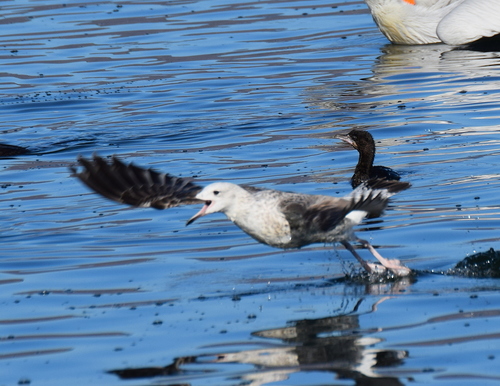
Closest Relatives at Rotterdam [The Hague]




Before you go
What are the chances of seeing a Yellow-legged Gull in Rotterdam [The Hague]?
Rare
Under 5% of wildlife watchers report a Yellow-legged Gull sighting in Rotterdam [The Hague] on a given day, based on 52 verified sightings from GBIF citizen-science data. It is the 108th most-seen of the 175 birds we can rate there. Over three days the chance rises to about 10%, if each day is a fresh chance.
When is the best time to see a Yellow-legged Gull in Rotterdam [The Hague]?
Any time of year
In every month with enough records, under 5% of wildlife watchers report a Yellow-legged Gull in Rotterdam [The Hague] on a given day, so our monthly data shows no clear season.
What time of day is best to see a Yellow-legged Gull?
Between 8 and 11 am
Across all the parks we cover, that three-hour window holds the most Yellow-legged Gull sightings with a recorded time, and about 8 in 10 of them come between 6 am and 6 pm: it is a daytime animal.
Is Rotterdam [The Hague] the best place to see a Yellow-legged Gull?
34th of 41
Of the 41 cities where we can rate Yellow-legged Gull sightings, Rotterdam [The Hague] ranks 34th at under 5%. The best odds are in Tangier (Morocco, over 90%), Rome (Italy, about 90%) and Naples (Italy, about 90%).
Which relatives of the Yellow-legged Gull live in Rotterdam [The Hague]?
Same genus: Larus
The closest relatives of the Yellow-legged Gull that you can see in Rotterdam [The Hague] (genus Larus, Large White-headed Gulls) are European Herring Gull (about 50%), Lesser Black-backed Gull (about 30%) and Common Gull (about 20%), with each one's daily chance of a sighting.
Where does the Yellow-legged Gull sighting chance come from?
GBIF citizen-science records
It is estimated from how often the Yellow-legged Gull is recorded against all the birds logged in Rotterdam [The Hague] (52 verified sightings), calibrated against known sighting rates. Figures are rounded to the nearest 10% because citizen-science data supports honest approximations, not decimals, and months with records from fewer than five people show "—". How it works.
