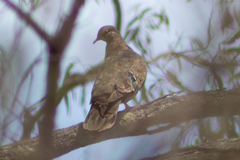
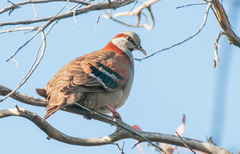
Brush Bronzewing

Brush Bronzewing

Phaps elegans

Silhouette: Michael Scroggie · PhyloPic

LCLeast ConcernNTVUENCR Endemic
Daily sighting probability <5% · Rare
at Sydney

In 3 days <5%

6 Verified sightings at Sydney
401 In all 9 parks From 2019 to 2026
October Best month
☀️ Diurnal When it's spotted

About the Brush Bronzewing

The brush bronzewing (Phaps elegans) is a species of bird in the pigeon family, Columbidae. It is endemic to Australia, with two biogeographically distinct subspecies. The brush bronzewing is one of around 310 species in the family Columbidae and can be classified into two distinct subspecies, P. elegans elegans and P. elegans occidentalis. P. elegans was first described by C. J. Temminck in 1809.

The brush bronzewing is similar in size and shape to the closely related common bronzewing (Phaps chalcoptera), however it's shorter and stockier in appearance. These birds are relatively small and range in size from 25 to 33 cm. Sexual dimorphism is apparent in these birds. Both sexes are dark-olive brown on top, rich chestnut in colour along the nape and shoulder with blue-grey underparts. The brush bronzewing is named for the iridescent bars of blue and green across the inner secondary feather of each wing.

The brush bronzewing is endemic to Australia, found in the South-West and South-East of the mainland with populations in Queensland, New South Wales, Victoria, South Australia, Western Australia and also Tasmania. The subspecies... Wikipedia →

Sounds

Call1:18

Australia · 2021

© Drew Davison · XC691794 · CC BY-NC-ND 4.0

Song0:32

Australia · 2020

© Iain Woxvold · XC603329 · CC BY-NC-SA 4.0

Song1:07

Australia · 2012

© Patrik Åberg · XC96918 · CC BY-NC-ND 2.5

Global Distribution

Parks Where Found

# Park Country Daily sighting probability
1 Flinders Chase 🇦🇺 Australia
~20%
2 Freycinet National Park 🇦🇺 Australia
~10%
3 Maria Island National Park 🇦🇺 Australia
~10%
4 Wilsons Promontory National Park 🇦🇺 Australia
~10%
5 Great Otway National Park 🇦🇺 Australia
<5%
6 Grampians National Park 🇦🇺 Australia
<5%
7 Royal National Park 🇦🇺 Australia
<5%
8 Cradle Mountain-Lake St Clair National Park 🇦🇺 Australia
<5%
9 Blue Mountains National Park 🇦🇺 Australia
<5%

Cities Where Found

# City Country Daily sighting probability
1 Hobart 🇦🇺 Australia
<5%
2 Melbourne 🇦🇺 Australia
<5%
3 Sydney 🇦🇺 Australia
<5%

Zoos & Centres Where Found

# Zoo / Centre Country
1 Taronga Zoo 🇦🇺 Australia In captivity
2 Currumbin Wildlife Sanctuary 🇦🇺 Australia In captivity
3 Perth Zoo 🇦🇺 Australia In captivity
4 Featherdale Sydney Wildlife Park 🇦🇺 Australia In captivity

Before you go

What are the chances of seeing a Brush Bronzewing in Sydney?

Rare

Under 5% of wildlife watchers report a Brush Bronzewing sighting in Sydney on a given day, based on 6 verified sightings from GBIF citizen-science data. It is the 242nd most-seen of the 243 birds we can rate there. Over three days the chance rises to under 5%, if each day is a fresh chance.

When is the best time to see a Brush Bronzewing in Sydney?

Any time of year

In every month with enough records, under 5% of wildlife watchers report a Brush Bronzewing in Sydney on a given day, so our monthly data shows no clear season.

What time of day is best to see a Brush Bronzewing?

Between 8 and 11 am

Across all the parks we cover, that three-hour window holds the most Brush Bronzewing sightings with a recorded time, and about 9 in 10 of them come between 6 am and 6 pm: it is a daytime animal.

Is Sydney the best place to see a Brush Bronzewing?

Among the best

Of the 3 cities where we can rate Brush Bronzewing sightings, Sydney ranks 3rd at under 5%, level with the leaders once rounded. The best odds are in Hobart (Australia, under 5%) and Melbourne (Australia, under 5%).

Where does the Brush Bronzewing sighting chance come from?

GBIF citizen-science records

It is estimated from how often the Brush Bronzewing is recorded against all the birds logged in Sydney (6 verified sightings), calibrated against known sighting rates. Figures are rounded to the nearest 10% because citizen-science data supports honest approximations, not decimals, and months with records from fewer than five people show "—". How it works.

← Back to Sydney