Rufous Fantail

Rufous Fantail

Rhipidura rufifrons

Silhouette: Michael Scroggie · PhyloPic

LCLeast ConcernNTVUENCR Endemic
Daily sighting probability ~10% · With luck
at Daintree National Park

In 3 days ~40% in a week ~60%

285 Verified sightings at Daintree National Park From 2019 to 2026
3,516 In all 11 parks
August Best month
☀️ Diurnal When it's spotted

About the Rufous Fantail

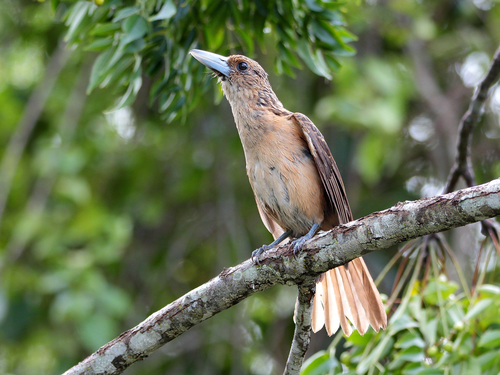
The Australian rufous fantail (Rhipidura rufifrons) is a small passerine bird, most commonly known also as the black-breasted rufous-fantail or rufous-fronted fantail, which can be found in Australia. Characteristic of species that have a large range, the Australian rufous fantail has many subspecies. However the taxonomic treatment of its subspecies and other relatives is still debated. The Australian rufous fantail is easily distinguished by their orange-reddish-brown back, rump and base of tail. They have a black and white breast that grades into a white colour on the chin and throat.

They are migratory, travelling to south-eastern Australia in the spring to breed, and then north in the autumn. The Australian rufous fantail tends to feed on small insects in the lower parts of the canopy. They are very active birds making short, frequent flights. They may also hop between foliage or on the ground, during foraging.

Although their population is thought to be declining, their relatively large range and abundance make them a species of least concern according to the IUCN. The Australian rufous fantail has complex evolutionary relationships and sometimes this results... Wikipedia →

Sounds

Song1:10

Australia · 2024

© Romuald Mikusek · XC1174000 · CC BY-NC-SA 4.0

Call0:11

Papua New Guinea · 2025

© Jan-Uwe Schmidt · XC1106215 · CC BY-NC-SA 4.0

Recording0:55

Australia · 2022

© Sreekar · XC719767 · CC BY-NC-SA 4.0

Global Distribution

Parks Where Found

# Park Country Daily sighting probability
1 Lamington National Park 🇦🇺 Australia
~50%
2 Springbrook National Park 🇦🇺 Australia
~20%
3 Royal National Park 🇦🇺 Australia
~20%
4 Daintree National Park 🇦🇺 Australia
~10%
5 Noosa National Park 🇦🇺 Australia
~10%
6 Booderee National Park 🇦🇺 Australia
~10%
7 Blue Mountains National Park 🇦🇺 Australia
~10%
8 Great Otway National Park 🇦🇺 Australia
~10%
9 Wilsons Promontory National Park 🇦🇺 Australia
~10%
10 Kosciuszko National Park 🇦🇺 Australia
<5%
11 Grampians National Park 🇦🇺 Australia
<5%

Cities Where Found

# City Country Daily sighting probability
1 Brisbane 🇦🇺 Australia
~10%
2 Sydney 🇦🇺 Australia
<5%
3 Melbourne 🇦🇺 Australia
<5%

Before you go

What are the chances of seeing a Rufous Fantail in Daintree National Park?

With luck

About 10% of wildlife watchers report a Rufous Fantail sighting in Daintree National Park on a given day, based on 285 verified sightings from GBIF citizen-science data from 2019 to 2026. It is the 67th most-seen of the 208 birds we can rate there. Over three days the chance rises to about 40%, and over a week to about 60%, if each day is a fresh chance.

When is the best time to see a Rufous Fantail in Daintree National Park?

June to August

In those months about 30% of wildlife watchers report a Rufous Fantail in Daintree National Park on a given day, against under 5% in November to February, the lowest months. Those are among Daintree National Park's driest months, with about 65 mm of rain a month against 380 mm in January.

What time of day is best to see a Rufous Fantail?

Between 11 am and 2 pm

Across all the parks we cover, that three-hour window holds the most Rufous Fantail sightings with a recorded time, and nearly all of them come between 6 am and 6 pm: it is a daytime animal.

Is Daintree National Park the best place to see a Rufous Fantail?

4th of 11

Of the 11 parks where we can rate Rufous Fantail sightings, Daintree National Park ranks 4th at about 10%. The best odds are in Lamington National Park (Australia, about 50%), Springbrook National Park (Australia, about 20%) and Royal National Park (Australia, about 20%).

Which relatives of the Rufous Fantail live in Daintree National Park?

Same genus: Rhipidura

The closest relatives of the Rufous Fantail that you can see in Daintree National Park (genus Rhipidura, Fantails) are Willie Wagtail (about 10%) and Grey Fantail (about 10%), with each one's daily chance of a sighting.

Where does the Rufous Fantail sighting chance come from?

GBIF citizen-science records

It is estimated from how often the Rufous Fantail is recorded against all the birds logged in Daintree National Park (285 verified sightings from 2019 to 2026), calibrated against known sighting rates. Figures are rounded to the nearest 10% because citizen-science data supports honest approximations, not decimals, and months with records from fewer than five people show "—". How it works.

← Back to Daintree National Park