


Completed

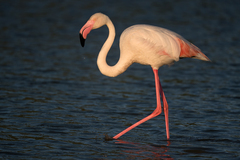


Greater Flamingo
Phoenicopterus roseus
Silhouette: Ferran Sayol · PhyloPic
- KingdomAnimalia (Animals)
- PhylumChordata (Chordates)
- ClassAves (Birds)
- OrderPhoenicopteriformes (Flamingos)
- FamilyPhoenicopteridae (Flamingos)
- GenusPhoenicopterus (Large Flamingos)
- SpeciesPhoenicopterus roseus (Greater Flamingo)
In 3 days >90%
127 Verified sightings at Djoudj National Bird Sanctuary From 2019 to 2026
11,134 In all 26 parks
January Best month
☀️ Diurnal When it's spotted
About the Greater Flamingo
The greater flamingo (Phoenicopterus roseus) is the largest and most widespread species of the flamingo family. Common in the Old World, they are found in Northern (coastal) and Sub-Saharan Africa, the Indian subcontinent (south of the Himalayas), Central Asia, the Middle East, the Levant, the Persian Gulf, the Gulf of Aden, the Red Sea, and the Mediterranean countries of Southern Europe.
The greater flamingo was described by Peter Simon Pallas in 1811. It was previously thought to be the same species as the American flamingo (Phoenicopterus ruber), but because of colouring differences of its head, neck, body, and bill, these two flamingos are now considered separate species. The greater flamingo is monotypic, with no subspecies.
It is found in parts of Northern Africa (including coastal areas of northern Algeria, Egypt further inland along the Nile River, Libya, Morocco, and Tunisia), portions of Sub-Saharan Africa (Kenya, Madagascar, Rwanda, Tanzania, Uganda), Southern Asia (coastal Bangladesh, India, Pakistan, and Sri Lanka), the Western Asia (Bahrain, Cyprus, Iraq, Iran, Oman, Israel, Palestine, Kuwait, Lebanon, Qatar, and the United Arab Emirates...
Recent sightings of Greater Flamingo in Djoudj National Bird Sanctuary
LIVEiNaturalistGlobal Distribution
Parks Where Found
Zoos & Centres Where Found
Closest Relatives at Djoudj National Bird Sanctuary







Before you go
What are the chances of seeing a Greater Flamingo in Djoudj National Bird Sanctuary?
Very likely
About 70% of wildlife watchers report a Greater Flamingo sighting in Djoudj National Bird Sanctuary on a given day, based on 127 verified sightings from GBIF citizen-science data from 2019 to 2026. It is the 22nd most-seen of the 173 birds we can rate there. Over three days the chance rises to over 90%, if each day is a fresh chance.
When is the best time to see a Greater Flamingo in Djoudj National Bird Sanctuary?
January–February and November
In those months about 70% of wildlife watchers report a Greater Flamingo in Djoudj National Bird Sanctuary on a given day, against about 40% in April, the lowest month. Those are among Djoudj National Bird Sanctuary's driest months, with almost no rain against 55 mm in August. May to October have too few records to rate.
What time of day is best to see a Greater Flamingo?
Between 7 and 10 am
Across all the parks we cover, that three-hour window holds the most Greater Flamingo sightings with a recorded time, and about 7 in 10 of them come between 6 am and 6 pm: it is a daytime animal.
Is Djoudj National Bird Sanctuary the best place to see a Greater Flamingo?
4th of 26
Of the 26 parks where we can rate Greater Flamingo sightings, Djoudj National Bird Sanctuary ranks 4th at about 70%. The best odds are in Camargue (France, about 80%), West Coast National Park (South Africa, about 80%) and Doñana National Park (Spain, about 70%). All parks ranked.
Where does the Greater Flamingo sighting chance come from?
GBIF citizen-science records
It is estimated from how often the Greater Flamingo is recorded against all the birds logged in Djoudj National Bird Sanctuary (127 verified sightings from 2019 to 2026), calibrated against known sighting rates. Figures are rounded to the nearest 10% because citizen-science data supports honest approximations, not decimals, and months with records from fewer than five people show "—". How it works.
