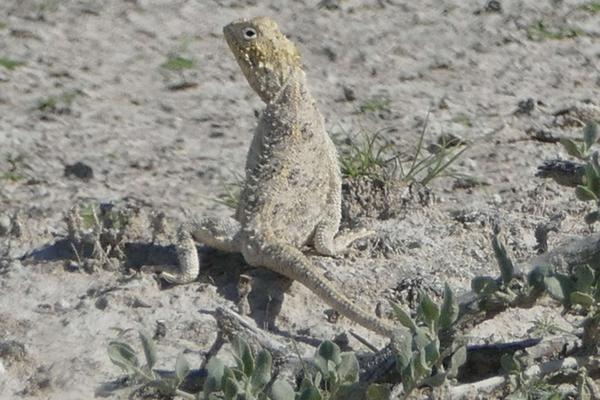
Flap-necked Chameleon

Flap-necked Chameleon

Chamaeleo dilepis

Silhouette: Alex Slavenko · PhyloPic

LCLeast ConcernNTVUENCR
Daily sighting probability ~10% · With luck
at Etosha National Park

In 3 days ~20% in a week ~50%

6 Verified sightings at Etosha National Park From 2019 to 2026
725 In all 19 parks
April Best month
🌅 Crepuscular When it's spotted

About the Flap-necked Chameleon

The flap-necked chameleon (Chamaeleo dilepis) is a species of arboreal chameleon, a lizard in the family Chamaeleonidae. The species is native to sub-Saharan Africa. There are eight recognized subspecies, including the nominotypical subspecies.

The following subspecies of the flap-necked chameleon are recognized as being valid. Chamaeleo dilepis dilepis Leach, 1819 – flap-necked chameleon Chamaeleo dilepis idjwiensis Loveridge, 1942 – Idjwi Island flap-necked chameleon

Chamaeleo dilepis isabellinus Günther, 1893 – Isabelline flap-necked chameleon Chamaeleo dilepis martensi Mertens, 1864 – Pemba Island flap-necked chameleon Chamaeleo dilepis petersii Gray, 1865 – Peters' flap-necked chameleon

Chamaeleo dilepis quilensis Bocage, 1866 Chamaeleo dilepis roperi Boulenger, 1890 Chamaeleo dilepis ruspolii Boettger, 1893 The subspecific name roperi is in honor of G.D. Trevor-Roper. The subspecific name ruspolii is in honor of Italian explorer Prince Eugenio Ruspoli. Chamaeleo dilepis is a large chameleon, reaching a total length (including tail) of 35 cm (14 in). Colouring ranges through various shades of green, yellow, and brown. There is... Wikipedia →

Global Distribution

Parks Where Found

# Park Country Daily sighting probability
1 Ruaha National Park 🇹🇿 Tanzania
~50%
2 Mkomazi National Park 🇹🇿 Tanzania
~40%
3 South Luangwa National Park 🇿🇲 Zambia
~40%
4 Liwonde National Park 🇲🇼 Malawi
~40%
5 Kruger National Park 🇿🇦 South Africa
~30%
6 iSimangaliso Wetland Park 🇿🇦 South Africa
~30%
7 Gorongosa National Park 🇲🇿 Mozambique
~20%
8 Arusha National Park 🇹🇿 Tanzania
~20%
9 Tsavo West National Park 🇰🇪 Kenya
~20%
10 Serengeti National Park 🇹🇿 Tanzania
~20%
11 Tarangire National Park 🇹🇿 Tanzania
~20%
12 uMkhuze Game Reserve 🇿🇦 South Africa
~20%
13 Hluhluwe-Imfolozi Park 🇿🇦 South Africa
~20%
14 Ngorongoro Conservation Area 🇹🇿 Tanzania
~20%
15 Moremi Game Reserve 🇧🇼 Botswana
~20%
16 Masai Mara National Reserve 🇰🇪 Kenya
~10%
17 Pilanesberg National Park 🇿🇦 South Africa
~10%
18 Chobe National Park 🇧🇼 Botswana
~10%
19 Etosha National Park 🇳🇦 Namibia
~10%

Cities Where Found

# City Country Daily sighting probability
1 Harare 🇿🇼 Zimbabwe
~30%
2 Lusaka 🇿🇲 Zambia
~30%
3 Durban 🇿🇦 South Africa
~20%

Zoos & Centres Where Found

# Zoo / Centre Country
1 Prague Zoo 🇨🇿 Czechia In captivity
2 Gambia Reptile Farm 🇬🇲 Gambia In captivity
3 Lory Park Zoo 🇿🇦 South Africa In captivity
4 Rákosův pavilon 🇨🇿 Czechia In captivity
5 Velemlokárium 🇨🇿 Czechia In captivity
6 Seattle Marine Aquarium 🇺🇸 United States In captivity

Closest Relatives at Etosha National Park

No species of the same family or order lives in Etosha National Park, so these are its closest relatives here: other reptiles.

Before you go

What are the chances of seeing a Flap-necked Chameleon in Etosha National Park?

With luck

About 10% of wildlife watchers report a Flap-necked Chameleon sighting in Etosha National Park on a given day, based on 6 verified sightings from GBIF citizen-science data from 2019 to 2026. It is the 16th most-seen of the 22 reptiles we can rate there. Over three days the chance rises to about 20%, and over a week to about 50%, if each day is a fresh chance.

When is the best time to see a Flap-necked Chameleon in Etosha National Park?

February to April

In those months about 20% of wildlife watchers report a Flap-necked Chameleon in Etosha National Park on a given day, against under 5% in May–June, August–October and December–January, the lowest months. Those are among Etosha National Park's wettest months, with about 50 mm of rain a month against almost none in June.

What time of day is best to see a Flap-necked Chameleon?

Between 6 and 9 pm

Across all the parks we cover, that three-hour window holds the most Flap-necked Chameleon sightings with a recorded time, and about half of them come between 6 am and 6 pm: it is most active around dawn and dusk.

Where does the Flap-necked Chameleon sighting chance come from?

GBIF citizen-science records

It is estimated from how often the Flap-necked Chameleon is recorded against all the reptiles logged in Etosha National Park (6 verified sightings from 2019 to 2026), calibrated against known sighting rates. Figures are rounded to the nearest 10% because citizen-science data supports honest approximations, not decimals, and months with records from fewer than five people show "—". How it works.

← Back to Etosha National Park