Dark-billed Cuckoo

Dark-billed Cuckoo

Coccyzus melacoryphus

Silhouette: Andy Wilson · PhyloPic

LCLeast ConcernNTVUENCR
Daily sighting probability ~10% · With luck
at Galápagos Islands

In 3 days ~30% in a week ~60%

1,088 Verified sightings at Galápagos Islands From 2019 to 2026
1,623 In all 8 parks
July Best month
☀️ Diurnal When it's spotted

About the Dark-billed Cuckoo

The dark-billed cuckoo (Coccyzus melacoryphus) is a species of bird in the tribe Phaenicophaeini, subfamily Cuculinae of the cuckoo family Cuculidae. It is regularly found in every mainland South American country except Chile plus the Galápagos Islands. It has also occurred as a vagrant in Chile and several other countries and islands.

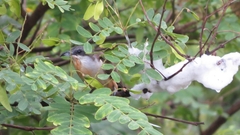
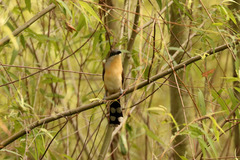
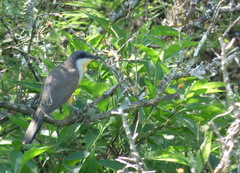
The dark-billed cuckoo is monotypic. The dark-billed cuckoo is 25 to 28 cm (9.8 to 11.0 in) long, about half of which is the tail. Males weigh about 42 to 54 g (1.5 to 1.9 oz) and females about 50 to 66 g (1.8 to 2.3 oz). Males and females have the same plumage. They have a gray crown and nape and grayish brown upperparts. Their wings are a darker grayish brown with no rufous. The upper surface of their tail is brown; the underside of the central pair of feathers is brown with black tips, the next pair blackish with narrow white tips, and the rest black with wide white tips. Their face is gray with a wide black "mask" past the eye, which is surrounded by a narrow ring of citron yellow, olive yellow, or gray bare skin. Their underparts are pale buff with the breast somewhat darker than the rest; the sides... Wikipedia →

Sounds

Call0:08

Brazil · 2025

© JAYRSON ARAUJO DE OLIVEIRA · XC1060004 · CC BY-NC-SA 4.0

Song0:23

Argentina · 2021

© Niels Krabbe · XC687791 · CC BY-NC-SA 4.0

Canto0:16

Brazil · 2017

© Caio Brito · XC427232 · CC BY-NC-SA 4.0

Global Distribution

Parks Where Found

# Park Country Daily sighting probability
1 Galápagos Islands 🇪🇨 Ecuador
~10%
2 Iberá National Park 🇦🇷 Argentina
~10%
3 El Impenetrable National Park 🇦🇷 Argentina
~10%
4 Iguazú National Park 🇦🇷 Argentina
<5%
5 Iguaçu National Park 🇧🇷 Brazil
<5%
6 Amacayacu National Natural Park 🇨🇴 Colombia
<5%
7 Manu National Park 🇵🇪 Peru
<5%
8 Tambopata National Reserve 🇵🇪 Peru
<5%

Cities Where Found

# City Country Daily sighting probability
1 Buenos Aires 🇦🇷 Argentina
<5%
2 Santa Cruz de la Sierra 🇧🇴 Bolivia
<5%
3 Asuncion 🇵🇾 Paraguay
<5%
4 Guayaquil 🇪🇨 Ecuador
<5%
5 Montevideo 🇺🇾 Uruguay
<5%
6 Cordoba 🇦🇷 Argentina
<5%
7 São Paulo 🇧🇷 Brazil
<5%

Before you go

What are the chances of seeing a Dark-billed Cuckoo in Galápagos Islands?

With luck

About 10% of wildlife watchers report a Dark-billed Cuckoo sighting in Galápagos Islands on a given day, based on 1,088 verified sightings from GBIF citizen-science data from 2019 to 2026. It is the 45th most-seen of the 114 birds we can rate there. Over three days the chance rises to about 30%, and over a week to about 60%, if each day is a fresh chance.

When is the best time to see a Dark-billed Cuckoo in Galápagos Islands?

May and July

In those months about 20% of wildlife watchers report a Dark-billed Cuckoo in Galápagos Islands on a given day, against under 5% in December, the lowest month.

What time of day is best to see a Dark-billed Cuckoo?

Between 8 and 11 am

Across all the parks we cover, that three-hour window holds the most Dark-billed Cuckoo sightings with a recorded time, and about 9 in 10 of them come between 6 am and 6 pm: it is a daytime animal.

Is Galápagos Islands the best place to see a Dark-billed Cuckoo?

Yes

Of the 8 parks where we can rate Dark-billed Cuckoo sightings, Galápagos Islands has the highest daily chance: about 10%. Next come Iberá National Park (Argentina, about 10%) and El Impenetrable National Park (Argentina, about 10%).

Where does the Dark-billed Cuckoo sighting chance come from?

GBIF citizen-science records

It is estimated from how often the Dark-billed Cuckoo is recorded against all the birds logged in Galápagos Islands (1,088 verified sightings from 2019 to 2026), calibrated against known sighting rates. Figures are rounded to the nearest 10% because citizen-science data supports honest approximations, not decimals, and months with records from fewer than five people show "—". How it works.

← Back to Galápagos Islands