


Completed



Impala
Aepyceros melampus
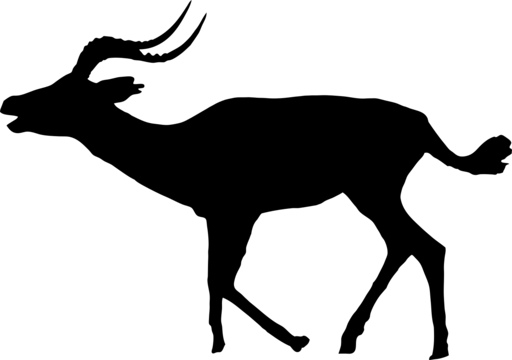
Silhouette: [unknown] · PhyloPic
- KingdomAnimalia (Animals)
- PhylumChordata (Chordates)
- ClassMammalia (Mammals)
- OrderArtiodactyla (Even-toed Ungulates and Cetaceans)
- FamilyBovidae (Bovids)
- GenusAepyceros (Deer-like Antelopes)
- SpeciesAepyceros melampus (Impala)
In 3 days ~80% in a week >90%
14 Verified sightings at Gonarezhou National Park From 2019 to 2026
5,660 In all 34 parks
April Best month
☀️ Diurnal When it's spotted
About the Impala
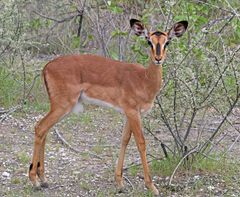
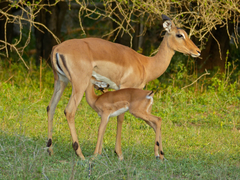
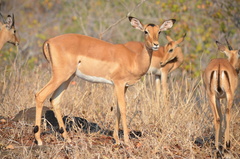
The impala or rooibok (Aepyceros melampus, lit. 'black-footed high-horn' in Ancient Greek) is a medium-sized antelope found in eastern and southern Africa. The only extant member of the genus Aepyceros, and tribe Aepycerotini, it was first described to Europeans by German zoologist Hinrich Lichtenstein in 1812. Two subspecies are recognised—the grassland-dwelling common impala (sometimes referred to as the Kenyan impala), and the larger and darker black-faced impala, which lives in slightly more arid, scrubland environments. The impala reaches 70–92 cm (28–36 in) at the shoulder and weighs 40–65 kg (88–143 lb). It features a glossy, reddish brown coat. The male's slender, lyre-shaped horns are 45–92 cm (18–36 in) long.
Active mainly during the day, the impala may be gregarious or territorial depending upon the climate and geography. Three distinct social groups can be observed: the territorial males, bachelor herds and female herds. The impala is known for two characteristic leaps that constitute an anti-predator strategy. Browsers as well as grazers, impala feed on monocots, dicots, forbs, fruits and acacia pods (whenever available). An annual, three-week-long rut takes place toward the end of the wet season, typically in May. Rutting males fight over dominance, and the victorious male courts females in oestrus. Gestation lasts six to seven months, following which a single calf is born and immediately concealed in cover. Calves are suckled for four to six months; young males—forced out of the all-female groups—join bachelor herds, while females may stay back.
The impala is found in woodlands and sometimes on the interface (ecotone) between woodlands and savannahs; it inhabits places near water. While the black-faced impala is confined to southwestern Angola and Kaokoland in northwestern Namibia, the common impala is widespread across its range and has been reintroduced in Gabon and southern Africa. The International Union for Conservation of Nature (IUCN) classifies the impala as a species of least concern; the black-faced subspecies has been classified as a vulnerable species, with fewer than 1,000 individuals remaining in the wild as of 2008. Wikipedia →
Sounds
Recording1:18
South Africa · 2026
© Sascha Schumann · iNaturalist · CC BY-NC 4.0
Recent sightings of Impala in Gonarezhou National Park
LIVEiNaturalistGlobal Distribution
Parks Where Found
Zoos & Centres Where Found
Closest Relatives at Gonarezhou National Park


Before you go
What are the chances of seeing an Impala in Gonarezhou National Park?
Likely
About 50% of wildlife watchers report an Impala sighting in Gonarezhou National Park on a given day, based on 14 verified sightings from GBIF citizen-science data from 2019 to 2026. It is the 5th most-seen of the 25 mammals we can rate there. Over three days the chance rises to about 80%, and over a week to over 90%, if each day is a fresh chance.
When is the best time to see an Impala in Gonarezhou National Park?
April
In that month about 70% of wildlife watchers report an Impala in Gonarezhou National Park on a given day, against about 10% in January–March and June–July, the lowest months. That is one of Gonarezhou National Park's driest months, with about 30 mm of rain against 150 mm in January.
What time of day is best to see an Impala?
Between 8 and 11 am
Across all the parks we cover, that three-hour window holds the most Impala sightings with a recorded time, and about 9 in 10 of them come between 6 am and 6 pm: it is a daytime animal.
Is Gonarezhou National Park the best place to see an Impala?
30th of 34
Of the 34 parks where we can rate Impala sightings, Gonarezhou National Park ranks 30th at about 50%. The best odds are in Akagera National Park (Rwanda, about 80%), Nairobi National Park (Kenya, about 80%) and Lake Mburo National Park (Uganda, about 80%). All parks ranked.
Which relatives of the Impala live in Gonarezhou National Park?
Same family: Bovidae
The closest relatives of the Impala that you can see in Gonarezhou National Park (family Bovidae, Bovids) are Nyala (about 60%), Waterbuck (about 60%) and Greater Kudu (about 50%), with each one's daily chance of a sighting.
Where does the Impala sighting chance come from?
GBIF citizen-science records
It is estimated from how often the Impala is recorded against all the mammals logged in Gonarezhou National Park (14 verified sightings from 2019 to 2026), calibrated against known sighting rates. Figures are rounded to the nearest 10% because citizen-science data supports honest approximations, not decimals, and months with records from fewer than five people show "—". How it works.
