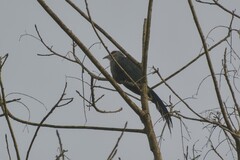
Green-billed Malkoha

Green-billed Malkoha

Rhopodytes tristis

LCLeast ConcernNTVUENCR
Daily sighting probability <5% · Rare
at Gunung Leuser National Park

In 3 days ~10%

6 Verified sightings at Gunung Leuser National Park From 2019 to 2026
5,627 In all 18 parks
December Best month
☀️ Diurnal When it's spotted

About the Green-billed Malkoha

The green-billed malkoha (Phaenicophaeus tristis) is a species of non-parasitic cuckoo found throughout the Indian subcontinent and Southeast Asia. The birds are waxy bluish black with a long graduated tail with white tips to the tail feathers. The bill is prominent and curved. These birds are found in dry scrub and thin forests.

Green-billed malkoha is about 50–60 cm long and weighs 100–128 g. It often has a clear white boarder to the red face patch salty grey on the face and neck. Adult green-billed malkoha has dark grey with green gloss above, oily green wings.

Its breeding habitat is primary forest, second growth, dense thickets, scrub, cultivated areas, rubber plantations across south Asia east from Nepal, India, and Sri Lanka to the Southeast Asia. It mainly lives on insects, but also is known to catch small lizards and small mammals, occasionally catches insects in flight. Wikipedia →

Sounds

Call0:29

Malaysia · 2026

© Kim Chuah Lim · XC1147216 · CC BY-NC-SA 4.0

Song0:28

India · 2013

© Niels Poul Dreyer · XC149782 · CC BY-NC-SA 3.0

Call0:35

China · 2026

© Dave Guo · XC1147150 · CC BY-NC-SA 4.0

Global Distribution

Parks Where Found

# Park Country Daily sighting probability
1 Cat Tien National Park 🇻🇳 Vietnam
~50%
2 Khao Yai National Park 🇹🇭 Thailand
~40%
3 Kaeng Krachan National Park 🇹🇭 Thailand
~40%
4 Kerinci Seblat National Park 🇮🇩 Indonesia
~30%
5 Manas National Park 🇮🇳 India
~20%
6 Kaziranga National Park 🇮🇳 India
~20%
7 Cuc Phuong National Park 🇻🇳 Vietnam
~20%
8 Royal Bardia National Park 🇳🇵 Nepal
~10%
9 Chitwan National Park 🇳🇵 Nepal
~10%
10 Royal Manas National Park 🇧🇹 Bhutan
~10%
11 Doi Inthanon National Park 🇹🇭 Thailand
~10%
12 Sundarbans National Park 🇮🇳 India
~10%
13 Khao Sok National Park 🇹🇭 Thailand
~10%
14 Khao Luang National Park 🇹🇭 Thailand
~10%
15 Namdapha National Park 🇮🇳 India
~10%
16 Jim Corbett National Park 🇮🇳 India
<5%
17 Taman Negara National Park 🇲🇾 Malaysia
<5%
18 Gunung Leuser National Park 🇮🇩 Indonesia
<5%

Cities Where Found

# City Country Daily sighting probability
1 Chattogram 🇧🇩 Bangladesh
~10%
2 Bangkok 🇹🇭 Thailand
~10%
3 Savar 🇧🇩 Bangladesh
~10%
4 Ho Chi Minh City 🇻🇳 Vietnam
<5%
5 Kuala Lumpur 🇲🇾 Malaysia
<5%
6 Guwahati 🇮🇳 India
<5%
7 Dhaka 🇧🇩 Bangladesh
<5%
8 Kathmandu 🇳🇵 Nepal
<5%
9 Phnom Penh 🇰🇭 Cambodia
<5%

Before you go

What are the chances of seeing a Green-billed Malkoha in Gunung Leuser National Park?

Rare

Under 5% of wildlife watchers report a Green-billed Malkoha sighting in Gunung Leuser National Park on a given day, based on 6 verified sightings from GBIF citizen-science data from 2019 to 2026. It is the 149th most-seen of the 166 birds we can rate there. Over three days the chance rises to about 10%, if each day is a fresh chance.

When is the best time to see a Green-billed Malkoha in Gunung Leuser National Park?

August and December

In those months about 10% of wildlife watchers report a Green-billed Malkoha in Gunung Leuser National Park on a given day, against under 5% in January–July and September–November, the lowest months.

What time of day is best to see a Green-billed Malkoha?

Between 7 and 10 am

Across all the parks we cover, that three-hour window holds the most Green-billed Malkoha sightings with a recorded time, and about 9 in 10 of them come between 6 am and 6 pm: it is a daytime animal.

Where does the Green-billed Malkoha sighting chance come from?

GBIF citizen-science records

It is estimated from how often the Green-billed Malkoha is recorded against all the birds logged in Gunung Leuser National Park (6 verified sightings from 2019 to 2026), calibrated against known sighting rates. Figures are rounded to the nearest 10% because citizen-science data supports honest approximations, not decimals, and months with records from fewer than five people show "—". How it works.

← Back to Gunung Leuser National Park