Black Jacobin

Black Jacobin

Florisuga fusca

Silhouette: Edwin Price · PhyloPic

LCLeast ConcernNTVUENCR
Daily sighting probability <5% · Rare
at Iguazú National Park

In 3 days ~10% in a week ~20%

126 Verified sightings at Iguazú National Park From 2019 to 2026
1,324 In all 7 parks
May Best month
☀️ Diurnal When it's spotted

About the Black Jacobin

The black jacobin (Florisuga fusca) is a species of hummingbird in the family Trochilidae. It is found in Argentina, Brazil, Paraguay, and Uruguay. The black jacobin was traditionally placed in the monotypic genus Melanotrochilus, but voice, anatomy, and reproductive behavior place it in Florisuga with the white-necked jacobin. The species is monotypic.

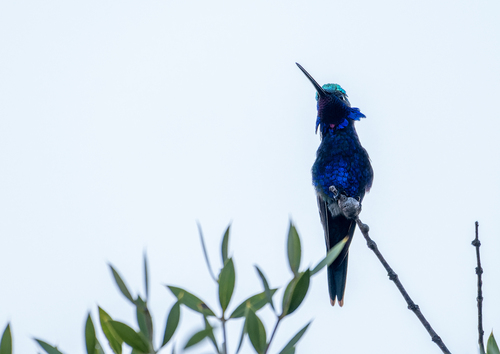
The black jacobin is 12 to 13 cm (4.7 to 5.1 in) long. Males weigh about 9 g (0.32 oz) and females 8 g (0.28 oz). Adults of both sexes are mostly black, with a bronzy-olive lower back and uppertail- and wing-coverts. The flanks are white, the inner rectrices black, and the outer rectrices white with black tips. Juveniles are dark except for a wide cinnamon band on the center and sides of the throat and a white belly and outer rectrices.

The black jacobin is found in southeastern Brazil, approximately from Bahia south through Rio Grande do Sul and into eastern Uruguay, and separately in southeastern Paraguay, northeastern Argentina, and adjoining Brazil. There are also scattered records from sites outside its primary range. It mostly inhabits woodlands, gardens... Wikipedia →

Sounds

Song0:31

Brazil · 2021

© Fernando Igor de Godoy · XC706085 · CC BY-NC-SA 4.0

Canto0:31

Brazil · 2017

© Caio Brito · XC427376 · CC BY-NC-SA 4.0

Call0:18

Brazil · 2015

© Jerome Fischer · XC286384 · CC BY-NC-SA 4.0

Global Distribution

Parks Where Found

# Park Country Daily sighting probability
1 Serra dos Órgãos National Park 🇧🇷 Brazil
~40%
2 Itatiaia National Park 🇧🇷 Brazil
~30%
3 Tijuca National Park 🇧🇷 Brazil
<5%
4 Serra da Canastra National Park 🇧🇷 Brazil
<5%
5 Iguazú National Park 🇦🇷 Argentina
<5%
6 Iguaçu National Park 🇧🇷 Brazil
<5%
7 Iberá National Park 🇦🇷 Argentina
<5%

Cities Where Found

# City Country Daily sighting probability
1 Porto Alegre 🇧🇷 Brazil
~10%
2 Curitiba 🇧🇷 Brazil
<5%
3 Vitória 🇧🇷 Brazil
<5%
4 Rio de Janeiro 🇧🇷 Brazil
<5%
5 Santos 🇧🇷 Brazil
<5%
6 Campo Grande 🇧🇷 Brazil
<5%
7 Belo Horizonte 🇧🇷 Brazil
<5%
8 São Paulo 🇧🇷 Brazil
<5%

Before you go

What are the chances of seeing a Black Jacobin in Iguazú National Park?

Rare

Under 5% of wildlife watchers report a Black Jacobin sighting in Iguazú National Park on a given day, based on 126 verified sightings from GBIF citizen-science data from 2019 to 2026. It is the 203rd most-seen of the 343 birds we can rate there. Over three days the chance rises to about 10%, and over a week to about 20%, if each day is a fresh chance.

When is the best time to see a Black Jacobin in Iguazú National Park?

May to August

In those months about 10% of wildlife watchers report a Black Jacobin in Iguazú National Park on a given day, against under 5% in September to April, the lowest months.

What time of day is best to see a Black Jacobin?

Between 9 am and noon

Across all the parks we cover, that three-hour window holds the most Black Jacobin sightings with a recorded time, and about 9 in 10 of them come between 6 am and 6 pm: it is a daytime animal.

Which relatives of the Black Jacobin live in Iguazú National Park?

Same family: Trochilidae

The closest relatives of the Black Jacobin that you can see in Iguazú National Park (family Trochilidae, Hummingbirds) are Violet-capped Woodnymph (about 20%), Versicolored Emerald (about 20%) and Gilded Hummingbird (about 10%), with each one's daily chance of a sighting.

Where does the Black Jacobin sighting chance come from?

GBIF citizen-science records

It is estimated from how often the Black Jacobin is recorded against all the birds logged in Iguazú National Park (126 verified sightings from 2019 to 2026), calibrated against known sighting rates. Figures are rounded to the nearest 10% because citizen-science data supports honest approximations, not decimals, and months with records from fewer than five people show "—". How it works.

← Back to Iguazú National Park