Black-throated Mango

Black-throated Mango

Anthracothorax nigricollis

Silhouette: Ferran Sayol · PhyloPic

LCLeast ConcernNTVUENCR
Daily sighting probability ~10% · With luck
at Iguazú National Park

In 3 days ~20% in a week ~40%

282 Verified sightings at Iguazú National Park From 2019 to 2026
3,352 In all 27 parks
October Best month
☀️ Diurnal When it's spotted

About the Black-throated Mango

The black-throated mango (Anthracothorax nigricollis) is a species in subfamily Polytminae of the hummingbird family Trochilidae. It is found in Panama, in every mainland South American country except Chile, and in Trinidad and Tobago.

The black-throated mango, like many hummingbirds, bounced among several genera before settling in its present Anthracothorax. Subspecies A. n. iridescens had previously been assigned to the green-breasted mango (A. prevostii).

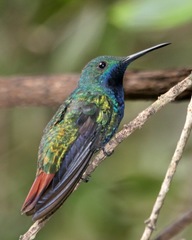
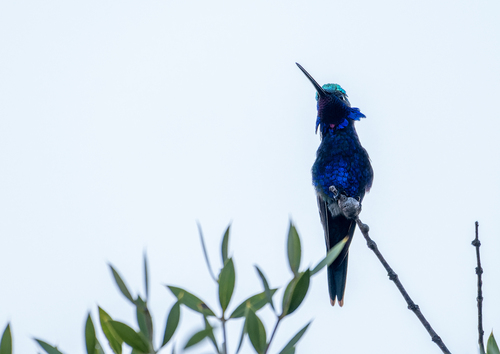
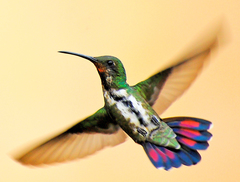
The black-throated mango is 10.2 to 14 cm (4.0 to 5.5 in) long and weighs 6 to 9 g (0.21 to 0.32 oz). Both sexes of both subspecies have a slightly decurved black bill. Adult males of the nominate subspecies have a metallic bronze-green crown, nape, and upperparts. Their innermost pair of tail feathers are dusky bronze green and the outer four pairs are metallic magenta-rufous with dark blue edges and a violet sheen. Their wings are grayish brown. They have a black chin, throat, and middle of the chest with metallic bluish green... Wikipedia →

Sounds

Call0:04

Brazil · 2026

© JAYRSON ARAUJO DE OLIVEIRA · XC1186316 · CC BY-NC-SA 4.0

Song0:14

Ecuador · 2024

© Jonas Nilsson · XC1175925 · CC BY-NC-SA 4.0

Call1:15

Ecuador · 2024

© Manuel Sánchez-Nivicela · XC1036631 · CC BY-NC-ND 4.0

Global Distribution

Parks Where Found

# Park Country Daily sighting probability
1 Main Ridge Forest Reserve 🇹🇹 Trinidad and Tobago
~30%
2 Chapada dos Guimarães National Park 🇧🇷 Brazil
~20%
3 Soberanía National Park 🇵🇦 Panama
~10%
4 Cuyabeno Wildlife Reserve 🇪🇨 Ecuador
~10%
5 Henri Pittier National Park 🇻🇪 Venezuela
~10%
6 Tayrona National Natural Park 🇨🇴 Colombia
~10%
7 Manu National Park 🇵🇪 Peru
~10%
8 Sierra de la Macarena National Park 🇨🇴 Colombia
~10%
9 Iguazú National Park 🇦🇷 Argentina
~10%
10 San Lorenzo Protected Forest 🇵🇦 Panama
~10%
11 Farallones de Cali National Natural Park 🇨🇴 Colombia
~10%
12 Serra dos Órgãos National Park 🇧🇷 Brazil
~10%
13 Yasuní National Park 🇪🇨 Ecuador
<5%
14 Amacayacu National Natural Park 🇨🇴 Colombia
<5%
15 Caroni Swamp 🇹🇹 Trinidad and Tobago
<5%
16 Parque Natural Metropolitano 🇵🇦 Panama
<5%
17 Darién National Park 🇵🇦 Panama
<5%
18 Parque Estadual Encontro das Águas 🇧🇷 Brazil
<5%
19 Tambopata National Reserve 🇵🇪 Peru
<5%
20 Iguaçu National Park 🇧🇷 Brazil
<5%
21 Chapada Diamantina National Park 🇧🇷 Brazil
<5%
22 Machalilla National Park 🇪🇨 Ecuador
<5%
23 Itatiaia National Park 🇧🇷 Brazil
<5%
24 Iberá National Park 🇦🇷 Argentina
<5%
25 Chagres National Park 🇵🇦 Panama
<5%
26 Podocarpus National Park 🇪🇨 Ecuador
<5%
27 Los Nevados National Natural Park 🇨🇴 Colombia
<5%

Cities Where Found

# City Country Daily sighting probability
1 Belém 🇧🇷 Brazil
~60%
2 Medellín 🇨🇴 Colombia
~20%
3 Cali 🇨🇴 Colombia
~20%
4 Caracas 🇻🇪 Venezuela
~10%
5 Campo Grande 🇧🇷 Brazil
~10%
6 Panama City 🇵🇦 Panama
~10%
7 João Pessoa 🇧🇷 Brazil
~10%
8 Valencia 🇻🇪 Venezuela
<5%
9 Curitiba 🇧🇷 Brazil
<5%
10 Guayaquil 🇪🇨 Ecuador
<5%

Zoos & Centres Where Found

# Zoo / Centre Country
1 Parque das Aves 🇧🇷 Brazil In captivity

Before you go

What are the chances of seeing a Black-throated Mango in Iguazú National Park?

With luck

About 10% of wildlife watchers report a Black-throated Mango sighting in Iguazú National Park on a given day, based on 282 verified sightings from GBIF citizen-science data from 2019 to 2026. It is the 161st most-seen of the 343 birds we can rate there. Over three days the chance rises to about 20%, and over a week to about 40%, if each day is a fresh chance.

When is the best time to see a Black-throated Mango in Iguazú National Park?

August and October–April

In those months about 10% of wildlife watchers report a Black-throated Mango in Iguazú National Park on a given day, against under 5% in May–July and September, the lowest months.

What time of day is best to see a Black-throated Mango?

Between 8 and 11 am

Across all the parks we cover, that three-hour window holds the most Black-throated Mango sightings with a recorded time, and about 9 in 10 of them come between 6 am and 6 pm: it is a daytime animal.

Which relatives of the Black-throated Mango live in Iguazú National Park?

Same family: Trochilidae

The closest relatives of the Black-throated Mango that you can see in Iguazú National Park (family Trochilidae, Hummingbirds) are Violet-capped Woodnymph (about 20%), Versicolored Emerald (about 20%) and Gilded Hummingbird (about 10%), with each one's daily chance of a sighting.

Where does the Black-throated Mango sighting chance come from?

GBIF citizen-science records

It is estimated from how often the Black-throated Mango is recorded against all the birds logged in Iguazú National Park (282 verified sightings from 2019 to 2026), calibrated against known sighting rates. Figures are rounded to the nearest 10% because citizen-science data supports honest approximations, not decimals, and months with records from fewer than five people show "—". How it works.

← Back to Iguazú National Park