


Completed


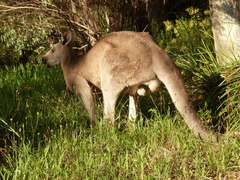

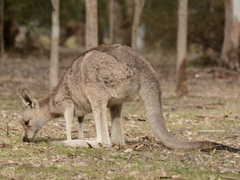

Eastern Grey Kangaroo
Macropus giganteus
Silhouette: Michael Scroggie · PhyloPic
- KingdomAnimalia (Animals)
- PhylumChordata (Chordates)
- ClassMammalia (Mammals)
- OrderDiprotodontia (Kangaroos, Possums, Wombats, and Allies)
- FamilyMacropodidae (Kangaroos, Wallabies and Allies)
- GenusMacropus (Grey Kangaroos)
- SpeciesMacropus giganteus (Eastern Grey Kangaroo)
In 3 days >90%
179 Verified sightings at Kosciuszko National Park From 2019 to 2026
1,623 In all 9 parks
June Best month
☀️ Diurnal When it's spotted



Completed
About the Eastern Grey Kangaroo
The eastern grey kangaroo (Macropus giganteus: gigantic large-foot; also great grey kangaroo or forester kangaroo) is a marsupial found in the eastern third of Australia, with a population of several million. A large M. giganteus kangaroo male can typically weigh up to 69 kg (152 lb) and have a length of well over 2 m (6 ft 7 in).
The eastern grey kangaroo was described by George Shaw in 1790 as Macropus giganteus. While two subspecies were recognised by Mammal Species of the World (MSW), there is some dispute as to the validity of this division, and the subspecies are not recognised by the Australian Mammal Society, the IUCN, or the American Society of Mammalogists, which produces the successor of the MSW. Albert Sherbourne Le Souef created the Tasmanian subspecies in 1923, based on coat colour. Wikipedia →
Sounds
Call0:33
Australia · 2015
© Marc Anderson · XC959812 · CC BY-NC-ND 4.0
Recording0:21
Australia · 2022
© Jo Track · iNaturalist · CC BY-NC 4.0
Recording0:13
Australia · 2025
© dkaysmith · iNaturalist · CC BY-NC 4.0
Recent sightings of Eastern Grey Kangaroo in Kosciuszko National Park
LIVEiNaturalistGlobal Distribution
Parks Where Found
| # | Park | Country | Daily sighting probability |
|---|---|---|---|
| 1 | Grampians National Park | 🇦🇺 Australia | |
| 2 | Booderee National Park | 🇦🇺 Australia | |
| 3 | Maria Island National Park | 🇦🇺 Australia | |
| 4 | Kosciuszko National Park | 🇦🇺 Australia | |
| 5 | Wilsons Promontory National Park | 🇦🇺 Australia | |
| 6 | Great Otway National Park | 🇦🇺 Australia | |
| 7 | Blue Mountains National Park | 🇦🇺 Australia | |
| 8 | Noosa National Park | 🇦🇺 Australia | |
| 9 | Lamington National Park | 🇦🇺 Australia |
Zoos & Centres Where Found
Closest Relatives at Kosciuszko National Park




Before you go
What are the chances of seeing an Eastern Grey Kangaroo in Kosciuszko National Park?
Very likely
About 70% of wildlife watchers report an Eastern Grey Kangaroo sighting in Kosciuszko National Park on a given day, based on 179 verified sightings from GBIF citizen-science data from 2019 to 2026. It is the most-seen of the 11 mammals we can rate there. Over three days the chance rises to over 90%, if each day is a fresh chance.
When is the best time to see an Eastern Grey Kangaroo in Kosciuszko National Park?
June
In that month about 80% of wildlife watchers report an Eastern Grey Kangaroo in Kosciuszko National Park on a given day, against about 50% in May, the lowest month.
What time of day is best to see an Eastern Grey Kangaroo?
Between 3 and 6 pm
Across all the parks we cover, that three-hour window holds the most Eastern Grey Kangaroo sightings with a recorded time, and about 9 in 10 of them come between 6 am and 6 pm: it is a daytime animal.
Is Kosciuszko National Park the best place to see an Eastern Grey Kangaroo?
4th of 9
Of the 9 parks where we can rate Eastern Grey Kangaroo sightings, Kosciuszko National Park ranks 4th at about 70%. The best odds are in Grampians National Park (Australia, about 80%), Booderee National Park (Australia, about 80%) and Maria Island National Park (Australia, about 80%). All parks ranked.
Which relatives of the Eastern Grey Kangaroo live in Kosciuszko National Park?
Same family: Macropodidae
The closest relatives of the Eastern Grey Kangaroo that you can see in Kosciuszko National Park (family Macropodidae, Kangaroos, Wallabies and Allies) are Red-necked Wallaby (about 60%) and Swamp Wallaby (about 40%), with each one's daily chance of a sighting.
Where does the Eastern Grey Kangaroo sighting chance come from?
GBIF citizen-science records
It is estimated from how often the Eastern Grey Kangaroo is recorded against all the mammals logged in Kosciuszko National Park (179 verified sightings from 2019 to 2026), calibrated against known sighting rates. Figures are rounded to the nearest 10% because citizen-science data supports honest approximations, not decimals, and months with records from fewer than five people show "—". How it works.
