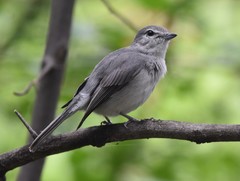
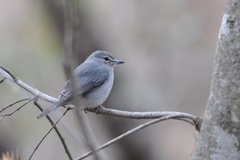
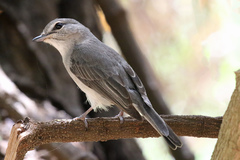
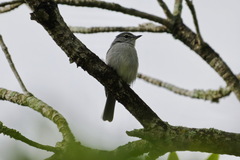
Ashy Alseonax

Ashy Alseonax

Muscicapa caerulescens

Silhouette: Ekytza · PhyloPic

LCLeast ConcernNTVUENCR
Daily sighting probability ~10% · With luck
at Kruger National Park

In 3 days ~30% in a week ~60%

1,039 Verified sightings at Kruger National Park From 2019 to 2026
2,530 In all 31 parks
October Best month
☀️ Diurnal When it's spotted

About the Ashy Alseonax

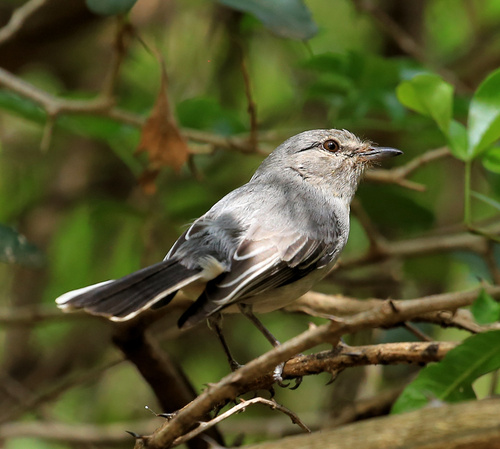
The ashy flycatcher (Fraseria caerulescens) is a species of bird in the Old World flycatcher family Muscicapidae. It is found throughout sub-Saharan Africa, excluding the drier areas of South Africa, Botswana, and Namibia, where it inhabits subtropical or tropical dry forest, subtropical or tropical moist lowland forest, and savanna. It has a disputed generic placement, with different authorities variously putting it in Muscicapa, Fraseria, or other genera. Ashy flycatchers are mostly grey in colour, with pale grey or white underparts, and display no sexual dimorphism.

The species has a small, thin, and pointed beak adapted for eating insects. Its diet is mostly insectivorous, although it also eats berries and small geckoes. The birds are very active, foraging alone, in groups, or in mixed-species flocks. They forage in the upper levels of the canopy, catching prey in flight and from foliage, bark, and leaves. The species breeds in solitary pairs, with each pair maintaining a territory of 1–4 hectares and raising young alone. A variety of vocalisations are used by the species, and there is very little geographical variation in calls.

The ashy flycatcher... Wikipedia →

Sounds

Call0:34

Zambia · 2024

© Dries Van de Loock · XC932710 · CC BY-NC-ND 4.0

Dawn song0:24

South Africa · 2022

© Ehren Eksteen · XC793323 · CC BY-NC-SA 4.0

Song0:41

Ghana · 2022

© Peter Boesman · XC719307 · CC BY-NC-ND 4.0

Global Distribution

Parks Where Found

# Park Country Daily sighting probability
1 Kafue National Park 🇿🇲 Zambia
~20%
2 Lower Zambezi National Park 🇿🇲 Zambia
~20%
3 Nyungwe National Park 🇷🇼 Rwanda
~20%
4 Mana Pools National Park 🇿🇼 Zimbabwe
~20%
5 iSimangaliso Wetland Park 🇿🇦 South Africa
~10%
6 South Luangwa National Park 🇿🇲 Zambia
~10%
7 Kruger National Park 🇿🇦 South Africa
~10%
8 Meru National Park 🇰🇪 Kenya
~10%
9 uMkhuze Game Reserve 🇿🇦 South Africa
~10%
10 Gonarezhou National Park 🇿🇼 Zimbabwe
~10%
11 Semuliki National Park 🇺🇬 Uganda
~10%
12 Gorongosa National Park 🇲🇿 Mozambique
~10%
13 Hluhluwe-Imfolozi Park 🇿🇦 South Africa
~10%
14 Liwonde National Park 🇲🇼 Malawi
~10%
15 Arusha National Park 🇹🇿 Tanzania
~10%
16 Virunga National Park 🇨🇩 Democratic Republic of the Congo
~10%
17 Kibale National Park 🇺🇬 Uganda
<5%
18 Volcanoes National Park 🇷🇼 Rwanda
<5%
19 Ngorongoro Conservation Area 🇹🇿 Tanzania
<5%
20 Ruaha National Park 🇹🇿 Tanzania
<5%
21 Moremi Game Reserve 🇧🇼 Botswana
<5%
22 Lake Manyara National Park 🇹🇿 Tanzania
<5%
23 Lake Mburo National Park 🇺🇬 Uganda
<5%
24 Hwange National Park 🇿🇼 Zimbabwe
<5%
25 Akagera National Park 🇷🇼 Rwanda
<5%
26 Chobe National Park 🇧🇼 Botswana
<5%
27 Bwindi Impenetrable National Park 🇺🇬 Uganda
<5%
28 Tarangire National Park 🇹🇿 Tanzania
<5%
29 Masai Mara National Reserve 🇰🇪 Kenya
<5%
30 Serengeti National Park 🇹🇿 Tanzania
<5%
31 Queen Elizabeth National Park 🇺🇬 Uganda
<5%

Cities Where Found

# City Country Daily sighting probability
1 Harare 🇿🇼 Zimbabwe
<5%
2 Durban 🇿🇦 South Africa
<5%
3 Kampala 🇺🇬 Uganda
<5%

Before you go

What are the chances of seeing an Ashy Alseonax in Kruger National Park?

With luck

About 10% of wildlife watchers report an Ashy Alseonax sighting in Kruger National Park on a given day, based on 1,039 verified sightings from GBIF citizen-science data from 2019 to 2026. It is the 149th most-seen of the 464 birds we can rate there. Over three days the chance rises to about 30%, and over a week to about 60%, if each day is a fresh chance.

When is the best time to see an Ashy Alseonax in Kruger National Park?

June–July and October

In those months about 20% of wildlife watchers report an Ashy Alseonax in Kruger National Park on a given day, against about 10% in August–September and November–May, the lowest months. Those are among Kruger National Park's driest months, with about 15 mm of rain a month against 110 mm in February.

What time of day is best to see an Ashy Alseonax?

Between 8 and 11 am

Across all the parks we cover, that three-hour window holds the most Ashy Alseonax sightings with a recorded time, and about 9 in 10 of them come between 6 am and 6 pm: it is a daytime animal.

Where does the Ashy Alseonax sighting chance come from?

GBIF citizen-science records

It is estimated from how often the Ashy Alseonax is recorded against all the birds logged in Kruger National Park (1,039 verified sightings from 2019 to 2026), calibrated against known sighting rates. Figures are rounded to the nearest 10% because citizen-science data supports honest approximations, not decimals, and months with records from fewer than five people show "—". How it works.

← Back to Kruger National Park