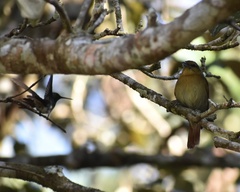
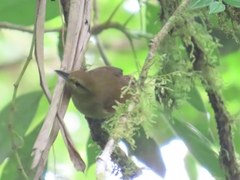

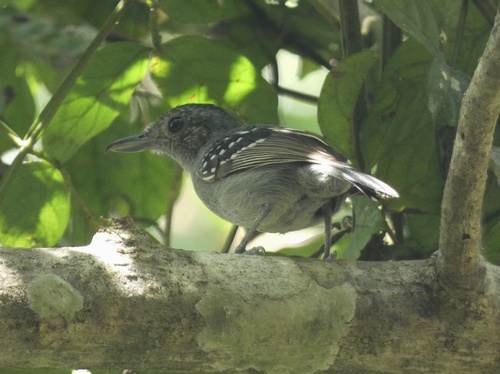
Russet Antshrike

Russet Antshrike

Thamnistes anabatinus

Silhouette: Sheatherius · PhyloPic

LCLeast ConcernNTVUENCR
Daily sighting probability <5% · Rare
at La Amistad International Park (Panama)

In 3 days <5%

31 Verified sightings at La Amistad International Park (Panama) From 2019 to 2026
3,678 In all 19 parks
August Best month
☀️ Diurnal When it's spotted

About the Russet Antshrike

The russet antshrike (Thamnistes anabatinus) is a passerine bird in subfamily Myrmornithinae of family Thamnophilidae, the "typical antbirds". It is found in Mexico, every Central American country except El Salvador, Colombia, Ecuador, Venezuela, and possibly Peru.

The russet antshrike was described by the English ornithologists Philip Sclater and Osbert Salvin in 1860. They erected the genus Thamnistes to accommodate the species and coined the binomial name Thamnistes anabatinus. The specific epithet is from the Ancient Greek anabatēs meaning "climber" or "mounter".

The taxonomy of the russet antshrike is unsettled. The International Ornithological Committee (IOC) and the Clements taxonomy assign it these six subspecies: Wikipedia →

Sounds

Call0:42

Ecuador · 2022

© Manuel Sánchez-Nivicela · XC1141577 · CC BY-NC-ND 4.0

Flight call0:10

Costa Rica · 2017

© Albert Lastukhin · XC1088537 · CC BY-NC-ND 4.0

Song0:37

Ecuador · 2025

© Charlie Vogt · XC1038944 · CC BY-NC-SA 4.0

Global Distribution

Parks Where Found

# Park Country Daily sighting probability
1 Arenal Volcano National Park 🇨🇷 Costa Rica
~10%
2 Tenorio Volcano National Park 🇨🇷 Costa Rica
~10%
3 Braulio Carrillo National Park 🇨🇷 Costa Rica
~10%
4 Corcovado National Park 🇨🇷 Costa Rica
~10%
5 Chagres National Park 🇵🇦 Panama
~10%
6 Darién National Park 🇵🇦 Panama
~10%
7 Carara National Park 🇨🇷 Costa Rica
<5%
8 Tapantí-Macizo de la Muerte National Park 🇨🇷 Costa Rica
<5%
9 Montes Azules Biosphere Reserve 🇲🇽 Mexico
<5%
10 Farallones de Cali National Natural Park 🇨🇴 Colombia
<5%
11 Pico Bonito National Park 🇭🇳 Honduras
<5%
12 Marino Ballena National Park 🇨🇷 Costa Rica
<5%
13 Amacayacu National Natural Park 🇨🇴 Colombia
<5%
14 Piedras Blancas National Park 🇨🇷 Costa Rica
<5%
15 Cahuita National Park 🇨🇷 Costa Rica
<5%
16 Podocarpus National Park 🇪🇨 Ecuador
<5%
17 La Amistad International Park (Panama) 🇵🇦 Panama
<5%
18 Soberanía National Park 🇵🇦 Panama
<5%
19 Monteverde Cloud Forest Reserve 🇨🇷 Costa Rica
<5%

Before you go

What are the chances of seeing a Russet Antshrike in La Amistad International Park (Panama)?

Rare

Under 5% of wildlife watchers report a Russet Antshrike sighting in La Amistad International Park (Panama) on a given day, based on 31 verified sightings from GBIF citizen-science data from 2019 to 2026. It is the 556th most-seen of the 657 birds we can rate there. Over three days the chance rises to under 5%, if each day is a fresh chance.

When is the best time to see a Russet Antshrike in La Amistad International Park (Panama)?

Any time of year

In every month with enough records, under 5% of wildlife watchers report a Russet Antshrike in La Amistad International Park (Panama) on a given day, so our monthly data shows no clear season.

What time of day is best to see a Russet Antshrike?

Between 8 and 11 am

Across all the parks we cover, that three-hour window holds the most Russet Antshrike sightings with a recorded time, and nearly all of them come between 6 am and 6 pm: it is a daytime animal.

Which relatives of the Russet Antshrike live in La Amistad International Park (Panama)?

Same family: Thamnophilidae

The closest relatives of the Russet Antshrike that you can see in La Amistad International Park (Panama) (family Thamnophilidae, Typical Antbirds) are Chestnut-backed Antbird (about 10%), Western Slaty-Antshrike (about 10%) and Dot-winged Antwren (about 10%), with each one's daily chance of a sighting.

Where does the Russet Antshrike sighting chance come from?

GBIF citizen-science records

It is estimated from how often the Russet Antshrike is recorded against all the birds logged in La Amistad International Park (Panama) (31 verified sightings from 2019 to 2026), calibrated against known sighting rates. Figures are rounded to the nearest 10% because citizen-science data supports honest approximations, not decimals, and months with records from fewer than five people show "—". How it works.

← Back to La Amistad International Park (Panama)