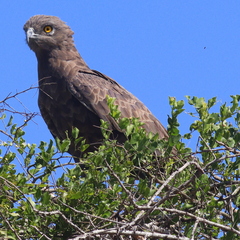
Brown Snake Eagle

Brown Snake Eagle

Circaetus cinereus

Silhouette: Sheatherius · PhyloPic

LCLeast ConcernNTVUENCR
Daily sighting probability ~20% · Possible
at Lower Zambezi National Park

In 3 days ~40% in a week ~70%

46 Verified sightings at Lower Zambezi National Park From 2019 to 2026
7,797 In all 42 parks
April Best month
☀️ Diurnal When it's spotted

About the Brown Snake Eagle

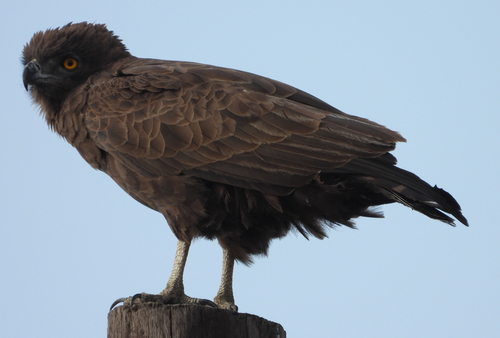
The brown snake eagle (Circaetus cinereus) is a fairly large species of bird of prey in the family Accipitridae. It is found in West, East and southern Africa. This species is an almost obligate predator of a variety of snakes. A very solitary bird, the brown snake eagle has a prolonged breeding cycle and raises a single eaglet. Although probably naturally scarce, it is classified as a least concern species as it continues to occur over a very broad range.

This species is distributed widely in Africa. In west Africa, ranges from southeastern Mauritania, Senegal, The Gambia, Guinea-Bissau, eastern and western Guinea, Sierra Leone, the northern, inland parts of Liberia, Ivory Coast, Ghana, Togo, Benin, Nigeria as well as inland in Mali and Niger. From there they range across to southern Chad, southern Sudan, South Sudan, inland in Eritrea and northern Ethiopia and central Ethiopia and in southern Somalia through much of Kenya, Uganda and the southern part of the Democratic Republic of the Congo down through southern Africa to about half of Namibia, all of Botswana and Zimbabwe and northeastern and eastern South Africa. Although it is not migratory, brown... Wikipedia →
Sounds

Call0:49

Zambia · 2023

© Donovan · XC863207 · CC BY-NC-SA 4.0

Uncertain0:23

Angola · 2021

© Ken Behrens · XC694107 · CC BY-NC-SA 4.0

Global Distribution

Parks Where Found

# Park Country Daily sighting probability
1 Gonarezhou National Park 🇿🇼 Zimbabwe
~30%
2 Tarangire National Park 🇹🇿 Tanzania
~30%
3 Kruger National Park 🇿🇦 South Africa
~30%
4 Niokolo-Koba National Park 🇸🇳 Senegal
~30%
5 Tsavo East National Park 🇰🇪 Kenya
~30%
6 Hwange National Park 🇿🇼 Zimbabwe
~30%
7 Queen Elizabeth National Park 🇺🇬 Uganda
~20%
8 Kidepo Valley National Park 🇺🇬 Uganda
~20%
9 Moremi Game Reserve 🇧🇼 Botswana
~20%
10 South Luangwa National Park 🇿🇲 Zambia
~20%
11 Meru National Park 🇰🇪 Kenya
~20%
12 Ruaha National Park 🇹🇿 Tanzania
~20%
13 Mana Pools National Park 🇿🇼 Zimbabwe
~20%
14 Kafue National Park 🇿🇲 Zambia
~20%
15 Akagera National Park 🇷🇼 Rwanda
~20%
16 Tsavo West National Park 🇰🇪 Kenya
~20%
17 uMkhuze Game Reserve 🇿🇦 South Africa
~20%
18 Hluhluwe-Imfolozi Park 🇿🇦 South Africa
~20%
19 Mkomazi National Park 🇹🇿 Tanzania
~20%
20 Lower Zambezi National Park 🇿🇲 Zambia
~20%
21 iSimangaliso Wetland Park 🇿🇦 South Africa
~20%
22 Murchison Falls National Park 🇺🇬 Uganda
~10%
23 Masai Mara National Reserve 🇰🇪 Kenya
~10%
24 Lake Manyara National Park 🇹🇿 Tanzania
~10%
25 Samburu National Reserve 🇰🇪 Kenya
~10%
26 Lake Mburo National Park 🇺🇬 Uganda
~10%
27 Serengeti National Park 🇹🇿 Tanzania
~10%
28 Liwonde National Park 🇲🇼 Malawi
~10%
29 Mikumi National Park 🇹🇿 Tanzania
~10%
30 Chobe National Park 🇧🇼 Botswana
~10%
31 Kgalagadi Transfrontier Park 🇿🇦 South Africa
~10%
32 Gorongosa National Park 🇲🇿 Mozambique
~10%
33 Ngorongoro Conservation Area 🇹🇿 Tanzania
~10%
34 Addo Elephant National Park 🇿🇦 South Africa
~10%
35 Pilanesberg National Park 🇿🇦 South Africa
~10%
36 Lake Nakuru National Park 🇰🇪 Kenya
<5%
37 Amboseli National Park 🇰🇪 Kenya
<5%
38 Virunga National Park 🇨🇩 Democratic Republic of the Congo
<5%
39 Arusha National Park 🇹🇿 Tanzania
<5%
40 Etosha National Park 🇳🇦 Namibia
<5%
41 Nairobi National Park 🇰🇪 Kenya
<5%
42 Kibale National Park 🇺🇬 Uganda
<5%

Cities Where Found

# City Country Daily sighting probability
1 Kampala 🇺🇬 Uganda
<5%
2 Kigali 🇷🇼 Rwanda
<5%

Zoos & Centres Where Found

# Zoo / Centre Country
1 National Zoological Garden of South Africa 🇿🇦 South Africa In captivity
2 Dullstroom Bird Of Prey & Rehabilitation Centre 🇿🇦 South Africa In captivity

Before you go

What are the chances of seeing a Brown Snake Eagle in Lower Zambezi National Park?

Possible

About 20% of wildlife watchers report a Brown Snake Eagle sighting in Lower Zambezi National Park on a given day, based on 46 verified sightings from GBIF citizen-science data from 2019 to 2026. It is the 115th most-seen of the 241 birds we can rate there. Over three days the chance rises to about 40%, and over a week to about 70%, if each day is a fresh chance.

When is the best time to see a Brown Snake Eagle in Lower Zambezi National Park?

January and April

In those months about 30% of wildlife watchers report a Brown Snake Eagle in Lower Zambezi National Park on a given day, against under 5% in August, the lowest month. Those are among Lower Zambezi National Park's wettest months, with about 170 mm of rain a month against almost none in September. February and March have too few records to rate.

What time of day is best to see a Brown Snake Eagle?

Between 10 am and 1 pm

Across all the parks we cover, that three-hour window holds the most Brown Snake Eagle sightings with a recorded time, and about 9 in 10 of them come between 6 am and 6 pm: it is a daytime animal.

Is Lower Zambezi National Park the best place to see a Brown Snake Eagle?

20th of 42

Of the 42 parks where we can rate Brown Snake Eagle sightings, Lower Zambezi National Park ranks 20th at about 20%. The best odds are in Gonarezhou National Park (Zimbabwe, about 30%), Tarangire National Park (Tanzania, about 30%) and Kruger National Park (South Africa, about 30%).

Which relatives of the Brown Snake Eagle live in Lower Zambezi National Park?

Same genus: Circaetus

The closest relatives of the Brown Snake Eagle that you can see in Lower Zambezi National Park (genus Circaetus, Snake-Eagles) are Banded Snake-Eagle (about 20%) and Black-breasted Snake Eagle (about 10%), with each one's daily chance of a sighting.

Where does the Brown Snake Eagle sighting chance come from?

GBIF citizen-science records

It is estimated from how often the Brown Snake Eagle is recorded against all the birds logged in Lower Zambezi National Park (46 verified sightings from 2019 to 2026), calibrated against known sighting rates. Figures are rounded to the nearest 10% because citizen-science data supports honest approximations, not decimals, and months with records from fewer than five people show "—". How it works.

← Back to Lower Zambezi National Park