Saddle-billed Stork

Saddle-billed Stork

Ephippiorhynchus senegalensis

Silhouette: Mike Keesey (vectorization) and Vaibhavcho (photography) · PhyloPic

LCNTNear ThreatenedVUENCR
Daily sighting probability ~50% · Likely
at Lower Zambezi National Park

In 3 days ~80% in a week >90%

159 Verified sightings at Lower Zambezi National Park From 2019 to 2026
8,707 In all 31 parks
August Best month
☀️ Diurnal When it's spotted

About the Saddle-billed Stork

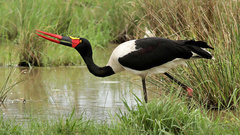
The saddle-billed stork or saddlebill (Ephippiorhynchus senegalensis) is a large wading bird in the stork family, Ciconiidae. It is a widespread species which is a resident breeder in sub-Saharan Africa from Sudan, Ethiopia, and Kenya south to South Africa and in the Gambia, Senegal, Côte d'Ivoire, and Chad in west Africa. It is considered endangered in South Africa.

It is a close relative of the widespread Asian and Australian black-necked stork, the only other member of the genus Ephippiorhynchus. The saddle-billed stork is a huge bird that regularly attains a height of 145 to 150 cm (4 ft 9 in to 4 ft 11 in), a length of 142 cm (4 ft 8 in), and a 2.4 to 2.7 m (7 ft 10 in to 8 ft 10 in) wingspan. While heights published have been in the aforementioned narrow range, reportedly adult saddle-billed storks in captivity can attain a height of up to 150 to 180 cm (4 ft 11 in to 5 ft 11 in). The male is larger and heavier than the female, with a range of 5.1–7.52 kg (11.2–16.6 lb), with a mean mass of 6.38 kg (14.1 lb). The female is usually between 5 and 6.84 kg (11.0 and 15.1 lb), with a mean mass of 5.95 kg (13.1 lb). Among the large storks, the saddle-billed broadly... Wikipedia →

Global Distribution

Parks Where Found

# Park Country Daily sighting probability
1 Gonarezhou National Park 🇿🇼 Zimbabwe
~60%
2 Moremi Game Reserve 🇧🇼 Botswana
~50%
3 South Luangwa National Park 🇿🇲 Zambia
~50%
4 Lower Zambezi National Park 🇿🇲 Zambia
~50%
5 Ruaha National Park 🇹🇿 Tanzania
~40%
6 Murchison Falls National Park 🇺🇬 Uganda
~40%
7 Mana Pools National Park 🇿🇼 Zimbabwe
~40%
8 Kafue National Park 🇿🇲 Zambia
~30%
9 Kruger National Park 🇿🇦 South Africa
~30%
10 Liwonde National Park 🇲🇼 Malawi
~30%
11 Amboseli National Park 🇰🇪 Kenya
~30%
12 Tarangire National Park 🇹🇿 Tanzania
~20%
13 Hwange National Park 🇿🇼 Zimbabwe
~20%
14 Gorongosa National Park 🇲🇿 Mozambique
~20%
15 Arusha National Park 🇹🇿 Tanzania
~20%
16 Masai Mara National Reserve 🇰🇪 Kenya
~20%
17 Mikumi National Park 🇹🇿 Tanzania
~10%
18 Lake Nakuru National Park 🇰🇪 Kenya
~10%
19 Chobe National Park 🇧🇼 Botswana
~10%
20 Queen Elizabeth National Park 🇺🇬 Uganda
~10%
21 Akagera National Park 🇷🇼 Rwanda
~10%
22 iSimangaliso Wetland Park 🇿🇦 South Africa
~10%
23 Virunga National Park 🇨🇩 Democratic Republic of the Congo
~10%
24 Ngorongoro Conservation Area 🇹🇿 Tanzania
~10%
25 Serengeti National Park 🇹🇿 Tanzania
~10%
26 Lake Manyara National Park 🇹🇿 Tanzania
~10%
27 Lake Mburo National Park 🇺🇬 Uganda
~10%
28 Awash National Park 🇪🇹 Ethiopia
<5%
29 Niokolo-Koba National Park 🇸🇳 Senegal
<5%
30 Semuliki National Park 🇺🇬 Uganda
<5%
31 Etosha National Park 🇳🇦 Namibia
<5%

Cities Where Found

# City Country Daily sighting probability
1 Kampala 🇺🇬 Uganda
<5%

Zoos & Centres Where Found

# Zoo / Centre Country
1 Disney's Animal Kingdom 🇺🇸 United States In captivity
2 SeaWorld Orlando 🇺🇸 United States In captivity
3 Busch Gardens Tampa 🇺🇸 United States In captivity
4 San Diego Zoo 🇺🇸 United States In captivity
5 Moscow Zoo 🇷🇺 Russia In captivity
6 Pairi Daiza 🇧🇪 Belgium In captivity
7 Tierpark Berlin 🇩🇪 Germany In captivity
8 Cincinnati Zoo and Botanical Garden 🇺🇸 United States In captivity
9 Dresden Zoo 🇩🇪 Germany In captivity
10 Barcelona Zoo 🇪🇸 Spain In captivity
11 Zlín-Lešná Zoo 🇨🇿 Czechia In captivity
12 Dvůr Králové Zoo 🇨🇿 Czechia In captivity
13 Réserve africaine de Sigean 🇫🇷 France In captivity
14 Parc des oiseaux 🇫🇷 France In captivity
15 San Diego Zoo Safari Park 🇺🇸 United States In captivity
16 Safari West 🇺🇸 United States In captivity
17 Columbus Zoo and Aquarium 🇺🇸 United States In captivity
18 Kansas City Zoo 🇺🇸 United States In captivity
19 Nashville Zoo at Grassmere 🇺🇸 United States In captivity
20 Sedgwick County Zoo 🇺🇸 United States In captivity
21 Dallas Zoo 🇺🇸 United States In captivity
22 The Maryland Zoo 🇺🇸 United States In captivity
23 Parco Natura Viva 🇮🇹 Italy In captivity
24 Saint Louis Zoo 🇺🇸 United States In captivity
25 Franklin Park Zoo 🇺🇸 United States In captivity
26 Night Safari 🇸🇬 Singapore In captivity
27 Fort Worth Zoo 🇺🇸 United States In captivity
28 Singapore Zoo 🇸🇬 Singapore In captivity
29 ABQ BioPark Zoo 🇺🇸 United States In captivity
30 Philadelphia Zoo 🇺🇸 United States In captivity
31 Ouwehands Dierenpark 🇳🇱 Netherlands In captivity
32 Zoo Santo Inácio 🇵🇹 Portugal In captivity
33 Bird Paradise 🇸🇬 Singapore In captivity
34 Aquarama Barcelona 🇪🇸 Spain In captivity
35 Rainforest Wild Asia 🇸🇬 Singapore In captivity
36 Valencia Bioparc 🇪🇸 Spain In captivity
37 Reserva Zoológica Oasys MiniHollywood 🇪🇸 Spain In captivity
38 Vogelpark Avifauna 🇳🇱 Netherlands In captivity
39 Potawatomi Zoo 🇺🇸 United States In captivity
40 Van Blanckendaell Park 🇳🇱 Netherlands In captivity
41 River Wonders 🇸🇬 Singapore In captivity
42 Palmitos Park 🇪🇸 Spain In captivity
43 World of Birds Wildlife Sanctuary and Monkey Park 🇿🇦 South Africa In captivity
44 Vogelpark Heiligenkirchen 🇩🇪 Germany In captivity
45 Zoo de Lourosa 🇵🇹 Portugal In captivity
46 Sobela Ocean Aquarium 🇺🇸 United States In captivity
47 Zooparque Itatiba 🇧🇷 Brazil In captivity

Before you go

What are the chances of seeing a Saddle-billed Stork in Lower Zambezi National Park?

Likely

About 50% of wildlife watchers report a Saddle-billed Stork sighting in Lower Zambezi National Park on a given day, based on 159 verified sightings from GBIF citizen-science data from 2019 to 2026. It is the 37th most-seen of the 241 birds we can rate there. Over three days the chance rises to about 80%, and over a week to over 90%, if each day is a fresh chance.

When is the best time to see a Saddle-billed Stork in Lower Zambezi National Park?

August

In that month about 60% of wildlife watchers report a Saddle-billed Stork in Lower Zambezi National Park on a given day, against about 30% in January, the lowest month. That is one of Lower Zambezi National Park's driest months, with almost no rain against 290 mm in January. February and March have too few records to rate.

What time of day is best to see a Saddle-billed Stork?

Between 8 and 11 am

Across all the parks we cover, that three-hour window holds the most Saddle-billed Stork sightings with a recorded time, and about 9 in 10 of them come between 6 am and 6 pm: it is a daytime animal.

Which relatives of the Saddle-billed Stork live in Lower Zambezi National Park?

Same family: Ciconiidae

The closest relatives of the Saddle-billed Stork that you can see in Lower Zambezi National Park (family Ciconiidae, Storks) are Yellow-billed Stork (about 40%), African Openbilled Stork (about 40%) and Marabou Stork (about 30%), with each one's daily chance of a sighting.

Where does the Saddle-billed Stork sighting chance come from?

GBIF citizen-science records

It is estimated from how often the Saddle-billed Stork is recorded against all the birds logged in Lower Zambezi National Park (159 verified sightings from 2019 to 2026), calibrated against known sighting rates. Figures are rounded to the nearest 10% because citizen-science data supports honest approximations, not decimals, and months with records from fewer than five people show "—". How it works.

← Back to Lower Zambezi National Park
