
Slaty Spinetail

Slaty Spinetail

Synallaxis brachyura

Silhouette: Sheatherius · PhyloPic

LCLeast ConcernNTVUENCR
Daily sighting probability ~10% · With luck
at Machalilla National Park

In 3 days ~20% in a week ~40%

44 Verified sightings at Machalilla National Park From 2019 to 2026
1,574 In all 17 parks
May Best month
☀️ Diurnal When it's spotted

About the Slaty Spinetail

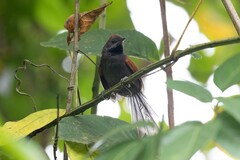
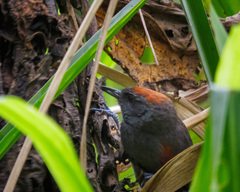
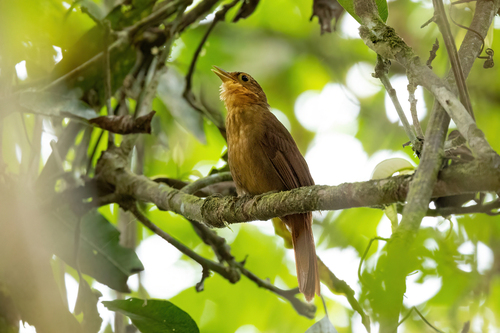
The slaty spinetail or slaty castlebuilder, (Synallaxis brachyura), is a passerine bird in the Furnariinae subfamily of the ovenbird family Furnariidae. It is found from Honduras south to Peru. The slaty spinetail has four subspecies:

The sexes have the same plumage. Adults of the nominate subspecies S. b. brachyura have a grayish supercilium on an otherwise darker gray face. Their crown and nape are deep rufous-chestnut, their back is dark sooty brown to slate-brown, and their rump and uppertail coverts are slightly browner than the back. Their wing coverts and base of their flight feathers are deep rufous-chestnut and the rest of the flight feathers are dark brown. Their tail is the same brown as the rump and uppertail coverts; it is long and the feathers lack barbs at their tips, giving a spiny appearance. Their throat is blackish, their breast and sides dark sooty brown, their belly a paler and grayer brown, and... Wikipedia →

Sounds

Aberrant0:16

Ecuador · 2025

© Charlie Vogt · XC1053463 · CC BY-NC-SA 4.0

Song0:28

Ecuador · 2025

© Marc Anderson · XC1032556 · CC BY-NC-ND 4.0

Alarm call0:07

Colombia · 2022

© Nick Bayly · XC772426 · CC BY-NC-ND 4.0

Global Distribution

Parks Where Found

# Park Country Daily sighting probability
1 Tenorio Volcano National Park 🇨🇷 Costa Rica
~10%
2 Machalilla National Park 🇪🇨 Ecuador
~10%
3 Chirripó National Park 🇨🇷 Costa Rica
<5%
4 La Amistad International Park (Panama) 🇵🇦 Panama
<5%
5 Piedras Blancas National Park 🇨🇷 Costa Rica
<5%
6 Arenal Volcano National Park 🇨🇷 Costa Rica
<5%
7 Darién National Park 🇵🇦 Panama
<5%
8 Gandoca-Manzanillo Wildlife Refuge 🇨🇷 Costa Rica
<5%
9 Tapantí-Macizo de la Muerte National Park 🇨🇷 Costa Rica
<5%
10 Farallones de Cali National Natural Park 🇨🇴 Colombia
<5%
11 Corcovado National Park 🇨🇷 Costa Rica
<5%
12 Braulio Carrillo National Park 🇨🇷 Costa Rica
<5%
13 Tortuguero National Park 🇨🇷 Costa Rica
<5%
14 Volcán Barú National Park 🇵🇦 Panama
<5%
15 Manuel Antonio National Park 🇨🇷 Costa Rica
<5%
16 Los Nevados National Natural Park 🇨🇴 Colombia
<5%
17 Carara National Park 🇨🇷 Costa Rica
<5%

Before you go

What are the chances of seeing a Slaty Spinetail in Machalilla National Park?

With luck

About 10% of wildlife watchers report a Slaty Spinetail sighting in Machalilla National Park on a given day, based on 44 verified sightings from GBIF citizen-science data from 2019 to 2026. It is the 118th most-seen of the 248 birds we can rate there. Over three days the chance rises to about 20%, and over a week to about 40%, if each day is a fresh chance.

When is the best time to see a Slaty Spinetail in Machalilla National Park?

May and December

In those months about 20% of wildlife watchers report a Slaty Spinetail in Machalilla National Park on a given day, against under 5% in January–February, April and July–September, the lowest months.

What time of day is best to see a Slaty Spinetail?

Between 6 and 9 am

Across all the parks we cover, that three-hour window holds the most Slaty Spinetail sightings with a recorded time, and about 9 in 10 of them come between 6 am and 6 pm: it is a daytime animal.

Is Machalilla National Park the best place to see a Slaty Spinetail?

Among the best

Of the 17 parks where we can rate Slaty Spinetail sightings, Machalilla National Park ranks 2nd at about 10%, level with the leaders once rounded. The best odds are in Tenorio Volcano National Park (Costa Rica, about 10%).

Where does the Slaty Spinetail sighting chance come from?

GBIF citizen-science records

It is estimated from how often the Slaty Spinetail is recorded against all the birds logged in Machalilla National Park (44 verified sightings from 2019 to 2026), calibrated against known sighting rates. Figures are rounded to the nearest 10% because citizen-science data supports honest approximations, not decimals, and months with records from fewer than five people show "—". How it works.

← Back to Machalilla National Park