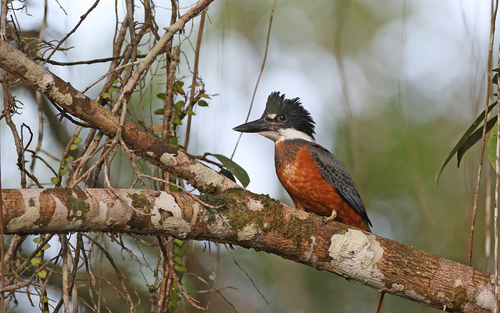
The green-and-rufous kingfisher (Chloroceryle inda) is a species of "water kingfisher" in subfamily Cerylinae of family Alcedinidae. It is found in the American tropics from Nicaragua to Panama and in every mainland South American country except Argentina, Chile, and Uruguay.
The first formal description of the green-and-rufous kingfisher was by the Swedish naturalist Carl Linnaeus in 1766 in the 12th edition of his Systema Naturae. He coined the binomial name Alcedo inda. Linnaeus based his description on George Edwards's "Spotted King's-Fisher" but mistakenly gave the type locality as India occidentali instead of Guiana. Linnaeus's specific epithet inda is from the Latin Indus for India. The current genus Chloroceryle was erected by Johann Jakob Kaup in 1848.
A molecular phylogenetic study published in 2006 found that the green-and-rufous kingfisher is a sister species to the smaller green kingfisher (C. americana). The green-and-rufous kingfisher is about 24 cm (9.4 in) long. Males weigh 40 to 60...