


Completed



Ocelot
Leopardus pardalis
Silhouette: Margot Michaud · PhyloPic
- KingdomAnimalia (Animals)
- PhylumChordata (Chordates)
- ClassMammalia (Mammals)
- OrderCarnivora (Carnivorans)
- FamilyFelidae (Felids)
- GenusLeopardus (American Small Cats)
- SpeciesLeopardus pardalis (Ocelot)
In 3 days ~30% in a week ~60%
14 Verified sightings at Manu National Park From 2019 to 2026
122 In all 12 parks
January Best month
☀️🌙 Day & Night When it's spotted
About the Ocelot
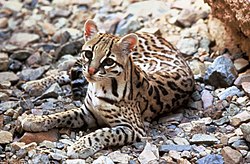
The ocelot (Leopardus pardalis) is a medium-sized spotted wild cat that reaches 40–50 cm (16–20 in) at the shoulders and weighs between 7 and 15.5 kg (15 and 34 lb) on average. It is native to the southwestern United States, Mexico, Central and South America, and the Caribbean islands of Trinidad and Margarita. Carl Linnaeus scientifically described it in 1758. Two subspecies are recognized.
The ocelot is efficient at climbing, leaping and swimming. It prefers areas close to water sources with dense vegetation cover and high prey availability. It preys on small terrestrial mammals, such as armadilloes, opossums, and lagomorphs. It is typically active during twilight and at night and tends to be solitary and territorial. Both sexes become sexually mature at around two years of age and can breed throughout the year; peak mating season varies geographically. After a gestation period of two to three months, the female gives birth to a litter of one to three kittens. They stay with their mother for up to two years, after which they leave to establish their own home ranges.
The ocelot is listed as Least Concern on the IUCN Red List and is threatened by habitat destruction, hunting, and traffic accidents. While its range is very large, various populations are decreasing in many parts of its range. The association of the ocelot with humans dates back to the Aztec and Incan civilizations; it has occasionally been kept as a pet. Wikipedia →
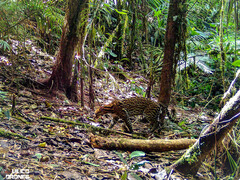
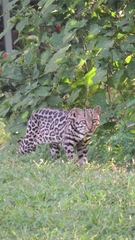
Recent sightings of Ocelot in Manu National Park
LIVEiNaturalistGlobal Distribution
Parks Where Found
| # | Park | Country | Daily sighting probability |
|---|---|---|---|
| 1 | Palo Verde National Park | 🇨🇷 Costa Rica | |
| 2 | Tenorio Volcano National Park | 🇨🇷 Costa Rica | |
| 3 | Tambopata National Reserve | 🇵🇪 Peru | |
| 4 | Manu National Park | 🇵🇪 Peru | |
| 5 | Braulio Carrillo National Park | 🇨🇷 Costa Rica | |
| 6 | Iguazú National Park | 🇦🇷 Argentina | |
| 7 | Yasuní National Park | 🇪🇨 Ecuador | |
| 8 | Carara National Park | 🇨🇷 Costa Rica | |
| 9 | Soberanía National Park | 🇵🇦 Panama | |
| 10 | Arenal Volcano National Park | 🇨🇷 Costa Rica | |
| 11 | Iguaçu National Park | 🇧🇷 Brazil | |
| 12 | Tapantí-Macizo de la Muerte National Park | 🇨🇷 Costa Rica |
Zoos & Centres Where Found
Closest Relatives at Manu National Park


Before you go
What are the chances of seeing an Ocelot in Manu National Park?
With luck
About 10% of wildlife watchers report an Ocelot sighting in Manu National Park on a given day, based on 14 verified sightings from GBIF citizen-science data from 2019 to 2026. It is the 21st most-seen of the 42 mammals we can rate there. Over three days the chance rises to about 30%, and over a week to about 60%, if each day is a fresh chance.
When is the best time to see an Ocelot in Manu National Park?
January
In that month about 30% of wildlife watchers report an Ocelot in Manu National Park on a given day, against under 5% in March–May, September and December, the lowest months.
What time of day is best to see an Ocelot?
Between 6 and 9 pm
Across all the parks we cover, that three-hour window holds the most Ocelot sightings with a recorded time, and about half of them come between 6 pm and 6 am: it is seen both by day and at night.
Is Manu National Park the best place to see an Ocelot?
4th of 12
Of the 12 parks where we can rate Ocelot sightings, Manu National Park ranks 4th at about 10%. The best odds are in Palo Verde National Park (Costa Rica, about 30%), Tenorio Volcano National Park (Costa Rica, about 20%) and Tambopata National Reserve (Peru, about 10%).
Where does the Ocelot sighting chance come from?
GBIF citizen-science records
It is estimated from how often the Ocelot is recorded against all the mammals logged in Manu National Park (14 verified sightings from 2019 to 2026), calibrated against known sighting rates. Figures are rounded to the nearest 10% because citizen-science data supports honest approximations, not decimals, and months with records from fewer than five people show "—". How it works.
