Tody Motmot

Tody Motmot

Hylomanes momotula

Silhouette: Sofía Terán Sánchez · PhyloPic

LCLeast ConcernNTVUENCR
Daily sighting probability <5% · Rare
at Montes Azules Biosphere Reserve

In 3 days ~10% in a week ~30%

12 Verified sightings at Montes Azules Biosphere Reserve From 2019 to 2026
2,021 In all 13 parks
September Best month
☀️ Diurnal When it's spotted

About the Tody Motmot

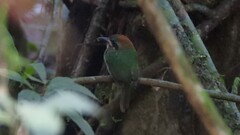
The tody motmot (Hylomanes momotula) is a species of near-passerine bird in the motmot family Momotidae. It is the only species placed in the genus Hylomanes. It is found in Belize, Colombia, Costa Rica, El Salvador, Guatemala, Honduras, Mexico, Nicaragua, and Panama.

The tody motmot is the sole member of its genus. It has three subspecies, the nominate The tody motmot is 16.5 to 18.0 cm (6.5 to 7.1 in) long. Males weigh 27 to 33 g (0.95 to 1.16 oz) and females 25 to 30 g (0.88 to 1.06 oz). It is by far the smallest motmot, and named because it resembles the closely related todies (family Todidae) of the Caribbean. The nominate subspecies has a green crown, a rufous neck, and a green back and rump. It has a blue supercilium and a black mask with a white stripe below it. It has a white throat, a greenish breast with light streaks, and a white belly. The other two subspecies are similar but darker, and M. m. obscurus also has less white on the throat.

The tody motmot ranges from southern... Wikipedia →

Sounds

Song0:09

Guatemala · 2024

© Manuel Grosselet - Josue de Leon · XC931042 · CC BY-NC-SA 4.0

Call0:16

Guatemala · 2024

© Peter Boesman · XC880137 · CC BY-NC-ND 4.0

Song0:08

Costa Rica · 2011

© Andrew Spencer · XC71982 · CC BY-NC-ND 2.5

Global Distribution

Parks Where Found

# Park Country Daily sighting probability
1 El Triunfo 🇲🇽 Mexico
~30%
2 Tenorio Volcano National Park 🇨🇷 Costa Rica
~30%
3 Rincón de la Vieja National Park 🇨🇷 Costa Rica
~20%
4 Tikal National Park 🇬🇹 Guatemala
~10%
5 Darién National Park 🇵🇦 Panama
~10%
6 Cusuco National Park 🇭🇳 Honduras
~10%
7 Cerro Azul Meámbar National Park 🇭🇳 Honduras
~10%
8 Chagres National Park 🇵🇦 Panama
~10%
9 Calakmul Biosphere Reserve 🇲🇽 Mexico
~10%
10 Pico Bonito National Park 🇭🇳 Honduras
~10%
11 Montes Azules Biosphere Reserve 🇲🇽 Mexico
<5%
12 Cockscomb Basin Wildlife Sanctuary 🇧🇿 Belize
<5%
13 Arenal Volcano National Park 🇨🇷 Costa Rica
<5%

Before you go

What are the chances of seeing a Tody Motmot in Montes Azules Biosphere Reserve?

Rare

Under 5% of wildlife watchers report a Tody Motmot sighting in Montes Azules Biosphere Reserve on a given day, based on 12 verified sightings from GBIF citizen-science data from 2019 to 2026. It is the 190th most-seen of the 240 birds we can rate there. Over three days the chance rises to about 10%, and over a week to about 30%, if each day is a fresh chance.

When is the best time to see a Tody Motmot in Montes Azules Biosphere Reserve?

September

In that month about 20% of wildlife watchers report a Tody Motmot in Montes Azules Biosphere Reserve on a given day, against under 5% in January–March, June–August and October, the lowest months. That is one of Montes Azules Biosphere Reserve's wettest months, with about 300 mm of rain against 55 mm in March.

What time of day is best to see a Tody Motmot?

Between 9 am and noon

Across all the parks we cover, that three-hour window holds the most Tody Motmot sightings with a recorded time, and about 9 in 10 of them come between 6 am and 6 pm: it is a daytime animal.

Is Montes Azules Biosphere Reserve the best place to see a Tody Motmot?

11th of 13

Of the 13 parks where we can rate Tody Motmot sightings, Montes Azules Biosphere Reserve ranks 11th at under 5%. The best odds are in El Triunfo (Mexico, about 30%), Tenorio Volcano National Park (Costa Rica, about 30%) and Rincón de la Vieja National Park (Costa Rica, about 20%).

Where does the Tody Motmot sighting chance come from?

GBIF citizen-science records

It is estimated from how often the Tody Motmot is recorded against all the birds logged in Montes Azules Biosphere Reserve (12 verified sightings from 2019 to 2026), calibrated against known sighting rates. Figures are rounded to the nearest 10% because citizen-science data supports honest approximations, not decimals, and months with records from fewer than five people show "—". How it works.

← Back to Montes Azules Biosphere Reserve