Bateleur

Bateleur

Terathopius ecaudatus

Silhouette: Shyamal · PhyloPic

LCNTVUENEndangeredCR
Daily sighting probability ~40% · Likely
at Moremi Game Reserve

In 3 days ~80% in a week >90%

665 Verified sightings at Moremi Game Reserve From 2019 to 2026
19,248 In all 41 parks
December Best month
☀️ Diurnal When it's spotted

About the Bateleur

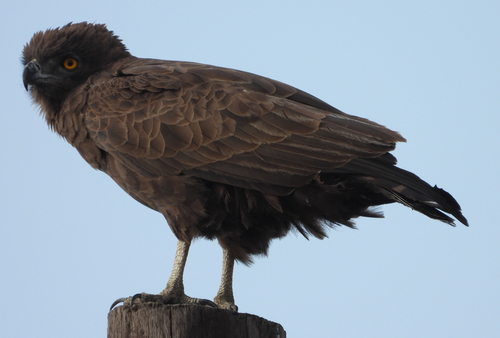
The bateleur (Terathopius ecaudatus), also known as the bateleur eagle, is a medium-sized eagle in the family Accipitridae. It is often considered a relative of the snake eagles and, like them, it is classified within the subfamily Circaetinae. It is the only member of the genus Terathopius and may be the origin of the "Zimbabwe Bird", the national emblem of Zimbabwe. Adult bateleurs are generally black in colour with a chestnut colour on the mantle as well as on the rump and tail. Adults also have gray patches about the leading edges of the wings (extending to the secondaries in females) with bright red on their cere and their feet. Adults also show white greater coverts, contrasting with black remiges in males, gray patches on the underwing primaries and black wingtips. The juvenile bateleur is quite different, being largely drab brown with a bit of paler feather scaling. All bateleurs have extremely large heads for their size, rather small bills, large feet, relatively short legs, long, bow-like wings and uniquely short tails, which are much smaller still on adults compared to juvenile birds.

This species is native to broad areas of Sub-Saharan Africa and scarcely up into Arabia. It is characteristically a bird of somewhat open habitats such as savanna with some trees present and open dry woodland. It is in life history, a rather peculiar bird of prey with a free-wheeling generalist diet that includes much carrion but also tends to hunt a wide range of live prey, including many small to unexpectedly relatively large mammals and reptiles along with generally relatively small birds. Bateleurs are highly aerial birds that spend much time soaring and will frequently fly with exaggerated embellishments, perhaps when excited or angered. They tend to build a relatively small if sturdy stick nest in a large tree and lay only a single egg. Despite being a rather aggressive bird in other contexts, bateleurs are easily flushed from their own nest, making them exceptionally vulnerable to nest predators, including humans, and nest failures. It may take as long as 7 to 8 years to attain full maturity, perhaps the longest stretch to maturity of any raptor. This species has long been known to be declining rather pronouncedly in overall population and it is mostly confined to protected areas today. Currently the IUCN classifies the bateleur as an Endangered species due primarily to anthropogenic causes such as habitat destruction, pesticide usage and persecution. Wikipedia →

Sounds

Begging call0:25

Tanzania · 1995

© Fernand DEROUSSEN · XC132437 · CC BY-NC-ND 3.0

Global Distribution

Parks Where Found

# Park Country Daily sighting probability
1 Ruaha National Park 🇹🇿 Tanzania
~60%
2 Tarangire National Park 🇹🇿 Tanzania
~60%
3 Gonarezhou National Park 🇿🇼 Zimbabwe
~50%
4 Tsavo East National Park 🇰🇪 Kenya
~50%
5 Meru National Park 🇰🇪 Kenya
~50%
6 Kruger National Park 🇿🇦 South Africa
~50%
7 Akagera National Park 🇷🇼 Rwanda
~50%
8 Lower Zambezi National Park 🇿🇲 Zambia
~50%
9 Mana Pools National Park 🇿🇼 Zimbabwe
~50%
10 Kafue National Park 🇿🇲 Zambia
~50%
11 Samburu National Reserve 🇰🇪 Kenya
~50%
12 Mikumi National Park 🇹🇿 Tanzania
~50%
13 Serengeti National Park 🇹🇿 Tanzania
~40%
14 Moremi Game Reserve 🇧🇼 Botswana
~40%
15 Kidepo Valley National Park 🇺🇬 Uganda
~40%
16 uMkhuze Game Reserve 🇿🇦 South Africa
~40%
17 Masai Mara National Reserve 🇰🇪 Kenya
~40%
18 Murchison Falls National Park 🇺🇬 Uganda
~40%
19 Tsavo West National Park 🇰🇪 Kenya
~40%
20 Hwange National Park 🇿🇼 Zimbabwe
~40%
21 Queen Elizabeth National Park 🇺🇬 Uganda
~40%
22 Lake Mburo National Park 🇺🇬 Uganda
~40%
23 Liwonde National Park 🇲🇼 Malawi
~40%
24 Selous Game Reserve 🇹🇿 Tanzania
~30%
25 Gorongosa National Park 🇲🇿 Mozambique
~30%
26 South Luangwa National Park 🇿🇲 Zambia
~30%
27 Niokolo-Koba National Park 🇸🇳 Senegal
~30%
28 Lake Manyara National Park 🇹🇿 Tanzania
~30%
29 Kgalagadi Transfrontier Park 🇿🇦 South Africa
~30%
30 Etosha National Park 🇳🇦 Namibia
~30%
31 Chobe National Park 🇧🇼 Botswana
~20%
32 Ngorongoro Conservation Area 🇹🇿 Tanzania
~20%
33 Awash National Park 🇪🇹 Ethiopia
~20%
34 Hluhluwe-Imfolozi Park 🇿🇦 South Africa
~20%
35 Mkomazi National Park 🇹🇿 Tanzania
~20%
36 Nairobi National Park 🇰🇪 Kenya
~10%
37 Virunga National Park 🇨🇩 Democratic Republic of the Congo
~10%
38 Amboseli National Park 🇰🇪 Kenya
~10%
39 Lake Nakuru National Park 🇰🇪 Kenya
~10%
40 Aberdare National Park 🇰🇪 Kenya
<5%
41 iSimangaliso Wetland Park 🇿🇦 South Africa
<5%

Cities Where Found

# City Country Daily sighting probability
1 Kampala 🇺🇬 Uganda
<5%

Zoos & Centres Where Found

# Zoo / Centre Country
1 Disney's Animal Kingdom 🇺🇸 United States In captivity
2 San Diego Zoo 🇺🇸 United States In captivity
3 Prague Zoo 🇨🇿 Czechia In captivity
4 ZooParc de Beauval 🇫🇷 France In captivity
5 Tierpark Berlin 🇩🇪 Germany In captivity
6 Zoorasia 🇯🇵 Japan In captivity
7 Cabarceno Natural Park 🇪🇸 Spain In captivity
8 Le rocher des aigles 🇫🇷 France In captivity
9 Mohamed bin Zayed Nature Reserve 🇧🇭 Bahrain In captivity
10 World Bird Sanctuary 🇺🇸 United States In captivity
11 Kansas City Zoo 🇺🇸 United States In captivity
12 Safari Madrid 🇪🇸 Spain In captivity
13 Cotswold Wildlife Park 🇬🇧 United Kingdom In captivity
14 Tama Zoological Park 🇯🇵 Japan In captivity
15 Wildgehege Hellenthal 🇩🇪 Germany In captivity
16 Granby Zoo 🇨🇦 Canada In captivity
17 Saint Louis Zoo 🇺🇸 United States In captivity
18 Berlin Zoological Garden 🇩🇪 Germany In captivity
19 Memphis Zoo 🇺🇸 United States In captivity
20 The Green Zoo Wuppertal 🇩🇪 Germany In captivity
21 San Antonio Zoo 🇺🇸 United States In captivity
22 Fresno Chaffee Zoo 🇺🇸 United States In captivity
23 Budapest Zoo & Botanical Garden 🇭🇺 Hungary In captivity
24 Ouwehands Dierenpark 🇳🇱 Netherlands In captivity
25 Ueno Zoo 🇯🇵 Japan In captivity
26 Hawk Conservancy Trust 🇬🇧 United Kingdom In captivity
27 Dullstroom Bird Of Prey & Rehabilitation Centre 🇿🇦 South Africa In captivity
28 Las Águilas Jungle Park 🇪🇸 Spain In captivity
29 Dierenpark Zie-ZOO 🇳🇱 Netherlands In captivity
30 The Raptor Foundation 🇬🇧 United Kingdom In captivity
31 Montecasino Bird Gardens 🇿🇦 South Africa In captivity
32 Adlerwarte Berlebeck 🇩🇪 Germany In captivity
33 Dierenpark De Oliemeulen 🇳🇱 Netherlands In captivity
34 Gauntlet Birds of Prey 🇬🇧 United Kingdom In captivity
35 Greifvogelpark Buchs 🇨🇭 Switzerland In captivity
36 Liberty's Owl, Raptor and Reptile Centre 🇬🇧 United Kingdom In captivity
37 National Aviary 🇺🇸 United States In captivity
38 Suffolk Owl Sanctuary 🇬🇧 United Kingdom In captivity
39 Aquarium Berlin 🇩🇪 Germany In captivity
40 Sobela Ocean Aquarium 🇺🇸 United States In captivity
41 Rákosův pavilon 🇨🇿 Czechia In captivity
42 Velemlokárium 🇨🇿 Czechia In captivity
43 Volerie des aigles 🇫🇷 France In captivity
44 African Bird of Prey Sanctuary 🇿🇦 South Africa In captivity
45 Donjon des aigles 🇫🇷 France In captivity
46 Moholoholo Wildlife Rehabilitation Centre 🇿🇦 South Africa In captivity

Before you go

What are the chances of seeing a Bateleur in Moremi Game Reserve?

Likely

About 40% of wildlife watchers report a Bateleur sighting in Moremi Game Reserve on a given day, based on 665 verified sightings from GBIF citizen-science data from 2019 to 2026. It is the 26th most-seen of the 334 birds we can rate there. Over three days the chance rises to about 80%, and over a week to over 90%, if each day is a fresh chance.

When is the best time to see a Bateleur in Moremi Game Reserve?

December

In that month about 70% of wildlife watchers report a Bateleur in Moremi Game Reserve on a given day, against about 40% in February, May and July–October, the lowest months. That is one of Moremi Game Reserve's wettest months, with about 85 mm of rain against almost none in May.

What time of day is best to see a Bateleur?

Between 7 and 10 am

Across all the parks we cover, that three-hour window holds the most Bateleur sightings with a recorded time, and about 9 in 10 of them come between 6 am and 6 pm: it is a daytime animal.

Which relatives of the Bateleur live in Moremi Game Reserve?

Same family: Accipitridae

The closest relatives of the Bateleur that you can see in Moremi Game Reserve (family Accipitridae, Hawks, Eagles, and Kites) are African Fish-Eagle (about 60%), White-backed Vulture (about 40%) and Black Kite (about 30%), with each one's daily chance of a sighting.

Where does the Bateleur sighting chance come from?

GBIF citizen-science records

It is estimated from how often the Bateleur is recorded against all the birds logged in Moremi Game Reserve (665 verified sightings from 2019 to 2026), calibrated against known sighting rates. Figures are rounded to the nearest 10% because citizen-science data supports honest approximations, not decimals, and months with records from fewer than five people show "—". How it works.

← Back to Moremi Game Reserve