Blue-bearded Bee-eater

Blue-bearded Bee-eater

Nyctyornis athertoni

Silhouette: Sheatherius · PhyloPic

LCLeast ConcernNTVUENCR
Daily sighting probability ~10% · With luck
at Mudumalai National Park

In 3 days ~20% in a week ~50%

81 Verified sightings at Mudumalai National Park From 2019 to 2026
4,081 In all 18 parks
February Best month
🌅 Crepuscular When it's spotted

About the Blue-bearded Bee-eater

The blue-bearded bee-eater (Nyctyornis athertoni) is a species of bee-eater found in much of the Indian subcontinent and parts of Southeast Asia. This bee-eater is found in forest clearings. It is found mainly in the Malayan region but extends west into peninsular India. The blue feathers of its throat are elongated and often fluffed giving it its name. They have a loud call but are not as gregarious or active as the smaller bee-eaters, and their square ended tail lacks the typical "wires" made up of the shafts of the longer central tail feathers found in many other bee-eaters.

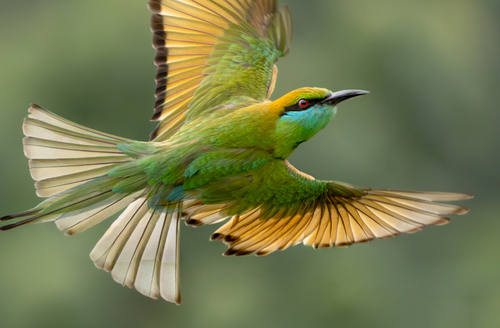
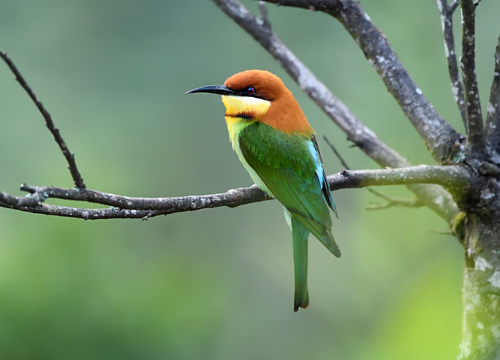
This is probably the largest species of the bee-eater family. Adults measure 31 to 35 cm (12 to 14 in) in length and weigh 70 to 93 g (2.5 to 3.3 oz). This species has a large sickle shaped bill and the square ended tail lacks the "wires" that are typical of smaller bee-eaters. The bird is grass green with a turquoise forehead, face and chin. The feathers of the throat are elongated giving it a bearded appearance when they are fluffed out. The belly is yellowish to olive with streaks of green or blue. The peninsular Indian populations are said to be paler green than the northeast Indian populations... Wikipedia →

Sounds

Call0:12

Vietnam · 2026

© Tim Dinh / Annambirding · XC1185619 · CC BY-NC-SA 4.0

Call0:14

China · 2024

© Bo Shunqi 薄顺奇 · XC963956 · CC BY-NC-SA 4.0

Call0:16

India · 2020

© Mandar Bhagat · XC598923 · CC BY-NC-SA 4.0

Global Distribution

Parks Where Found

# Park Country Daily sighting probability
1 Cat Tien National Park 🇻🇳 Vietnam
~30%
2 Khao Yai National Park 🇹🇭 Thailand
~20%
3 Royal Manas National Park 🇧🇹 Bhutan
~20%
4 Kaziranga National Park 🇮🇳 India
~20%
5 Bandhavgarh National Park 🇮🇳 India
~20%
6 Kaeng Krachan National Park 🇹🇭 Thailand
~20%
7 Manas National Park 🇮🇳 India
~20%
8 Royal Bardia National Park 🇳🇵 Nepal
~20%
9 Jim Corbett National Park 🇮🇳 India
~10%
10 Chitwan National Park 🇳🇵 Nepal
~10%
11 Namdapha National Park 🇮🇳 India
~10%
12 Mudumalai National Park 🇮🇳 India
~10%
13 Bandipur National Park 🇮🇳 India
~10%
14 Nagarhole National Park 🇮🇳 India
<5%
15 Doi Inthanon National Park 🇹🇭 Thailand
<5%
16 Kanha National Park 🇮🇳 India
<5%
17 Periyar National Park 🇮🇳 India
<5%
18 Satpura National Park 🇮🇳 India
<5%

Cities Where Found

# City Country Daily sighting probability
1 Dehradun 🇮🇳 India
<5%
2 Guwahati 🇮🇳 India
<5%
3 Kathmandu 🇳🇵 Nepal
<5%

Before you go

What are the chances of seeing a Blue-bearded Bee-eater in Mudumalai National Park?

With luck

About 10% of wildlife watchers report a Blue-bearded Bee-eater sighting in Mudumalai National Park on a given day, based on 81 verified sightings from GBIF citizen-science data from 2019 to 2026. It is the 134th most-seen of the 233 birds we can rate there. Over three days the chance rises to about 20%, and over a week to about 50%, if each day is a fresh chance.

When is the best time to see a Blue-bearded Bee-eater in Mudumalai National Park?

February and August

In those months about 20% of wildlife watchers report a Blue-bearded Bee-eater in Mudumalai National Park on a given day, against under 5% in March–April, July and November, the lowest months.

What time of day is best to see a Blue-bearded Bee-eater?

Between 7 and 10 am

Across all the parks we cover, that three-hour window holds the most Blue-bearded Bee-eater sightings with a recorded time, and about 6 in 10 of them come between 6 am and 6 pm: it is most active around dawn and dusk.

Is Mudumalai National Park the best place to see a Blue-bearded Bee-eater?

12th of 18

Of the 18 parks where we can rate Blue-bearded Bee-eater sightings, Mudumalai National Park ranks 12th at about 10%. The best odds are in Cat Tien National Park (Vietnam, about 30%), Khao Yai National Park (Thailand, about 20%) and Royal Manas National Park (Bhutan, about 20%).

Where does the Blue-bearded Bee-eater sighting chance come from?

GBIF citizen-science records

It is estimated from how often the Blue-bearded Bee-eater is recorded against all the birds logged in Mudumalai National Park (81 verified sightings from 2019 to 2026), calibrated against known sighting rates. Figures are rounded to the nearest 10% because citizen-science data supports honest approximations, not decimals, and months with records from fewer than five people show "—". How it works.

← Back to Mudumalai National Park