Cape Crombec

Cape Crombec

Sylvietta rufescens

Silhouette: PhyloPic

LCLeast ConcernNTVUENCR
Daily sighting probability ~10% · With luck
at Namib-Naukluft National Park

In 3 days ~20% in a week ~40%

26 Verified sightings at Namib-Naukluft National Park From 2019 to 2026
5,466 In all 22 parks
September Best month
☀️ Diurnal When it's spotted

About the Cape Crombec

The long-billed crombec or Cape crombec (Sylvietta rufescens) is an African warbler. The long-billed crombec breeds in southern Africa from the Democratic Republic of the Congo, Zambia and Tanzania southwards to South Africa.

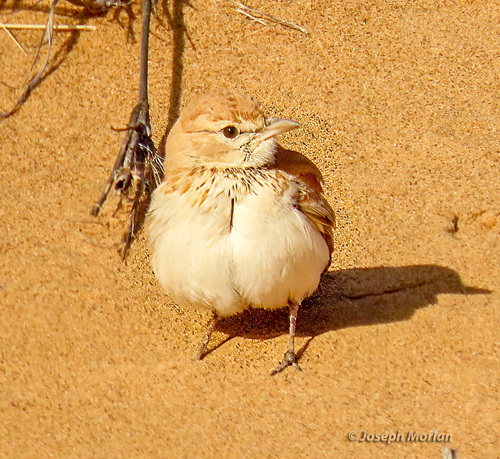
This is a common species in fynbos, open woodland, savannah and dry Acacia scrub. The long-billed crombec is a small, nearly tailless bird 12 cm long and weighing around 16 g. Its upperparts are brownish grey-brown, and there is a pale grey supercilium, separated from the whitish throat by a dark eye stripe. The whitish breast shades into the buff belly. The long slightly curved bill is blackish.

The sexes are similar, and the juvenile resembles the adult. The call is a variable series of trilled notes including trreee-rriiit trreee-rriiit and a harsh pttt. The long-billed crombec's nest is a large, hanging bag of grasses, spider webs, and plant fibres, which is attached to the lower limbs of a tree, often an Acacia. The one to three white eggs are incubated for two weeks to hatching, and the chicks are fed by both parents for another two weeks to fledging. This territorial species is monogamous, pairing for life.

This bird is... Wikipedia →

Sounds

Song0:17

South Africa · 2023

© Marc Anderson · XC880497 · CC BY-NC-ND 4.0

Call0:05

Zambia · 2023

© Dries Van de Loock · XC854375 · CC BY-NC-ND 4.0

Alarm call0:30

South Africa · 1991

© Rick Nuttall · XC779268 · CC BY-NC-SA 4.0

Global Distribution

Parks Where Found

# Park Country Daily sighting probability
1 uMkhuze Game Reserve 🇿🇦 South Africa
~40%
2 Kruger National Park 🇿🇦 South Africa
~30%
3 Gonarezhou National Park 🇿🇼 Zimbabwe
~30%
4 Lower Zambezi National Park 🇿🇲 Zambia
~30%
5 Waterberg Plateau Park 🇳🇦 Namibia
~20%
6 Mana Pools National Park 🇿🇼 Zimbabwe
~20%
7 Kafue National Park 🇿🇲 Zambia
~20%
8 Etosha National Park 🇳🇦 Namibia
~20%
9 Liwonde National Park 🇲🇼 Malawi
~20%
10 West Coast National Park 🇿🇦 South Africa
~20%
11 Pilanesberg National Park 🇿🇦 South Africa
~20%
12 Hluhluwe-Imfolozi Park 🇿🇦 South Africa
~20%
13 Moremi Game Reserve 🇧🇼 Botswana
~10%
14 South Luangwa National Park 🇿🇲 Zambia
~10%
15 Hwange National Park 🇿🇼 Zimbabwe
~10%
16 Gorongosa National Park 🇲🇿 Mozambique
~10%
17 Chobe National Park 🇧🇼 Botswana
~10%
18 Namib-Naukluft National Park 🇳🇦 Namibia
~10%
19 iSimangaliso Wetland Park 🇿🇦 South Africa
<5%
20 De Hoop Nature Reserve 🇿🇦 South Africa
<5%
21 Kgalagadi Transfrontier Park 🇿🇦 South Africa
<5%
22 Addo Elephant National Park 🇿🇦 South Africa
<5%

Cities Where Found

# City Country Daily sighting probability
1 Lusaka 🇿🇲 Zambia
~10%
2 Pretoria 🇿🇦 South Africa
~10%
3 Cape Town 🇿🇦 South Africa
<5%

Before you go

What are the chances of seeing a Cape Crombec in Namib-Naukluft National Park?

With luck

About 10% of wildlife watchers report a Cape Crombec sighting in Namib-Naukluft National Park on a given day, based on 26 verified sightings from GBIF citizen-science data from 2019 to 2026. It is the 53rd most-seen of the 108 birds we can rate there. Over three days the chance rises to about 20%, and over a week to about 40%, if each day is a fresh chance.

When is the best time to see a Cape Crombec in Namib-Naukluft National Park?

April and September

In those months about 20% of wildlife watchers report a Cape Crombec in Namib-Naukluft National Park on a given day, against under 5% in May, July, October and December–March, the lowest months.

What time of day is best to see a Cape Crombec?

Between 7 and 10 am

Across all the parks we cover, that three-hour window holds the most Cape Crombec sightings with a recorded time, and about 9 in 10 of them come between 6 am and 6 pm: it is a daytime animal.

Which relatives of the Cape Crombec live in Namib-Naukluft National Park?

Same order: Passeriformes

The closest relatives of the Cape Crombec that you can see in Namib-Naukluft National Park (order Passeriformes, Perching Birds) are Cape Sparrow (about 80%), Familiar Chat (about 60%) and Pied Crow (about 60%), with each one's daily chance of a sighting.

Where does the Cape Crombec sighting chance come from?

GBIF citizen-science records

It is estimated from how often the Cape Crombec is recorded against all the birds logged in Namib-Naukluft National Park (26 verified sightings from 2019 to 2026), calibrated against known sighting rates. Figures are rounded to the nearest 10% because citizen-science data supports honest approximations, not decimals, and months with records from fewer than five people show "—". How it works.

← Back to Namib-Naukluft National Park