Guayaquil Dwarf Frog

Guayaquil Dwarf Frog

Engystomops pustulosus

Silhouette: Luke Larter, based on photo by Amanda Lea · PhyloPic

LCLeast ConcernNTVUENCR
Daily sighting probability ~30% · Possible
at Palo Verde National Park

In 3 days ~60% in a week ~90%

21 Verified sightings at Palo Verde National Park From 2019 to 2026
514 In all 9 parks
October Best month
🌙 Nocturnal When it's spotted

About the Guayaquil Dwarf Frog

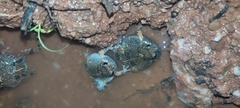
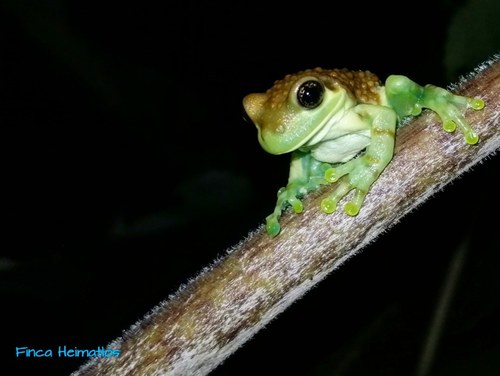
The túngara frog (Engystomops pustulosus) is a species of frog in the family Leptodactylidae. It is a small nocturnal terrestrial frog found in Mexico, Central America, and the northeastern regions of South America. The túngara frog exhibits unique behavior in male/female interactions. Male vocalizations are critical in female mate choice, and females often prefer males who give complex mating calls at a lower frequency rather than simple calls at a higher frequency.

This long distance vocalization is the primary mating behavior of túngara frogs, and it is produced by a fibrous mass in the frog's larynx. The túngara frog may also have a mutualistic relationship with tarantulas, where tarantulas participate in predator defense while frogs protect tarantula eggs. Túngara frogs have distinct coloration which helps defend them from predators.

Engystomops pustulosus is a small species of terrestrial frog growing to a length of between 25 and 35 mm (1.0 and 1.4 in). The tympanum is not visible and the dorsum is covered in small warts. These warts resulted in other early descriptions falsely identifying túngara frogs as a species of toad in the Bufo genus. The eyes are... Wikipedia →

Sounds

Advertisement call0:30

Honduras · 2023

© Enrique Mejía · XC992837 · CC BY-NC-SA 4.0

Advertisement call0:46

Costa Rica · 2023

© Chris Harrison · XC893965 · CC BY-NC-SA 4.0

Recording0:08

El Salvador · 2025

© Adalberto González · iNaturalist · CC BY-NC 4.0

Global Distribution

Parks Where Found

# Park Country Daily sighting probability
1 Tayrona National Natural Park 🇨🇴 Colombia
~50%
2 Piedras Blancas National Park 🇨🇷 Costa Rica
~50%
3 Santa Rosa National Park 🇨🇷 Costa Rica
~40%
4 Soberanía National Park 🇵🇦 Panama
~40%
5 Palo Verde National Park 🇨🇷 Costa Rica
~30%
6 Chagres National Park 🇵🇦 Panama
~30%
7 Corcovado National Park 🇨🇷 Costa Rica
~10%
8 Marino Ballena National Park 🇨🇷 Costa Rica
~10%
9 Parque Natural Metropolitano 🇵🇦 Panama
~10%

Cities Where Found

# City Country Daily sighting probability
1 Valencia 🇻🇪 Venezuela
~30%
2 Managua 🇳🇮 Nicaragua
~10%
3 Panama City 🇵🇦 Panama
~10%
4 Caracas 🇻🇪 Venezuela
~10%

Before you go

What are the chances of seeing a Guayaquil Dwarf Frog in Palo Verde National Park?

Possible

About 30% of wildlife watchers report a Guayaquil Dwarf Frog sighting in Palo Verde National Park on a given day, based on 21 verified sightings from GBIF citizen-science data from 2019 to 2026. It is the 8th most-seen of the 12 amphibians we can rate there. Over three days the chance rises to about 60%, and over a week to about 90%, if each day is a fresh chance.

When is the best time to see a Guayaquil Dwarf Frog in Palo Verde National Park?

June and September–October

In those months about 50% of wildlife watchers report a Guayaquil Dwarf Frog in Palo Verde National Park on a given day, against under 5% in February–April, July and November, the lowest months. Those are among Palo Verde National Park's wettest months, with about 410 mm of rain a month against almost none in February.

What time of day is best to see a Guayaquil Dwarf Frog?

Between 7 and 10 pm

Across all the parks we cover, that three-hour window holds the most Guayaquil Dwarf Frog sightings with a recorded time, and about 7 in 10 of them come between 6 pm and 6 am: it is mostly seen at night.

Which relatives of the Guayaquil Dwarf Frog live in Palo Verde National Park?

Same family: Leptodactylidae

The closest relatives of the Guayaquil Dwarf Frog that you can see in Palo Verde National Park (family Leptodactylidae, Southern Frogs) are Mexican White-lipped Frog (about 20%) and Black Jungle-Frog (about 20%), with each one's daily chance of a sighting.

Where does the Guayaquil Dwarf Frog sighting chance come from?

GBIF citizen-science records

It is estimated from how often the Guayaquil Dwarf Frog is recorded against all the amphibians logged in Palo Verde National Park (21 verified sightings from 2019 to 2026), calibrated against known sighting rates. Figures are rounded to the nearest 10% because citizen-science data supports honest approximations, not decimals, and months with records from fewer than five people show "—". How it works.

← Back to Palo Verde National Park