Striated Thornbill

Striated Thornbill

Acanthiza lineata

Silhouette: Matt Wilkins (photo by Patrick Kavanagh) · PhyloPic

LCLeast ConcernNTVUENCR Endemic
Daily sighting probability <5% · Rare
at Phillip Island Nature Park

In 3 days <5% in a week ~10%

16 Verified sightings at Phillip Island Nature Park From 2019 to 2026
4,821 In all 11 parks
July Best month
☀️ Diurnal When it's spotted

About the Striated Thornbill

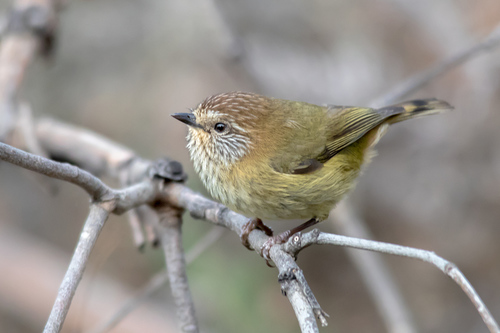
The striated thornbill (Acanthiza lineata) is a species of bird in the family Acanthizidae. It is endemic to Australia, where its natural habitat is subtropical or tropical dry forests. John Gould described the striated thornbill in 1838, giving it the common name of striated acanthiza. Alternative common names include striped-crowned thornbill or tit-warbler, striated tit-warbler or tit, and green thornbill.

The striated thornbill still bears its original name. A 2017 genetic study using both mitochondrial and nuclear DNA found that the ancestor of the striated thornbill diverged from that of the yellow thornbill around 6 million years ago.

Four subspecies are recognised. Acanthiza lineata alberti is found in southeast Queensland and is paler and more yellowish overall than the nominate subspecies. It has a bright orange-brown cap with prominent white streaks, and a yellow-olive back. There is a broad zone of intermediate birds stretching from Tenterfield south to Port Macquarie on the coast and Tamworth inland.

Acanthiza lineata lineata is found across New South Wales and Victoria, with a zone between the Grampians and Warrnambool, and the South Australian border where...
Wikipedia →

Sounds

Call0:30

Australia · 2024

© Romuald Mikusek · XC1173780 · CC BY-NC-SA 4.0

Alarm call0:32

Australia · 2026

© Marc Anderson · XC1084989 · CC BY-NC-ND 4.0

Song0:42

Australia · 2015

© Frank Lambert · XC407724 · CC BY-NC-ND 4.0

Global Distribution

Parks Where Found

# Park Country Daily sighting probability
1 Blue Mountains National Park 🇦🇺 Australia
~40%
2 Flinders Chase 🇦🇺 Australia
~40%
3 Kosciuszko National Park 🇦🇺 Australia
~30%
4 Grampians National Park 🇦🇺 Australia
~30%
5 Great Otway National Park 🇦🇺 Australia
~30%
6 Springbrook National Park 🇦🇺 Australia
~20%
7 Royal National Park 🇦🇺 Australia
~10%
8 Wilsons Promontory National Park 🇦🇺 Australia
~10%
9 Booderee National Park 🇦🇺 Australia
~10%
10 Lamington National Park 🇦🇺 Australia
~10%
11 Phillip Island Nature Park 🇦🇺 Australia
<5%

Cities Where Found

# City Country Daily sighting probability
1 Sydney 🇦🇺 Australia
<5%
2 Melbourne 🇦🇺 Australia
<5%

Before you go

What are the chances of seeing a Striated Thornbill in Phillip Island Nature Park?

Rare

Under 5% of wildlife watchers report a Striated Thornbill sighting in Phillip Island Nature Park on a given day, based on 16 verified sightings from GBIF citizen-science data from 2019 to 2026. It is the 130th most-seen of the 149 birds we can rate there. Over three days the chance rises to under 5%, and over a week to about 10%, if each day is a fresh chance.

When is the best time to see a Striated Thornbill in Phillip Island Nature Park?

Any time of year

In every month with enough records, under 5% of wildlife watchers report a Striated Thornbill in Phillip Island Nature Park on a given day, so our monthly data shows no clear season.

What time of day is best to see a Striated Thornbill?

Between 11 am and 2 pm

Across all the parks we cover, that three-hour window holds the most Striated Thornbill sightings with a recorded time, and about 9 in 10 of them come between 6 am and 6 pm: it is a daytime animal.

Which relatives of the Striated Thornbill live in Phillip Island Nature Park?

Same genus: Acanthiza

The closest relatives of the Striated Thornbill that you can see in Phillip Island Nature Park (genus Acanthiza, Australasian Thornbills) are Brown Thornbill (about 40%) and Yellow-rumped Thornbill (about 10%), with each one's daily chance of a sighting.

Where does the Striated Thornbill sighting chance come from?

GBIF citizen-science records

It is estimated from how often the Striated Thornbill is recorded against all the birds logged in Phillip Island Nature Park (16 verified sightings from 2019 to 2026), calibrated against known sighting rates. Figures are rounded to the nearest 10% because citizen-science data supports honest approximations, not decimals, and months with records from fewer than five people show "—". How it works.

← Back to Phillip Island Nature Park