Red Wattlebird

Red Wattlebird

Anthochaera carunculata

Silhouette: James Klarevas · PhyloPic

LCLeast ConcernNTVUENCR Endemic
Daily sighting probability ~70% · Very likely
at Phillip Island Nature Park

In 3 days >90%

1,382 Verified sightings at Phillip Island Nature Park From 2019 to 2026
11,961 In all 12 parks
May Best month
☀️ Diurnal When it's spotted

About the Red Wattlebird

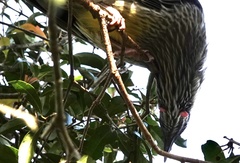
The red wattlebird (Anthochaera carunculata) is a passerine bird native to southern Australia. At 33–37 cm (13–14+1⁄2 in) in length, it is the second largest species of Australian honeyeater, after the yellow wattlebird. It has mainly grey-brown plumage, with red eyes, distinctive pinkish-red wattles on either side of the neck, white streaks on the chest and a large bright yellow patch on the lower belly. The sexes are similar in plumage. Juveniles have less prominent wattles and browner eyes. John White described the red wattlebird in 1790. Three subspecies are recognized.

The species is found in southeast Queensland, New South Wales, Victoria, South Australia and southwest Western Australia in open forest and woodland, and is a common visitor to urban gardens and parks. Loud and conspicuous, the red wattlebird is generally found in trees, where it gets most of its food; occasionally it forages on the ground. It is one of the largest nectarivorous birds in the world, feeding from a wide variety of flowering plants. Insects also comprise part of its diet. It is territorial and at times aggressive towards birds of other species, often defending rich sources of nectar. Breeding throughout its range, the red wattlebird builds a cup-shaped nest in a tree and raises one or two broods a year. Although it has declined in places from land-clearing, it is classified as Least Concern on the IUCN Red List.

Wikipedia →

Sounds

Call0:07

Australia · 2023

© Romuald Mikusek · XC1163878 · CC BY-NC-SA 4.0

Alarm call0:17

Australia · 2021

© Marc Anderson · XC816084 · CC BY-NC-ND 4.0

Begging call0:18

Australia · 2022

© Toby Esplin · XC729319 · CC BY-NC-ND 4.0

Global Distribution

Parks Where Found

# Park Country Daily sighting probability
1 Grampians National Park 🇦🇺 Australia
~70%
2 Great Otway National Park 🇦🇺 Australia
~70%
3 Wilsons Promontory National Park 🇦🇺 Australia
~70%
4 Phillip Island Nature Park 🇦🇺 Australia
~70%
5 Blue Mountains National Park 🇦🇺 Australia
~60%
6 Flinders Chase 🇦🇺 Australia
~60%
7 Kosciuszko National Park 🇦🇺 Australia
~50%
8 Booderee National Park 🇦🇺 Australia
~50%
9 Royal National Park 🇦🇺 Australia
~30%
10 Hattah-Kulkyne National Park 🇦🇺 Australia
~30%
11 Flinders Ranges National Park 🇦🇺 Australia
~10%
12 Rottnest Island 🇦🇺 Australia
~10%

Cities Where Found

# City Country Daily sighting probability
1 Perth 🇦🇺 Australia
~90%
2 Melbourne 🇦🇺 Australia
~70%
3 Sydney 🇦🇺 Australia
~30%
4 Brisbane 🇦🇺 Australia
<5%

Before you go

What are the chances of seeing a Red Wattlebird in Phillip Island Nature Park?

Very likely

About 70% of wildlife watchers report a Red Wattlebird sighting in Phillip Island Nature Park on a given day, based on 1,382 verified sightings from GBIF citizen-science data from 2019 to 2026. It is the 9th most-seen of the 149 birds we can rate there. Over three days the chance rises to over 90%, if each day is a fresh chance.

When is the best time to see a Red Wattlebird in Phillip Island Nature Park?

January and March–June

In those months about 70% of wildlife watchers report a Red Wattlebird in Phillip Island Nature Park on a given day, against about 60% in February and July–December, the lowest months.

What time of day is best to see a Red Wattlebird?

Between noon and 3 pm

Across all the parks we cover, that three-hour window holds the most Red Wattlebird sightings with a recorded time, and nearly all of them come between 6 am and 6 pm: it is a daytime animal.

Where does the Red Wattlebird sighting chance come from?

GBIF citizen-science records

It is estimated from how often the Red Wattlebird is recorded against all the birds logged in Phillip Island Nature Park (1,382 verified sightings from 2019 to 2026), calibrated against known sighting rates. Figures are rounded to the nearest 10% because citizen-science data supports honest approximations, not decimals, and months with records from fewer than five people show "—". How it works.

← Back to Phillip Island Nature Park