Striped Owl

Striped Owl

Pseudoscops clamator

Silhouette: Ferran Sayol · PhyloPic

LCLeast ConcernNTVUENCR
Daily sighting probability <5% · Rare
at Piedras Blancas National Park

In 3 days <5% in a week ~10%

29 Verified sightings at Piedras Blancas National Park From 2019 to 2026
223 In all 14 parks
May Best month
☀️🌙 Day & Night When it's spotted

About the Striped Owl

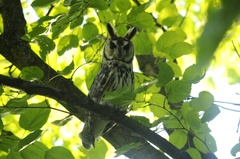
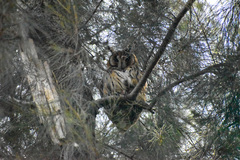
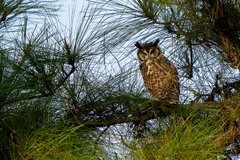
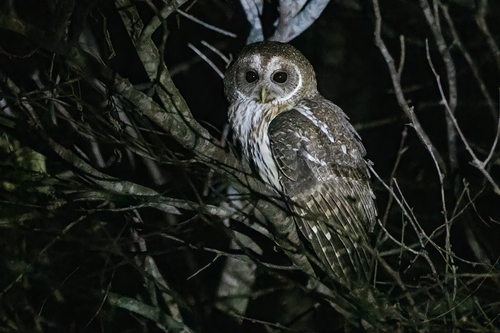
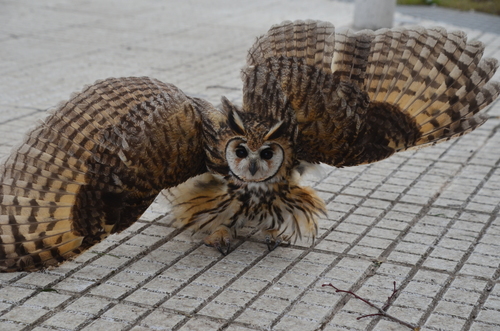
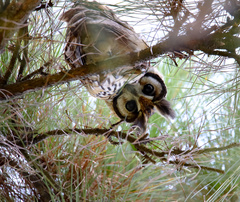
The striped owl (Asio clamator) is a medium-sized owl with large ear tufts and a brownish-white facial disk rimmed with black. Its beak is black, and it has cinnamon-colored eyes. It has shorter, rounder wings than most of its close relatives. The upperparts are cinnamon with fine black vermiculation and heavy stripes. The underparts are pale tawny with dusky streaks. It is native to South America and parts of Central America.

The striped owl was formally described by the French ornithologist Louis Pierre Vieillot in 1808 under the binomial name Bubo clamator. The specific epithet clamator is Latin meaning "shouter". The type locality is Cayenne in French Guiana. The striped owl was at one time placed in its own genus Rhinoptynx and was then transferred to the genus Pseudoscops. A molecular study that compared mitochondrial DNA sequences indicated that it should be placed in the genus Asio. This result was confirmed by a large molecular phylogenetic study of the owls published in 2019.

The striped owl is a relatively large species with prominent tufts of elongated feathers on the crown resembling ears. It is 30–38 cm (12–15 in) long and weighs from... Wikipedia →

Sounds

Alarm call0:11

Brazil · 2020

© JAYRSON ARAUJO DE OLIVEIRA · XC1154638 · CC BY-NC-SA 4.0

Begging call0:56

Brazil · 2025

© Gabriel CAUCANAS · XC1040539 · CC BY-NC-SA 4.0

Call1:23

Brazil · 2024

© Ricardo José Mitidieri · XC934127 · CC BY-NC-SA 4.0

Global Distribution

Parks Where Found

# Park Country Daily sighting probability
1 Serra dos Órgãos National Park 🇧🇷 Brazil
<5%
2 Henri Pittier National Park 🇻🇪 Venezuela
<5%
3 Cerro Azul Meámbar National Park 🇭🇳 Honduras
<5%
4 Piedras Blancas National Park 🇨🇷 Costa Rica
<5%
5 Amacayacu National Natural Park 🇨🇴 Colombia
<5%
6 Manu National Park 🇵🇪 Peru
<5%
7 Yasuní National Park 🇪🇨 Ecuador
<5%
8 Iberá National Park 🇦🇷 Argentina
<5%
9 Tenorio Volcano National Park 🇨🇷 Costa Rica
<5%
10 Arenal Volcano National Park 🇨🇷 Costa Rica
<5%
11 Tambopata National Reserve 🇵🇪 Peru
<5%
12 Iguazú National Park 🇦🇷 Argentina
<5%
13 La Amistad International Park (Panama) 🇵🇦 Panama
<5%
14 Carara National Park 🇨🇷 Costa Rica
<5%

Cities Where Found

# City Country Daily sighting probability
1 Bogota 🇨🇴 Colombia
<5%
2 Curitiba 🇧🇷 Brazil
<5%
3 São Paulo 🇧🇷 Brazil
<5%
4 Buenos Aires 🇦🇷 Argentina
<5%
5 Medellín 🇨🇴 Colombia
<5%
6 Santa Cruz de la Sierra 🇧🇴 Bolivia
<5%
7 Asuncion 🇵🇾 Paraguay
<5%
8 Porto Alegre 🇧🇷 Brazil
<5%
9 Panama City 🇵🇦 Panama
<5%
10 Campo Grande 🇧🇷 Brazil
<5%

Zoos & Centres Where Found

# Zoo / Centre Country
1 Parque das Aves 🇧🇷 Brazil In captivity
2 Zoological Garden of Belo Horizonte 🇧🇷 Brazil In captivity
3 Auto Safari Chapin 🇬🇹 Guatemala In captivity
4 São Paulo Zoo 🇧🇷 Brazil In captivity
5 Parque Municipal Summit 🇵🇦 Panama In captivity
6 Ukumarí Biopark 🇨🇴 Colombia In captivity
7 Zoológico de Goiânia 🇧🇷 Brazil In captivity
8 Parque Zoobotânico Arruda Câmara (BICA) 🇧🇷 Brazil In captivity
9 Zoológico Dois Irmãos 🇧🇷 Brazil In captivity
10 Ecopark 🇦🇷 Argentina In captivity
11 Municipal Zoological Park Quinzinho de Barros 🇧🇷 Brazil In captivity
12 Parque Ecológico de São Carlos 🇧🇷 Brazil In captivity
13 Amaru 🇪🇨 Ecuador In captivity
14 Complejo Turistico de Quistococha 🇵🇪 Peru In captivity
15 Bosque dos Jequitibás 🇧🇷 Brazil In captivity
16 La Paz Waterfall Gardens 🇨🇷 Costa Rica In captivity
17 Aviario Nacional de Colombia 🇨🇴 Colombia In captivity
18 Bioparque Los Ocarros 🇨🇴 Colombia In captivity
19 Reserva de Fauna y Flora Pan de Azúcar 🇺🇾 Uruguay In captivity
20 Zoológico Municipal de Guarulhos 🇧🇷 Brazil In captivity
21 Zoo Park da Montanha 🇧🇷 Brazil In captivity
22 Parque de la Conservación 🇨🇴 Colombia In captivity
23 Les Aigles du Léman 🇫🇷 France In captivity
24 Parque Zoológico Miguel Ángel de Quevedo 🇲🇽 Mexico In captivity
25 Santacruz zoo 🇨🇴 Colombia In captivity
26 Macaw mountain bird park 🇭🇳 Honduras In captivity
27 Ecozoológico San Martín 🇪🇨 Ecuador In captivity
28 Granja los Pibes 🇦🇷 Argentina In captivity
29 Aquarium of Veracruz 🇲🇽 Mexico In captivity
30 Parque dos Falcões 🇧🇷 Brazil In captivity
31 Belo Horizonte Aquarium 🇧🇷 Brazil In captivity
32 Cali Zoo 🇨🇴 Colombia In captivity
33 GüiráOga 🇦🇷 Argentina In captivity
34 National Zoo of Nicaragua 🇳🇮 Nicaragua In captivity
35 Zoológico Miguél Álvarez del Toro 🇲🇽 Mexico In captivity
36 Zooparque Itatiba 🇧🇷 Brazil In captivity

Before you go

What are the chances of seeing a Striped Owl in Piedras Blancas National Park?

Rare

Under 5% of wildlife watchers report a Striped Owl sighting in Piedras Blancas National Park on a given day, based on 29 verified sightings from GBIF citizen-science data from 2019 to 2026. It is the 277th most-seen of the 344 birds we can rate there. Over three days the chance rises to under 5%, and over a week to about 10%, if each day is a fresh chance.

When is the best time to see a Striped Owl in Piedras Blancas National Park?

Any time of year

In every month with enough records, under 5% of wildlife watchers report a Striped Owl in Piedras Blancas National Park on a given day, so our monthly data shows no clear season.

What time of day is best to see a Striped Owl?

Between 6 and 9 pm

Across all the parks we cover, that three-hour window holds the most Striped Owl sightings with a recorded time, and about 6 in 10 of them come between 6 am and 6 pm: it is seen both by day and at night.

Where does the Striped Owl sighting chance come from?

GBIF citizen-science records

It is estimated from how often the Striped Owl is recorded against all the birds logged in Piedras Blancas National Park (29 verified sightings from 2019 to 2026), calibrated against known sighting rates. Figures are rounded to the nearest 10% because citizen-science data supports honest approximations, not decimals, and months with records from fewer than five people show "—". How it works.
← Back to Piedras Blancas National Park