White-rumped Sandpiper

White-rumped Sandpiper

Calidris fuscicollis

Silhouette: Edwin Price · PhyloPic

LCNTVUVulnerableENCR
Daily sighting probability <5% · Rare
at Point Pelee National Park

In 3 days <5%

33 Verified sightings at Point Pelee National Park From 2019 to 2026
600 In all 21 parks
November Best month
☀️ Diurnal When it's spotted

About the White-rumped Sandpiper

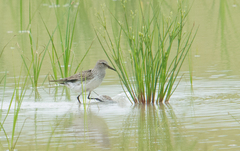
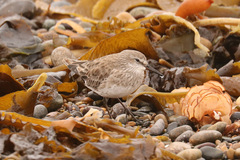
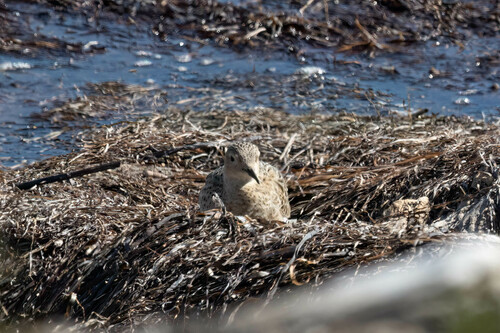
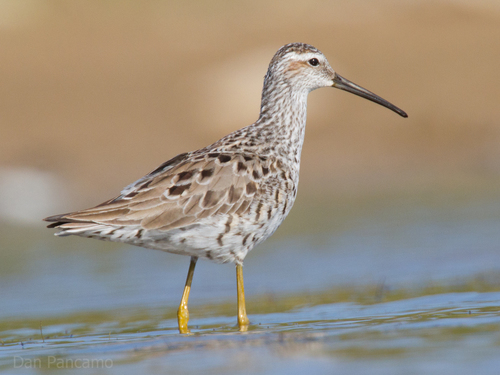
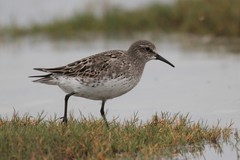
The white-rumped sandpiper (Calidris fuscicollis) is a small migratory shorebird that breeds in the northern tundra of Canada and Alaska. This bird can be difficult to distinguish from other similar tiny shorebirds; these are known collectively as "peeps" or "stints". In flight, it is more easily picked out by its namesake white rump.

The white-rumped sandpiper is a relatively small bird measuring only 15–18 cm (5.9–7.1 in), with a wingspan of 36–38 cm (14–15 in). The top of its body is a dull grey-brown colour and it has a white eye stripe. Its beak is of medium length, thin and dark, and its legs are very dark. This bird is often mistaken with many similar-looking sandpipers that live in its range or along its migration path.

The plumage is much less distinct during the winter; however, during all seasons males and females remain similar in their appearance. In adult breeding plumage, the crown and face have a brownish tinge. The supercilium is pale, there are black feathers on the back and there are grey edges on the wing coverts. The breast and flanks are streaked and the underparts are white. In adult winter plumage, the upperparts are a dark grey and at the... Wikipedia →

Sounds

Call0:30

Brazil · 2024

© JAYRSON ARAUJO DE OLIVEIRA · XC940082 · CC BY-NC-SA 4.0

Flight call0:05

France · 2019

© Stanislas Wroza · XC526459 · CC BY-NC-SA 4.0

Alarm call0:08

Argentina

© Bernabe Lopez-Lanus · XC48612 · CC BY-NC-SA 3.0

Global Distribution

Parks Where Found

# Park Country Daily sighting probability
1 Península Valdés 🇦🇷 Argentina
~10%
2 Caroni Swamp 🇹🇹 Trinidad and Tobago
~10%
3 Isla del Coco National Park 🇨🇷 Costa Rica
<5%
4 El Impenetrable National Park 🇦🇷 Argentina
<5%
5 Ría Lagartos Biosphere Reserve 🇲🇽 Mexico
<5%
6 Celestún Biosphere Reserve 🇲🇽 Mexico
<5%
7 Gros Morne National Park 🇨🇦 Canada
<5%
8 Tierra del Fuego National Park 🇦🇷 Argentina
<5%
9 Arrecifes de Cozumel National Park 🇲🇽 Mexico
<5%
10 Padre Island National Seashore 🇺🇸 United States
<5%
11 Amacayacu National Natural Park 🇨🇴 Colombia
<5%
12 Iberá National Park 🇦🇷 Argentina
<5%
13 Acadia National Park 🇺🇸 United States
<5%
14 Bastimentos Island National Marine Park 🇵🇦 Panama
<5%
15 Tortuguero National Park 🇨🇷 Costa Rica
<5%
16 Parque Estadual Encontro das Águas 🇧🇷 Brazil
<5%
17 La Amistad International Park (Panama) 🇵🇦 Panama
<5%
18 Sian Ka'an Biosphere Reserve 🇲🇽 Mexico
<5%
19 Point Pelee National Park 🇨🇦 Canada
<5%
20 Everglades National Park 🇺🇸 United States
<5%
21 Merritt Island National Wildlife Refuge 🇺🇸 United States
<5%

Cities Where Found

# City Country Daily sighting probability
1 Santa Cruz de la Sierra 🇧🇴 Bolivia
<5%
2 Montevideo 🇺🇾 Uruguay
<5%
3 Panama City 🇵🇦 Panama
<5%
4 Rio de Janeiro 🇧🇷 Brazil
<5%
5 Santos 🇧🇷 Brazil
<5%
6 Havana 🇨🇺 Cuba
<5%
7 Asuncion 🇵🇾 Paraguay
<5%
8 Boston 🇺🇸 United States
<5%
9 New York City 🇺🇸 United States
<5%
10 Caracas 🇻🇪 Venezuela
<5%

Zoos & Centres Where Found

# Zoo / Centre Country
1 National Zoological Park 🇺🇸 United States In captivity

Before you go

What are the chances of seeing a White-rumped Sandpiper in Point Pelee National Park?

Rare

Under 5% of wildlife watchers report a White-rumped Sandpiper sighting in Point Pelee National Park on a given day, based on 33 verified sightings from GBIF citizen-science data from 2019 to 2026. It is the 246th most-seen of the 278 birds we can rate there. Over three days the chance rises to under 5%, if each day is a fresh chance.

When is the best time to see a White-rumped Sandpiper in Point Pelee National Park?

Any time of year

In every month with enough records, under 5% of wildlife watchers report a White-rumped Sandpiper in Point Pelee National Park on a given day, so our monthly data shows no clear season.

What time of day is best to see a White-rumped Sandpiper?

Between 10 am and 1 pm

Across all the parks we cover, that three-hour window holds the most White-rumped Sandpiper sightings with a recorded time, and about 9 in 10 of them come between 6 am and 6 pm: it is a daytime animal.

Is Point Pelee National Park the best place to see a White-rumped Sandpiper?

19th of 21

Of the 21 parks where we can rate White-rumped Sandpiper sightings, Point Pelee National Park ranks 19th at under 5%. The best odds are in Península Valdés (Argentina, about 10%), Caroni Swamp (Trinidad and Tobago, about 10%) and Isla del Coco National Park (Costa Rica, under 5%).

Which relatives of the White-rumped Sandpiper live in Point Pelee National Park?

Same genus: Calidris

The closest relatives of the White-rumped Sandpiper that you can see in Point Pelee National Park (genus Calidris, Calidris Sandpipers) are Dunlin (about 20%) and Sanderling (about 10%), with each one's daily chance of a sighting.

Where does the White-rumped Sandpiper sighting chance come from?

GBIF citizen-science records

It is estimated from how often the White-rumped Sandpiper is recorded against all the birds logged in Point Pelee National Park (33 verified sightings from 2019 to 2026), calibrated against known sighting rates. Figures are rounded to the nearest 10% because citizen-science data supports honest approximations, not decimals, and months with records from fewer than five people show "—". How it works.

← Back to Point Pelee National Park