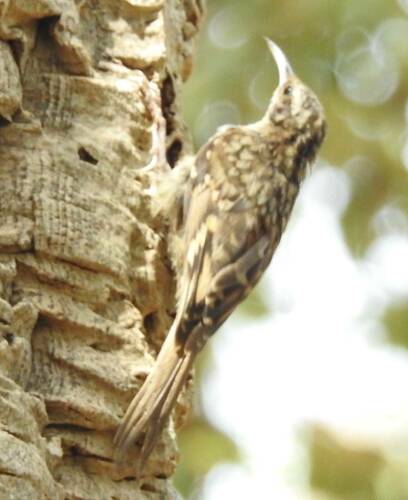
Short-toed Treecreeper

Short-toed Treecreeper

Certhia brachydactyla

Silhouette: א (Aleph) · PhyloPic

LCLeast ConcernNTVUENCR
Daily sighting probability ~30% · Possible
at Pyrénées National Park

In 3 days ~60% in a week ~90%

754 Verified sightings at Pyrénées National Park From 2019 to 2026
6,593 In all 19 parks
March Best month
☀️ Diurnal When it's spotted

About the Short-toed Treecreeper

The short-toed treecreeper (Certhia brachydactyla) is a small passerine bird found in woodlands through much of the warmer regions of Europe and into north Africa. It has a generally more southerly distribution than the other European treecreeper species, the common treecreeper, with which it is easily confused where they both occur. The short-toed treecreeper tends to prefer deciduous trees and lower altitudes than its relative in these overlap areas. Although mainly sedentary, vagrants have occurred outside the breeding range.

The short-toed treecreeper is one of a group of four very similar Holarctic treecreepers, including the closely related North American brown creepers, and has five subspecies differing in appearance and song. Like other treecreepers, the short-toed is inconspicuously plumaged brown above and whitish below, and has a curved bill and stiff tail feathers. It is a resident in woodlands throughout its range, and nests in tree crevices or behind bark flakes, laying about six eggs. This common, unwary, but inconspicuous species feeds mainly on insects which are picked from the tree trunk as the treecreeper ascends with short hops.

The short-toed treecreeper... Wikipedia →
Sounds

Call0:47

Spain · 2026

© Esperanza Poveda · XC1158162 · CC BY-NC-SA 4.0

Song0:04

Poland · 2026

© Romuald Mikusek · XC1104923 · CC BY-NC-SA 4.0

Begging call0:34

France · 2025

© Thierry THOMAS · XC1010976 · CC BY-NC-SA 4.0

Global Distribution

Parks Where Found

# Park Country Daily sighting probability
1 Sierra de Guadarrama National Park 🇪🇸 Spain
~50%
2 Monfragüe National Park 🇪🇸 Spain
~30%
3 Cévennes National Park 🇫🇷 France
~30%
4 Pyrénées National Park 🇫🇷 France
~30%
5 Aigüestortes National Park 🇪🇸 Spain
~20%
6 Ordesa y Monte Perdido National Park 🇪🇸 Spain
~20%
7 Sierra Nevada National Park 🇪🇸 Spain
~20%
8 Picos de Europa National Park 🇪🇸 Spain
~20%
9 Doñana National Park 🇪🇸 Spain
~20%
10 Kiskunság National Park 🇭🇺 Hungary
~10%
11 Bavarian Forest National Park 🇩🇪 Germany
~10%
12 Ecrins National Park 🇫🇷 France
~10%
13 Triglav National Park 🇸🇮 Slovenia
~10%
14 Fertő-Hanság National Park 🇭🇺 Hungary
~10%
15 Plitvice Lakes National Park 🇭🇷 Croatia
~10%
16 Mercantour National Park 🇫🇷 France
<5%
17 Wadden Sea National Park 🇩🇪 Germany
<5%
18 Tatra National Park 🇸🇰 Slovakia
<5%
19 Camargue 🇫🇷 France
<5%

Cities Where Found

# City Country Daily sighting probability
1 Turin 🇮🇹 Italy
~50%
2 Paris 🇫🇷 France
~40%
3 Madrid 🇪🇸 Spain
~40%
4 Berlin 🇩🇪 Germany
~40%
5 Cologne 🇩🇪 Germany
~40%
6 Lisbon 🇵🇹 Portugal
~40%
7 Brussels 🇧🇪 Belgium
~40%
8 Lyon 🇫🇷 France
~30%
9 Munich 🇩🇪 Germany
~30%
10 Rome 🇮🇹 Italy
~30%

Before you go

What are the chances of seeing a Short-toed Treecreeper in Pyrénées National Park?

Possible

About 30% of wildlife watchers report a Short-toed Treecreeper sighting in Pyrénées National Park on a given day, based on 754 verified sightings from GBIF citizen-science data from 2019 to 2026. It is the 29th most-seen of the 174 birds we can rate there. Over three days the chance rises to about 60%, and over a week to about 90%, if each day is a fresh chance.

When is the best time to see a Short-toed Treecreeper in Pyrénées National Park?

March and November–December

In those months about 40% of wildlife watchers report a Short-toed Treecreeper in Pyrénées National Park on a given day, against about 20% in April and July–September, the lowest months.

What time of day is best to see a Short-toed Treecreeper?

Between 10 am and 1 pm

Across all the parks we cover, that three-hour window holds the most Short-toed Treecreeper sightings with a recorded time, and about 8 in 10 of them come between 6 am and 6 pm: it is a daytime animal.

Where does the Short-toed Treecreeper sighting chance come from?

GBIF citizen-science records

It is estimated from how often the Short-toed Treecreeper is recorded against all the birds logged in Pyrénées National Park (754 verified sightings from 2019 to 2026), calibrated against known sighting rates. Figures are rounded to the nearest 10% because citizen-science data supports honest approximations, not decimals, and months with records from fewer than five people show "—". How it works.

← Back to Pyrénées National Park