





Completed

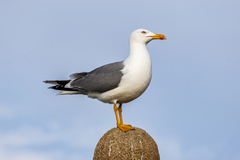


Yellow-legged Gull
Larus michahellis
Silhouette: Sharon Wegner-Larsen · PhyloPic
- KingdomAnimalia (Animals)
- PhylumChordata (Chordates)
- ClassAves (Birds)
- OrderCharadriiformes (Shorebirds and Allies)
- FamilyLaridae (Gulls, Terns, and Skimmers)
- GenusLarus (Large White-headed Gulls)
- SpeciesLarus michahellis (Yellow-legged Gull)
In 3 days ~10%
72 Verified sightings at Pyrénées National Park From 2019 to 2026
3,809 In all 12 parks
March Best month
☀️ Diurnal When it's spotted
About the Yellow-legged Gull
The yellow-legged gull or western yellow-legged gull (Larus michahellis) is a large gull found in Europe, the Middle East and North Africa, which has only recently achieved wide recognition as a distinct species. It was formerly treated as a subspecies of either the Caspian gull L. cachinnans, or more broadly as a subspecies of the herring gull L. argentatus.
The genus name is from Latin Larus which appears to have referred to a gull or other large seabird, and the species name honours the German zoologist Karl Michahelles. It is now generally accepted that the yellow-legged gull is a full species, but until recently there was much disagreement. For example, British Birds magazine split the yellow-legged gull from the herring gull in 1993 but included the Caspian gull in the former, but the BOU in Great Britain retained the yellow-legged gull as a subspecies of the herring gull until 2007. DNA research, however, suggests that the yellow-legged gull is actually closest to the great black-backed gull L. marinus and the Armenian gull L. armenicus, while the Caspian gull is closer to the herring gull and the lesser black-backed gull L. fuscus, rather than being each... Wikipedia →
Recent sightings of Yellow-legged Gull in Pyrénées National Park
LIVEiNaturalistGlobal Distribution
Parks Where Found
| # | Park | Country | Daily sighting probability |
|---|---|---|---|
| 1 | Camargue | 🇫🇷 France | |
| 2 | Doñana National Park | 🇪🇸 Spain | |
| 3 | Fertő-Hanság National Park | 🇭🇺 Hungary | |
| 4 | Hortobágy National Park | 🇭🇺 Hungary | |
| 5 | Bavarian Forest National Park | 🇩🇪 Germany | |
| 6 | Triglav National Park | 🇸🇮 Slovenia | |
| 7 | Kiskunság National Park | 🇭🇺 Hungary | |
| 8 | Cévennes National Park | 🇫🇷 France | |
| 9 | Sierra de Guadarrama National Park | 🇪🇸 Spain | |
| 10 | Pyrénées National Park | 🇫🇷 France | |
| 11 | Wadden Sea National Park | 🇩🇪 Germany | |
| 12 | Monfragüe National Park | 🇪🇸 Spain |
Closest Relatives at Pyrénées National Park





Before you go
What are the chances of seeing a Yellow-legged Gull in Pyrénées National Park?
Rare
Under 5% of wildlife watchers report a Yellow-legged Gull sighting in Pyrénées National Park on a given day, based on 72 verified sightings from GBIF citizen-science data from 2019 to 2026. It is the 106th most-seen of the 174 birds we can rate there. Over three days the chance rises to about 10%, if each day is a fresh chance.
When is the best time to see a Yellow-legged Gull in Pyrénées National Park?
March
In that month about 10% of wildlife watchers report a Yellow-legged Gull in Pyrénées National Park on a given day, against under 5% in April to February, the lowest months.
What time of day is best to see a Yellow-legged Gull?
Between 8 and 11 am
Across all the parks we cover, that three-hour window holds the most Yellow-legged Gull sightings with a recorded time, and about 8 in 10 of them come between 6 am and 6 pm: it is a daytime animal.
Is Pyrénées National Park the best place to see a Yellow-legged Gull?
10th of 12
Of the 12 parks where we can rate Yellow-legged Gull sightings, Pyrénées National Park ranks 10th at under 5%. The best odds are in Camargue (France, about 70%), Doñana National Park (Spain, about 30%) and Fertő-Hanság National Park (Hungary, about 30%). All parks ranked.
Where does the Yellow-legged Gull sighting chance come from?
GBIF citizen-science records
It is estimated from how often the Yellow-legged Gull is recorded against all the birds logged in Pyrénées National Park (72 verified sightings from 2019 to 2026), calibrated against known sighting rates. Figures are rounded to the nearest 10% because citizen-science data supports honest approximations, not decimals, and months with records from fewer than five people show "—". How it works.
