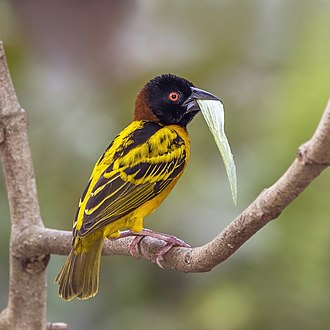
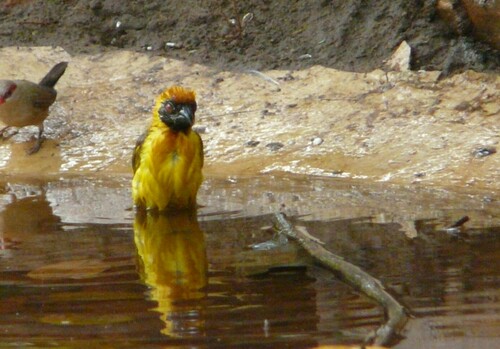
Red-headed Weaver

Red-headed Weaver

Anaplectes rubriceps

Silhouette: Sheatherius · PhyloPic

LCLeast ConcernNTVUENCR
Daily sighting probability <5% · Rare
at Queen Elizabeth National Park

In 3 days <5% in a week ~10%

15 Verified sightings at Queen Elizabeth National Park From 2019 to 2026
3,324 In all 34 parks
September Best month
☀️ Diurnal When it's spotted

About the Red-headed Weaver

The red-headed weaver (Anaplectes rubriceps) is a species of bird in the family Ploceidae. It is placed in the monotypic genus Anaplectes and is found throughout the Afrotropics. The red-headed weaver (Anaplectes rubriceps) is a bird commonly found in eastern and southern Africa in countries such as Zambia, Zimbabwe and most of Mozambique and Botswana. They frequent savanna biomes as well as bushland and other wooded areas. At this time the species trend is stable and the population is concentrated and not fragmented into different regions.

The red-headed weaver is typically found with a white belly and brown wings. The northern male red-headed weavers commonly have a distinct red head that sticks out to the females of the species. The northern females have a more brown head that doesn't stick out as much, while the southern females are found with yellow heads and yellow accents on their wings. All red-headed weavers are found with a moderately long and pointed beak and short strong claws. A typical red-headed weaver flock tends to usually have one male who stays with a pack of eight or nine females. Their nest is usually made of dry sticks that they have collected... Wikipedia →

Sounds

Song0:42

Zimbabwe · 2024

© Dries Van de Loock · XC962987 · CC BY-NC-ND 4.0

Call0:23

Kenya · 2024

© Peter Boesman · XC947901 · CC BY-NC-ND 4.0

Call0:14

Kenya · 2020

© isaac kilusu · XC599196 · CC BY-NC-SA 4.0

Global Distribution

Parks Where Found

# Park Country Daily sighting probability
1 Gonarezhou National Park 🇿🇼 Zimbabwe
~30%
2 Ruaha National Park 🇹🇿 Tanzania
~30%
3 Meru National Park 🇰🇪 Kenya
~20%
4 Kidepo Valley National Park 🇺🇬 Uganda
~20%
5 Liwonde National Park 🇲🇼 Malawi
~20%
6 Lake Mburo National Park 🇺🇬 Uganda
~20%
7 Lower Zambezi National Park 🇿🇲 Zambia
~20%
8 Mkomazi National Park 🇹🇿 Tanzania
~20%
9 Akagera National Park 🇷🇼 Rwanda
~20%
10 Mikumi National Park 🇹🇿 Tanzania
~20%
11 Mana Pools National Park 🇿🇼 Zimbabwe
~20%
12 Kruger National Park 🇿🇦 South Africa
~10%
13 Hwange National Park 🇿🇼 Zimbabwe
~10%
14 Samburu National Reserve 🇰🇪 Kenya
~10%
15 Tarangire National Park 🇹🇿 Tanzania
~10%
16 Lake Nakuru National Park 🇰🇪 Kenya
~10%
17 Serengeti National Park 🇹🇿 Tanzania
~10%
18 Arusha National Park 🇹🇿 Tanzania
~10%
19 Gorongosa National Park 🇲🇿 Mozambique
~10%
20 Tsavo West National Park 🇰🇪 Kenya
~10%
21 Moremi Game Reserve 🇧🇼 Botswana
~10%
22 Lake Manyara National Park 🇹🇿 Tanzania
~10%
23 Murchison Falls National Park 🇺🇬 Uganda
~10%
24 Masai Mara National Reserve 🇰🇪 Kenya
~10%
25 Chobe National Park 🇧🇼 Botswana
<5%
26 South Luangwa National Park 🇿🇲 Zambia
<5%
27 Pilanesberg National Park 🇿🇦 South Africa
<5%
28 Ngorongoro Conservation Area 🇹🇿 Tanzania
<5%
29 Etosha National Park 🇳🇦 Namibia
<5%
30 Nairobi National Park 🇰🇪 Kenya
<5%
31 Kafue National Park 🇿🇲 Zambia
<5%
32 Aberdare National Park 🇰🇪 Kenya
<5%
33 Queen Elizabeth National Park 🇺🇬 Uganda
<5%
34 Amboseli National Park 🇰🇪 Kenya
<5%

Cities Where Found

# City Country Daily sighting probability
1 Harare 🇿🇼 Zimbabwe
<5%
2 Kigali 🇷🇼 Rwanda
<5%
3 Kampala 🇺🇬 Uganda
<5%

Zoos & Centres Where Found

# Zoo / Centre Country
1 Hong Kong Zoological and Botanical Gardens 🇨🇳 China In captivity
2 Edward Youde Aviary 🇭🇰 Hong Kong SAR China In captivity

Before you go

What are the chances of seeing a Red-headed Weaver in Queen Elizabeth National Park?

Rare

Under 5% of wildlife watchers report a Red-headed Weaver sighting in Queen Elizabeth National Park on a given day, based on 15 verified sightings from GBIF citizen-science data from 2019 to 2026. It is the 338th most-seen of the 434 birds we can rate there. Over three days the chance rises to under 5%, and over a week to about 10%, if each day is a fresh chance.

When is the best time to see a Red-headed Weaver in Queen Elizabeth National Park?

Any time of year

In every month with enough records, under 5% of wildlife watchers report a Red-headed Weaver in Queen Elizabeth National Park on a given day, so our monthly data shows no clear season.

What time of day is best to see a Red-headed Weaver?

Between 9 am and noon

Across all the parks we cover, that three-hour window holds the most Red-headed Weaver sightings with a recorded time, and about 9 in 10 of them come between 6 am and 6 pm: it is a daytime animal.

Is Queen Elizabeth National Park the best place to see a Red-headed Weaver?

33rd of 34

Of the 34 parks where we can rate Red-headed Weaver sightings, Queen Elizabeth National Park ranks 33rd at under 5%. The best odds are in Gonarezhou National Park (Zimbabwe, about 30%), Ruaha National Park (Tanzania, about 30%) and Meru National Park (Kenya, about 20%).

Which relatives of the Red-headed Weaver live in Queen Elizabeth National Park?

Same family: Ploceidae

The closest relatives of the Red-headed Weaver that you can see in Queen Elizabeth National Park (family Ploceidae, Weavers and Allies) are Black-headed Weaver (about 40%), Village Weaver (about 40%) and Red-billed Quelea (about 30%), with each one's daily chance of a sighting.

Where does the Red-headed Weaver sighting chance come from?

GBIF citizen-science records

It is estimated from how often the Red-headed Weaver is recorded against all the birds logged in Queen Elizabeth National Park (15 verified sightings from 2019 to 2026), calibrated against known sighting rates. Figures are rounded to the nearest 10% because citizen-science data supports honest approximations, not decimals, and months with records from fewer than five people show "—". How it works.

← Back to Queen Elizabeth National Park