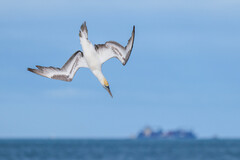
Australasian Gannet

Australasian Gannet

Morus serrator

Silhouette: Ferran Sayol · PhyloPic

LCLeast ConcernNTVUENCR
Daily sighting probability <5% · Rare
at Rakiura National Park

In 3 days ~10% in a week ~20%

59 Verified sightings at Rakiura National Park From 2019 to 2026
1,733 In all 12 parks
February Best month
☀️ Diurnal When it's spotted

About the Australasian Gannet

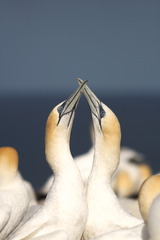
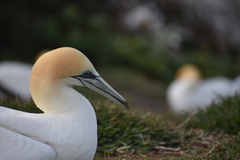
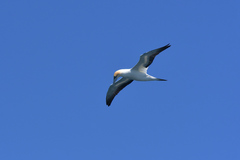
The Australasian gannet (Morus serrator), also known as the Australian gannet or tākapu, is a large seabird of the booby and gannet family, Sulidae. Adults are mostly white, with black flight feathers at the wingtips and lining the trailing edge of the wing. The central tail feathers are also black. The head is tinged buff-yellow, with a pearly grey bill edged in dark grey or black, and blue-rimmed eyes. Young birds have mottled plumage in their first year, dark above and light below. The head is an intermediate mottled grey, with a dark bill. The birds gradually acquire more white in subsequent seasons until they reach maturity after five years.

The species range over water above the continental shelf along the southern and eastern Australian coastline, from Steep Point in Western Australia to Rockhampton, Queensland, as well as the North and South Islands of New Zealand, Lord Howe and Norfolk Islands. Nesting takes place in colonies along the coastlines of New Zealand, Victoria and Tasmania—mostly on offshore islands, although there are several mainland colonies in both countries. Highly territorial when breeding, the Australasian gannet performs agonistic displays to defend its nest. Potential and mated pairs engage in courtship and greeting displays. The nest is a cup-shaped mound composed of seaweed, earth, and other debris, built by the female from material mainly gathered by the male. A single pale blue egg is laid yearly, though lost eggs may be replaced. The chick is born featherless but is soon covered in white down. Fed regurgitated fish by its parents, it grows rapidly and outweighs the average adult when it fledges.

These birds are plunge divers and spectacular fishers, plunging into the ocean at high speed. They eat mainly squid and forage fish that school near the surface. The species faces few natural or man-made threats, and since its population is growing it is considered to be a least-concern species by the International Union for Conservation of Nature (IUCN). Wikipedia →

Sounds

Call0:45

New Zealand · 2012

© Chris Benesh · XC112823 · CC BY-NC-SA 3.0

Recording0:10

New Zealand · 2019

© Spencer McIntyre · iNaturalist · CC BY 4.0

Recording0:22

Australia · 2026

© ashgirl2023 · iNaturalist · CC BY-NC 4.0

Global Distribution

Parks Where Found

# Park Country Daily sighting probability
1 Freycinet National Park 🇦🇺 Australia
~20%
2 Flinders Chase 🇦🇺 Australia
~20%
3 Great Otway National Park 🇦🇺 Australia
~20%
4 Abel Tasman National Park 🇳🇿 New Zealand
~20%
5 Maria Island National Park 🇦🇺 Australia
~20%
6 Rottnest Island 🇦🇺 Australia
~20%
7 Booderee National Park 🇦🇺 Australia
~10%
8 Noosa National Park 🇦🇺 Australia
~10%
9 Royal National Park 🇦🇺 Australia
~10%
10 Wilsons Promontory National Park 🇦🇺 Australia
~10%
11 Fiordland National Park 🇳🇿 New Zealand
<5%
12 Rakiura National Park 🇳🇿 New Zealand
<5%

Cities Where Found

# City Country Daily sighting probability
1 Sydney 🇦🇺 Australia
<5%
2 Melbourne 🇦🇺 Australia
<5%
3 Auckland 🇳🇿 New Zealand
<5%
4 Perth 🇦🇺 Australia
<5%
5 Brisbane 🇦🇺 Australia
<5%

Before you go

What are the chances of seeing an Australasian Gannet in Rakiura National Park?

Rare

Under 5% of wildlife watchers report an Australasian Gannet sighting in Rakiura National Park on a given day, based on 59 verified sightings from GBIF citizen-science data from 2019 to 2026. It is the 56th most-seen of the 80 birds we can rate there. Over three days the chance rises to about 10%, and over a week to about 20%, if each day is a fresh chance.

When is the best time to see an Australasian Gannet in Rakiura National Park?

February–April and June

In those months about 10% of wildlife watchers report an Australasian Gannet in Rakiura National Park on a given day, against under 5% in May and July–January, the lowest months.

What time of day is best to see an Australasian Gannet?

Between 1 and 4 pm

Across all the parks we cover, that three-hour window holds the most Australasian Gannet sightings with a recorded time, and nearly all of them come between 6 am and 6 pm: it is a daytime animal.

Is Rakiura National Park the best place to see an Australasian Gannet?

12th of 12

Of the 12 parks where we can rate Australasian Gannet sightings, Rakiura National Park ranks 12th at under 5%. The best odds are in Freycinet National Park (Australia, about 20%), Flinders Chase (Australia, about 20%) and Great Otway National Park (Australia, about 20%).

Which relatives of the Australasian Gannet live in Rakiura National Park?

Same order: Suliformes

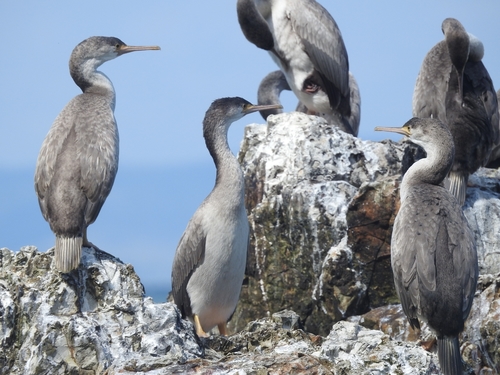
The closest relatives of the Australasian Gannet that you can see in Rakiura National Park (order Suliformes, Gannets, Cormorants, and Allies) are Australian Pied Cormorant (about 40%), Spotted Shag (about 40%) and Bronze Shag (about 40%), with each one's daily chance of a sighting.

Where does the Australasian Gannet sighting chance come from?

GBIF citizen-science records

It is estimated from how often the Australasian Gannet is recorded against all the birds logged in Rakiura National Park (59 verified sightings from 2019 to 2026), calibrated against known sighting rates. Figures are rounded to the nearest 10% because citizen-science data supports honest approximations, not decimals, and months with records from fewer than five people show "—". How it works.

← Back to Rakiura National Park