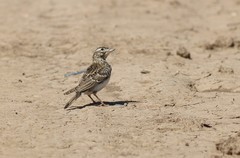
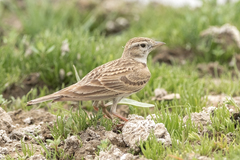
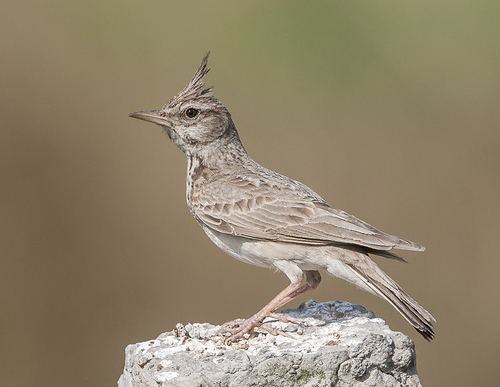
Greater Short-toed Lark

Greater Short-toed Lark

Calandrella brachydactyla

Silhouette: Gossipguy and T. Michael Keesey · PhyloPic

LCLeast ConcernNTVUENCR
Daily sighting probability <5% · Rare
at Ranthambore National Park

In 3 days ~10%

22 Verified sightings at Ranthambore National Park From 2019 to 2026
307 In all 8 parks
February Best month
☀️ Diurnal When it's spotted

About the Greater Short-toed Lark

The greater short-toed lark (Calandrella brachydactyla) is a small passerine bird. The current scientific name is from Ancient Greek. The genus name, Calandrella, is a diminutive of kalandros, the calandra lark, and brachydactila is from brakhus, "short", and daktulos, "toe".

It breeds in southern Europe, north-west Africa, and across the Palearctic from Turkey and southern Russia to Mongolia. During migration they form large, tight flocks that move in unison; at other times they form loose flocks.

The greater short-toed lark was described by the German naturalist Johann Leisler in 1814 and given the binomial name Alauda brachydactila. This lark is now placed in the genus Calandrella that was established by another German naturalist, Johann Jakob Kaup, in 1829. The specific name brachydactyla is from the Ancient Greek βραχυδακτυλος brakhudaktulos "short-toed" from brakhus "short" and daktulos "toe". The alternate name short-toed lark may also be used for three other species in the genus Calandrella. Wikipedia →

Sounds

Song0:10

Russian Federation · 2026

© Albert Lastukhin · XC1148779 · CC BY-NC-ND 4.0

Flight song0:24

Kazakhstan · 2025

© Frank Lambert · XC1029681 · CC BY-NC-ND 4.0

Call0:36

Spain · 2024

© Esperanza Poveda · XC933918 · CC BY-NC-SA 4.0

Global Distribution

Parks Where Found

# Park Country Daily sighting probability
1 Doñana National Park 🇪🇸 Spain
~10%
2 Gobi Gurvansaikhan National Park 🇲🇳 Mongolia
<5%
3 Ranthambore National Park 🇮🇳 India
<5%
4 Mudumalai National Park 🇮🇳 India
<5%
5 Chitwan National Park 🇳🇵 Nepal
<5%
6 Monfragüe National Park 🇪🇸 Spain
<5%
7 Keoladeo National Park 🇮🇳 India
<5%
8 Sierra de Guadarrama National Park 🇪🇸 Spain
<5%

Cities Where Found

# City Country Daily sighting probability
1 Taipei 🇹🇼 Taiwan
<5%
2 Beirut 🇱🇧 Lebanon
<5%
3 Kathmandu 🇳🇵 Nepal
<5%
4 Kozhikode 🇮🇳 India
<5%
5 Vasai-Virar 🇮🇳 India
<5%
6 Tel Aviv 🇮🇱 Israel
<5%
7 Ramallah 🇵🇸 Palestine
<5%
8 Abu Dhabi 🇦🇪 United Arab Emirates
<5%
9 Antalya 🇹🇷 Turkey
<5%
10 Pune 🇮🇳 India
<5%

Before you go

What are the chances of seeing a Greater Short-toed Lark in Ranthambore National Park?

Rare

Under 5% of wildlife watchers report a Greater Short-toed Lark sighting in Ranthambore National Park on a given day, based on 22 verified sightings from GBIF citizen-science data from 2019 to 2026. It is the 198th most-seen of the 251 birds we can rate there. Over three days the chance rises to about 10%, if each day is a fresh chance.

When is the best time to see a Greater Short-toed Lark in Ranthambore National Park?

February and October

In those months about 10% of wildlife watchers report a Greater Short-toed Lark in Ranthambore National Park on a given day, against under 5% in March–September and November–January, the lowest months. Those are among Ranthambore National Park's driest months, with about 10 mm of rain a month against 270 mm in August.

What time of day is best to see a Greater Short-toed Lark?

Between 7 and 10 am

Across all the parks we cover, that three-hour window holds the most Greater Short-toed Lark sightings with a recorded time, and about 9 in 10 of them come between 6 am and 6 pm: it is a daytime animal.

Is Ranthambore National Park the best place to see a Greater Short-toed Lark?

3rd of 8

Of the 8 parks where we can rate Greater Short-toed Lark sightings, Ranthambore National Park ranks 3rd at under 5%. The best odds are in Doñana National Park (Spain, about 10%) and Gobi Gurvansaikhan National Park (Mongolia, under 5%).

Where does the Greater Short-toed Lark sighting chance come from?

GBIF citizen-science records

It is estimated from how often the Greater Short-toed Lark is recorded against all the birds logged in Ranthambore National Park (22 verified sightings from 2019 to 2026), calibrated against known sighting rates. Figures are rounded to the nearest 10% because citizen-science data supports honest approximations, not decimals, and months with records from fewer than five people show "—". How it works.

← Back to Ranthambore National Park